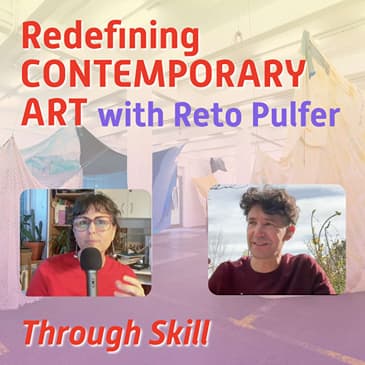
So many definitions of contemporary art… but what if the notion of skill took us deeper into it? As a curator, our host often hears: “my kid could do this”. So, she put her art writer and curator talents to the task of uncovering expectations and misconceptions about visual arts that it expresses. This is also an artist conversation episode: the first part explores 20th century art through the notion of skill, and the second invites the Swiss self-taught artist Reto Pulfer to provide his own art experience and education insights into this matter.
Did you enjoy the episode? Think about supporting Exhibitionistas by leaving a small donation: https://buymeacoffee.com/exhibitionista
Skill, takes us to art tradition, craft, art education, curatorial work, exhibition expertise and more. Together, Reto Pulfer and our host explore art as a raw and dynamic relation with ourselves and the world around us.
Sign up for a tiered monthly support: https://www.buzzsprout.com/2624749/monetization/supporter_settings Your contribution keeps us going.
To know more about Reto Pulfer:
Follow him on Instagram: @zustand_retopulfer
Visit his website: www.retopulfer.com | www.artmap.com/retopulfer
Or have a look at his gallery, Hollybush Gardens, London
https://hollybushgardens.co.uk/artists/reto-pulfer/
You can find his novel, Gina (2020) in the links below:
Jingle: "Wunder", experimental poem by Joana P. R. Neves.
Did the episode stir Art Wonderment memories? Share them via text or voice message.
Save the World PodcastIn-depth lectures and interviews on issues affecting the continued survival of human...
Listen on: Apple Podcasts Spotify
Created & Hosted by Dr. Joana P. R. Neves, art curator and writer with over 20 years of experience in the contemporary art field. Artistic director of Drawing Now Paris since 2018, she has worked across the industry, from the art market to education. She co-launched the art residency and project space Worlding in 2020. Exhibitionistas’ first year offered exhibition discussions with guest co-host Emily Harding; organically, it grew into a more experimental show exploring art topics, stories and interviews complemented by Joana’s publication Art Thinkosaurus on Substack. She champions ‘Art Wonderment’s’ embrace of complexity against the lure of ready-made opinions. A polyglot, she grew up in Lisbon, studied and lived in Paris, to finally settle in London with her artist husband, four children and two cats.
READ JOANA'S TEXTS:
Joana on Substack: https://joanaprneves.substack.com
Where you find the Exhibitionistas Files, our Newsletter: ...
Intro: Art Redefines Itself through SKILL
SPEAKER_01Ever since prehistory, art has kept redefining itself. It has shifted perspectives, it has reframed its materials, its disciplines, up until today. So today, how is art redefining itself? What is art in the 21st century? Right here, right now. And I'm bringing something into the fold, the notion of skill. Because once you said, my kid could have done this, what else is there to say? Where do you go from here in the conversation? It seems to be a dead end. But I believe that talking about skill is crucial, not only to understand the misinterpretations of contemporary art, of what it does, of what it is, but also to find new pathways, a more immersive and deeper way of connecting to what artists do, to how they make their work, and ultimately how you apprehend, how you perceive, and how you get involved with an artwork. I love the expression my kids could have done this because it says a lot about where we place value. It tells me that art equals skill, which is something masterfully, exceptionally executed technically. So today I'm going to argue first that skill is the most misunderstood thing in contemporary art. And also, secondly, that us, all of us, even myself, I'm not a very manual person. We underestimate skill in contemporary art practices. And I have a funny story about this. My husband, Diog Pimentel, is an artist. And we have often worked together. We have oh my cat just jumped on the table. We have often worked together. So we produce workshops where I bring more of a theoretical approach. He works mainly with drawings, very large sculptural drawings, even though he uses most often than not paper and graphites. He has a work called polymonochrome, which is a rectangular piece of paper whose edge, bottom edge, he cuts into and then works the paper to bend it onto itself to kind of curve it until you can't see any of the edges of the paper. And then he places those little improvised sculptures on the floor below the hung piece of paper, so the other element of the sculpture on the wall. He took that piece once to one of the workshops that we were doing together, and I was really elated. I thought, oh my gosh, people are gonna have so much fun making those little sculptures and also having this sort of iconoclastic relationship to the work where you cut into it and you take a piece of it, and yet it's still the same thing, it's still the same artwork. There's a sort of passage from one element to the other, but the artwork in and of itself stays intact. So I was really excited about that until we arrive at the workshop, I do my bit, and then we move on to the work itself, to the manual work. Diogo explains the work, people start cutting into the paper and they start making their shapes. And when I looked at what they were doing, they looked absolutely nothing like what Diogo produces. They were, and I dread to say the words, ugly. They look really ugly in the hands of someone who doesn't know how to make them, who hasn't lived all their lives with paper, trying to collaborate with it and knowing exactly where it is going to yield, where it isn't, what are the limits of pushing the shape onto itself and into itself? Well, those people are not gonna produce the same seductive pieces. And this was many moons ago, this is more than 15 years ago, I would dare say, but I learned a really important lesson that day. I had not anticipated the difficulty of making those little shapes cut from the main piece of graphite covered element. All this to say that skill is sometimes in contemporary art not really where we expect it, and it is very easy to take certain things for granted. So the question today is how is skill redefining contemporary art? And I have a guest who I think is the perfect artist to have a conversation with about this. I have pre-recorded a segment with him, and I'm going to slot in a few of the moments of the conversation because Reto Pulfer, the Swiss artist I invited to bring in a few lights about this topic in this episode, is someone who describes themselves as a self-taught artist.
SPEAKER_02Hello, my name is Reto Pulfer or Rito Palfer or Reto Pulfer, depending on your um dialect. And uh I am in I'm a Swiss artist, or like I was born in Switzerland and I live outside of Berlin in the countryside uh since a couple of years.
SPEAKER_01I wrote a text for a resident in a residency in France that demanded that whoever applied to the residency as an artist had gone to fine art school. And that was surprising to him. I told him that I was surprised because what about artists who came to the fold from other walks of life? Self-taught doesn't mean uneducated, and that's what we're going to find out with Retopolf. But also, it means that learning a skill was done differently, and that will allow us to understand maybe a bit better without the academic context. What exactly is a skill, how we acquire it, and where does it end up in contemporary art practices, and what effect does it have on the way we connect
Genres, Skill, Tradition, Drawing
SPEAKER_01to them? This is Exhibitionista's Notes on Contemporary Art and Life, and I am Joanna Pierre Nevis, your host and also creator of the podcast. First and foremost, what is a skill? So, on a basic level, skill is a masterful assimilation of a discipline on a technical level, but the Cambridge Dictionary adds because you have practiced it. So the element of repetition and time is essential for the notion of skill. Skill is an acquired gesture, it's a new form of behavior for the body with intent of acting upon a material or any other thing. I have argued in a text I wrote for an academic magazine titled Um Unskilled Beauty or Ugly Truth that drawing is the skill in art, or at least traditionally. Pliny the Elder certainly said so. He talked about Apelles, who was one of the great ancient Greek artists. It was said that he wouldn't go a day without a line, meaning that he would draw all day long. This was reinforced from the Renaissance onward, where three genres were established painting, sculpture, and architecture. But then it all came down to painting and sculpture. And drawing was the skill that held up the outcome of the masterpiece. Drawing was the very soul of the artwork.
Pulverising Skill and Genre: Dada and Surrealism
SPEAKER_01The Renaissance artists deemed drawing to be almost the real art within a finished piece. All throughout the twentieth century, skill was pulverized. If anything defines the last century, it is precisely this gnawing at perfection, at masterfulness of any type of technique, and even going at the very notion of genre and does missing it completely. Artists don't decide to destroy old categories just like that. What happened is that technology, new technologies, suddenly took over, and of course that had an impact not only on the way we lived, but also on the way we created and the kind of images that we needed. Marcel Duchamp, in visiting one of the world expositions, asked his friend Brancuzi, what is more beautiful than this? Pointing at a propeller. So it is said very often that the twentieth century dismissed skill completely. Think of Dadaism. Dada is what the baby says. And so the highest form of complexity that was accepted by the Dadaists was the repetition of the sound dada, which is the first accomplished sound of the baby. That's why in several languages the father, because it is usually the first sound that comes of the mouth of newborns, is called Dada, the twentieth century. Dadaism, surrealism, interested in dreams, in children's drawings, all of that deconstructed the notion of a structured, representational, recognizable image made by painting or through with bronze or any other material to make up a sculpture. But is it really true that we dismissed skill, or does it mean that we have opened the gates for any type of skill that artists may want to interact with? Once we part with tradition, we have to move on to something else. And here what happened was that photography, film, experimental film, postal art, computer art, so many things started being part of the new types of tools that artists could use to make images. And I will tell you that as a curator, it is dizzying sometimes because each studio visit is going to be a new discovery. You will go into a studio and the artist will be working with organic fibers. Then you go into another studio and an artist is producing a film, but they decided to work with 35mm, so it's film instead of digital, but they are also working with volcanic rocks. So every time you visit an artist's studio, it's like going into Wonderland. You never know what you're gonna get, you never know what rules are going to be applied, and precisely what is going to be a skillful handling of which material. We're not gonna dwell on that today, but let's say that were two very big movements of avant-garde in the 20th century, right at the beginning and then closer to the 60s, 70s, with very big consequences for the decades afterwards up until today. What happened was that the genres, you know, those traditional genres of painting and sculpture, were not a term that was useful anymore.
Genre is dead, long live the medium
SPEAKER_01It didn't serve the purpose of this very big widening scope on materials and their techniques and eventually technologies. The genre was dead. Long lived the medium.
SPEAKER_00The medium is the message. When future historians look back on the 20th century, it's almost certain that one of the statements from this uh era, which I will treasure for posterity, is the medium is the message. Like most of Marshall McLuhan's statements, it's pithy, apparently simple, and provocative to the point of being outrageous.
SPEAKER_01That's the word that replaced the notion of genre, which means that when I was studying um philosophy and then curatorial studies, we did not say of an artist who produced photography, that he was a photographer. We would say he was an artist who used photography. At the end of the 20th century, there was a moment, there was a big, big, big upheaval against a group of artists, the abstract expressionists. They had come to a very interesting form of abstraction, but also in the way it was theorized by an art critic called Clement Greenberg. A very dogmatic definition of what art was. It had to be painting, and what painting did. It was, according to Clement Greenberg, pure experience. And the minimalists were fed up with this notion, they opened up again the art making practices and disciplines to objects, to different materials, because at a certain point, through this big change in terms of what an image did, we remained in a very traditional, after all, type of skill which was to paint. But then the skill was pure expression and utter innovation from the singularity, the depths of the soul of the painter. It felt rather esoteric to certain minimalist or conceptual artists, and it also felt very restrictive. So we opened up and then we closed again. Clement Greenberg was a very interesting character because he did argue that abstract art and particularly abstract expressionism was touching on something typical of the time. And again, a time that was, especially in the United States, more and more invaded by big letterings, big ads, a sort of um technology that took over the landscape, it took over perception itself. And therefore, abstract expressionism brought about a sort of an inner state, um more introspective, more meditative even relationship to the craft of painting. And Clement Greenberg argued it was ugly in the beginning, or it could be ugly in the beginning because it challenges and it challenged at the time notions of beauty. The sentence my kid could do that meant that we associate with a childish perception and making something that is in fact highly skilled, but that we don't have the power or the education or the disposition to spend time with and analyze and deeply know. There is a form of elitism and there's a form of purity and elevation in Clement Greenberg's notion of what the skill brought by painting did. And I quote Clement Greenberg, these are not my words. Quote The peasant finds no quote unquote natural urgency within himself that will drive him toward Picasso in spite of all difficulties. In the end, the peasant will go back to kitsch when he feels like looking at pictures, for he can enjoy kitsch without effort. However, skill was challenged, redefined, and even at times completely set
Art, redefined constantly
SPEAKER_01aside. That's where the attention was in the 20th century. But then the relationship to those challenges were very different from artist to artist. There are no static definitions of art. I like to say that rigid definitions are the enemies of spectrums. We need a certain direction. Artists constantly in a state of motion, it is a dynamic relationship between whoever makes it and whoever receives it through an object. So this idea that there are no painters, there are artists and not photographers or sculptors, had many different consequences. So the first one was that there was an emphasis, suddenly, placed on material. The second consequence is that it is the material that oftentimes may dictate the kind of skill that the artist is going to develop. And then another thing that is really important is that skill transcends function. For example, think about historic painting. So paintings in the 19th century, 18th, 17th, and so forth illustrated the big moments of the history of a nation or a region or a kingdom or an empire. It was a way to reinforce power for sure. Artists and political power have had interesting relationships, and it would be really interesting one day to talk about this because we have a very uh rose-tinted notion of the Renaissance. The Renaissance was a moment where power understood that artists could serve it. It's not as simple as that, but it was also that. And we go back to Clement Greenberg to really understand the separation, but also to understand where the 21st century might go now in contrast with the 20th century. I'm going to read another quote from uh Clement Greenberg. So quote, photography is the most transparent of the art mediums devised or discovered by man. It is probably for this reason that it proves so difficult to make the photograph transcend its almost inevitable function as document and act as a work of art as well. So one of the difficulties in bringing photography into contemporary art is that it is an archive, it is a document in so many different ways, other than to be artistically expressive. And so here Clement Greenberg is talking about two things. First and foremost, the separation between function, use and shape, or expressive potential. And secondly, he is talking about elevating the object from its mere functional use to the realm of something far superior, purer, something exquisite, something almost in the realm of spirituality. This is something very typical of the twentieth century. Once art becomes universal, detached from a specific context, art is supposed to be universal. It is supposed to speak to everyone. Once it detaches itself from place, it becomes something that is attainable only by those who have this global education. A lot of people walk past a Mark Rothko and do not feel equipped to deal with it. That's something difficult to say, especially for those of us who work in contemporary art, because it has been so instilled in us that art is universal that it feels almost like a glitch in the system to at the same time admit that because it is so accessible, it has become highly elitist.
21rst century: art education and the self-taught artist
SPEAKER_01So we arrive at the 21st century. Reto Puffer is a Swiss artist, as I said in the beginning, he lives near Berlin in the country. Countryside and he uses an array of materials, repurposed fabrics that he builds these constructions like tents in exhibition spaces with. So he uses sewing, he ropes and he ties up pieces of fabric and threads and yarn. He also works with music, with guitar in particular. He has written a book called Gina. He has this notion of Zustand, the word Zustand, which I'm probably mispronouncing, meaning state, an external state or an interior state. And Zustand is really this approach that he has to whatever the art is and what it does, a state. And what is really interesting in his work is that, in my view, he always tried to approach music, fabric, installations, configurations, shapes, even the exhibition space. As someone who was experiencing it for the first time, why does he define himself as self-taught? What does that mean to you?
SPEAKER_02I sometimes say that I am a self-taught artist. I use that as a statement because uh I just didn't go to fine art school, but at the same time, I'm learning all the time uh from from everybody, like in various parts of life, but also in like artistic uh in an artistic way. Um so I'm always learning and enjoy learning, also enjoy learning languages, for instance, or uh like new skills or how to how to grow food, or um so recently I started to learn textile crafts and uh uh fastenry weaving. As a teenager I was I was playing in punk bands and I was writing and uh making drawings and performances of sculptures, and I so I applied for art school and there was a test uh which I failed to to enter. And uh I was also really young and then uh I didn't try again, but also I was thinking like I'm also like writing and making music, why should I go to art school? And I'm already like organizing my own shows, and so there's not really a need to um to do that, and also I just want to be I want to be free, that's actually the main point. I try to find my own style, which I think is the most important thing if you look at artists. And uh I don't want to go to or follow a school in whatever that means to be part of a school. I want to be able to pick my own. And uh and then I was backpacking in Southeast Asia with an artist friend, an Indonesian artist, and uh who had shows there, and I met a lot of artists, and then at some point I also met like a lot of Western artists. I then later met again in uh Europe, or like well global artists, not necessarily Western, but like artists that did a lot of uh international show like panels and stuff, and I thought, oh, that's much more interesting. Like uh maybe just hang out with them. I don't I don't have to like hang out with all the other students. So every for my friends or people I hang out with they were like 10-15 years older once I was in Berlin in the early 2000s. And that was just very, very much fun, and yeah. I mean some judged it, of course, and questioned it and some not, and uh and then I slowly started to make art because Berlin at that time was a very experimental place, uh, and so people would say, Oh, I have a I do a small show in my studio, why don't you like perform? Or like do you have a piece for like in two weeks? You know, it was very playful and also not serious, so you wouldn't really have like this burden of okay, what is the concept of this work and what is the materiality and like can I sell it actually? Like all these heavy questions they were not relevant. So I I was in Berlin and I learned from many artists, and this was very informal, like um I would learn from experienced, well-known artists without them even knowing that I'm learning from them. So there were a lot of like informal conversations, and everybody seemed to have time, it was cheap, and I was doing some assistant jobs or like working abroad, and then I made a bit of money with art also, and and so this was like a nice uh and uh relaxed uh pla way of of learning, and also I was just in the middle of the actual uh you know reality of being an artist. So I I understood what it means to have like a week to set up a show or to have a conflict with your gallery or you know, issues of developing your work, and it was just in a real space and not so much in an artificial art context space uh of of like an art school.
SPEAKER_01What is school then?
SPEAKER_02Personally I think art schools are totally useless. So my experience in art schools is that uh the real thing is like how do you balance your life and your art and how do you approach an idea, how do you um promote yourself, what do you say if you meet the curator or a gallerist or an artist, like all these uh things. It's um and how do you fund, for instance, a show and all these questions they have never really been talked about. And at the same time, there is such like a kind of a kindergarten atmosphere often. Oh, I have an idea, I want to do this. Oh, I you can use this machine, I can help you to do that, and you can do this, and we have this new 3D whatever, and uh which is totally fine, you know, depending on the type of work, but my work involved in a way it is because of my DIY approach. Like I didn't have fancy machines and and skilled uh professors and workshops where people like advised me on how to do things. So I said, okay, what can I do by myself? Oh, I can get some fabrics, I can oh, I can get a sewing machine at some point, or I can uh draw on it, or I can do a performance, or I can speak to musicians and borrow their amp, whatever. So there was a or still is this DIY approach, how can I learn something by myself and develop a a style in this material? Um so not so much starting from a concept with something I want to say and then finding a formal product that like represents this um this concept.
Tradition, contemporary and the hierarchies of skill and craft
SPEAKER_01There's this friction with tradition that arises in the 20th century and that affects everything in art up until today.
SPEAKER_02Some art forms not part of the contemporary art circus or just slowly entering. I think there was, let's say, dance and film that entered at some point, and ceramics or textile crafts, and because many of them were considered either female or weak or just uh uh decorative or they were just part of some everyday local peasant culture, and and somehow but some developed to some kind of high art form. So I've I have been doing a lot of uh works where I just like without knowing how to properly saw making fabrics installations without knowing how to paint or whatever, just painting on the fabrics and music and and but then I started into to learn more about textile crafts, and then I I just uh I also want to honor the like tradition, and there's like a couple of mistakes that first time we were still like they there is always a problem with tensions. So when I'm doing the fabric works, I I'm always thinking like it has to be uh a good piece of uh of fabric, like in measured by by fabric standards, and also when I do music, I I would relate it to music, or if I do writing. So how would that how is that seen from a uh perspective of literature? And a reason for this is also this um my aunt is uh so is a ceramic artist. So I was doing lots of ceramics with her uh on like quite a skilled level because I mean she's doing that over time, so it's quite a still skill, but then I see contemporary artists doing ceramics, and it's just they just do all the beginner mistakes and they call it art. And I say like, well, that's just the thing you do first time you touch clay and add some like uh weird glaze, and and then it's supposed to be an artwork because there is this like concept about it, and everybody talks about this concept, and it doesn't make sense. So so I was always very critical, for instance, in ceramics, yeah, that's where I'm coming from, and uh there is just you like not honoring all the tradition of the thousand-year-olds traditions of ceramics that happened all over the world just because you're an artist, it doesn't mean that whatever you do is is like a masterpiece. So when I'm uh starting to work with now basketry, I say like okay, so what is the so what is the difference? So I can I can learn and make styles, but I should also be like clear that not everything I do is like uh is like good or something. So I live in the uh German countryside, so I'm learning from from willow basketry makers that learned their craft in in the GDR and they did lots of baskets. Uh then once the the uh the country collapsed, uh that skill became useless because people just buy import plastic um containers. And so I'm learning from them and I want to know everything. Um but at the same time I'm like mixing it with other techniques and I'm doing shapes, and I I will be like inspired by an African basket or a Japanese, I'm mixing it to this willow shape, and they say, like, well, what's what's that? Oh wow, and they say, Oh, that's beyond my skills. And I don't know. So it's it's a dialogue.
Unlearning in order to respect traditions
SPEAKER_01It is difficult to acquire or to unlearn certain things. So the notion of tradition I found to be really interestingly paired with the notion of unlearning. Listen to what he has to say about precisely that.
SPEAKER_02I had some musical training, also guitar and like violin and uh cello and all of that stuff. But uh but I had to, but this is something I had to well people call it unlearn. Like I had to let go of all the things, and and then I got more interested in minimal music, and I met people like um Tony Conrad uh several times and all of that. So the so I I learned from that and I tried to find my own thing. Uh punk music is perhaps a good example of skills or like music in general, because you people take one thing that is like tradition, like an instrument, scale, singing, like craft, something you you really learn how to do. And then you just make something out of it, your own thing. Like you destroy it and you you take the tool but you use it for something else. And then as time goes by, it's paradox and absurd. Like punk becomes a fashion and people pick it up and make a pop song with punkish elements. But for me, this is also the way how uh to look at a c a craft like a spasketry or textile craft, like they come from a tradition and then you learn it, but then you can change it and use it in a different way and use different materials or you make interpretation of something which you can still honor.
SPEAKER_01As Europeans, I can't speak for the whole of the planet, and I'd be interested to know you out there who are listening to the podcast in Nigeria, in Taiwan, um, in Singapore, in Buenos Aires, how is it for you where you live? In Europe and what I know of the United States, for example, there is a big disconnection with skills that would have been part of anyone's education at a certain point. So, for example, working with wood, carpentry, um, even the high society women of the 17th, 18th century, 19th century were educated in music, in drawing, in ceramics, in even in printing. They also eventually ended up learning how to engrave, for example. So we have been quite separated from notions of skill, not so much the notion of tradition, because tradition is a term that comes very heavily loaded with something that it's a bit like the cliche. It's something that at some point made sense, but now it is perpetuated only for the sake of reverence and respect, but not for itself. But if we think about skills and separate them from the weight of this notion of tradition, we may be talking about the same thing, but we're not putting the emphasis on the same aspect of it. Something I really do not understand is how on earth in schools, and I'm talking even high schools and maybe even lower than that in age, why are we not learning editing techniques, for example? What does Reto have to say with the way we deal with skill? He has a really interesting perspective because it is seen from the side of the artist. And an artist who, for a self-taught artist, and I'm saying this as in how that residency sees self-taught artists, not me. He knows quite a lot of things and he is quite a skillful artist. So I'm interested in knowing how conscious he is of how people relate to skill and what people feedback to him in regards to his own work.
SPEAKER_02My work has been shown in uh institutions which give a formal context to my perhaps informal approach or DIY approach, self-taught approach to making art, which I think is um uh to me it's also kind of funny actually, also, because I do these things and then suddenly there is this like seriousness about it. But this also gives the the space to look at it to say, ah well, there is a mistake. And there's like a thread hanging that happens all the time when installers say, Oh, there is a shred. It's like what happens to it? Are we like cutting it? Is it like intentionally? What is this thread? And say, Well, we just leave it. Oh, there's a tear in the fabric. What are we gonna do with it? And well, we just look at it. But then I do like let's say quite a complex braid, um and people say, Oh yeah, these like loose yarns at the end are very beautiful. Like, okay, but the braid you didn't look at okay, it's no problem. People just like also this kind of freedom of some yarns and some fabrics and like the the non-skills um approach, or yeah. When I show my work, that is uh the recent work is like let's say handwoven patterns or like uh images woven, and it's technically quite complex to to do that and uh I make it myself, I learn it, and then it's an institutional context, and and like people come like gallerists and they say, Oh, is this some kind of ethno appropriation? Did you order somebody to do that? What is your concept? And then let's say, Oh well, actually I'm practicing weaving and I and I create my own patterns So people have like such a stiff understanding of like contemporary art as like a a conceptual slack or douchebag who like pays
Why and what do we underestimate in contemporary art?
SPEAKER_02other people to do the stuff. It's so it's so wrong.
SPEAKER_01At this point, I feel like saying that there's a form of impermeability to certain skills or an inability to realize the difficulty of certain crafts, of certain disciplines, of certain art forms even. Think about rap, think about grime, to come up with lyrics, come up with spoken slash sung lyrics with a certain pace, a certain rhythm, they're interlaced with sounds, they're interlaced with music, they are told, voiced in a certain way that is not singing, but it's not talking either. That is such an amount of skill, it's so much work, the sentence of the beginning. My son, my daughter, my child could have done that. It speaks precisely to this desire to be impacted by a virtuosic technology technique, something that really seems unattainable to the average person. The thing that is most impressive and hardest to do in terms of the articulation between the eye, the hand, the mind, the brain is certainly figurative drawing or painting, producing something, even a sculpture that is lifelike, that is photographically faithful to the way we perceive the world. In that sense, then if we want a skillful image, uh a copy, let's say, of something that we can recognize as existing in reality, then art would be imitating, right? It would be standing in the place of something that we can see through our senses. That seems quite absurd when you really think about it. But Reto has another objection to what is deemed as great and impressive art. Listen to it.
SPEAKER_02As a crafts person, like or me learning basketry, I I follow this I think it's a usual progression almost like cosmological, like you learn a skill and then you challenge your your skills. Oh, how could I do this hexagonal, blah blah blah? And then you try to do it, and then at some point you say, okay, now I've reached this level, how can I just make it nice without um showing off, without like the hexagonal thing being in the center of it, just like making it so it like touches or it's uh good in itself, and it can have this super complex uh moment, but nobody needs to know. Also, when I'm doing this fabric and these braids, then I say, Well, the most complex part about this you actually don't see, but how do you get from that structure to that structure without looking at ugly? Because I had to reinvent the and take talking about skills and daily life. So there is, for instance, uh some uh an old an older woman I I mean uh I know she's here who works with them weaving and uh wool, especially wool, like wool dyeing and you know, you know, people have sheep here and then they do their own wool or things like that. And so she said that as a as a child she learned how to make a basket from from reed grass. It's just things they did. And then also when when uh my generation in school we we had to do some some craft things, but then nowadays in school they they hardly like know how to use a sewing machine or like make some some other handiwork or like crocheting, all these like basic, very basic, very simple crafts that are very easy to learn and um so at but at the same time uh people want to learn these crafts and then there is there is this like uh problematic aspect that you want to just do it quick you know you see like a small clip or like a small workshop like one hour or like just 60 seconds oh you can do that it's very easy so people do something quickly and then they say oh I have it I made it it looks like I made a bit of craft today and uh then I go back to my usual pace so I think imperfections are very interesting to work with as an artist like if or I guess there is also like cultures um that celebrate imperfections and use use uh imperfections in like you know I don't know Japanese ceramics or so there is a a kind of uh a play with it or let's say you have um you have like fabrics made from from feathers for instance or wool and so the natural color changes become part of the work and they become part of the pattern so you kind of play with this uh uh with these slight irregularities or like I don't know like singing a voice when it's not perfect you have something that's interesting with it and uh so I think there is it's something that is like impossible to teach but it's or like to also or for me to recreate but then sometimes I think I manage to get some kind of imperfection and sometimes not. The funny thing is I it happens to me that I do a sound check for a uh performance with a guitar and then it sounds better than my actual concert because I'm just playing drafting checking out no pressure and also it happens with my art that I do something oh yeah I made this model and it's very nice and I want to do it kind of a bit bigger with like a kind of clear selection of colors and then I can do it in put it in that show but then it becomes boring or it becomes like some product because there is an intention to make something nice and I think that's that's like very much at the core of this problem with the skill like when you try to do something nice and beautiful because somebody could buy it and perhaps it's somebody with like a shit ton of money only likes like nice expensive stuff then it really like I always fail doing something nice and so I never really work with expensive material because I think like it I wouldn't like it's not really my style to to work with that and also I don't really have the I don't have the drive to make something that is just so expensive looking and uh made to perfection that you don't see that a person made it so uh yeah so I'm really into the draft and also um keeping the draft alive. I think that also brings us back to your um background with the drawing like the the drawing is is like can you draw can you sketch something up and I think it's not so much can you draw but can draw in the moment like oh I don't know what you mean take a piece of paper a pencil or like draw it in the sand what is it can you like show your magic right now what is your skill I think that's always uh more interesting like so I went to for instance I just went to the uh Italian part of Switzerland for a ex for an insulation exhibition concert and then I I learned there was bamboo and so we harvest I harvest bamboo and willow and I and palm palm leaves and I made some basketry shapes on site and it was such a challenge with everybody around and limited time but it was really good because okay I can actually do something on site and show it and uh it will it it's fun and it could work out but it's but I think only that is like a moment where I think I can actually master a skill where I don't have like my perfect tools or my perfect studio or whatever perfect time but I can just I'm able to improvise something on site with um perhaps not everything that I usually have. But usually such moments are more interesting because then I for instance combine this bamboo with willow which I haven't done before and as and I realized okay if I use the willow on that part then I can do something that I wouldn't be able to do with bamboo. And then uh yeah you I learn from and I grow from this experience so then something new is created. So at the end of it what is skill I asked Reto the question at the end of our conversation very directly I have a definition for skill I just thought of it right now through this conversation so skill is isn't the mastery of the material but the material mastering you it is well because when I'm let's say each uh willow rod or piece of bamboo is different it's a bit different with like fabric because it's usually like machine spun or but let's say the the each rod is different for basketry. So you have to each time like feel it and say okay what's actually possible with it can I bend it a bit more can I twist it? And you have to be like very attentive in the moment to to s to know where does it actually go to and and then perhaps it will break and it's okay we'll have to take another one or you have to do it in a way that it's possible and so when I'm like stressed or like I want to just do this uh I want to finish it or it should look like this then uh then I don't master the the scale let's say but when I'm in that moment and I say okay let's let's have the material speaking and I think it's the same for music you would uh especially if you play with other people which I also often do like improvised collaborations it'd say how what can I add what can they add and what's already there and uh well and to sum it up you can also I can also say that for installations like I'm looking at the space and I think what's the atmosphere where do people come in with very like architectural questions where's the light coming from do I want people to like guide uh their view and the way they walk maybe I could block the entrance with a fabric maybe not so it's a lot about about just understanding the space and then um using the material I have like if the fabric is has a certain color or a certain transparency or is osmotic or whatever I can't um I can't like force it in any way. Yeah and I I think that comes also from making ceramics like there is so much in it that uh like in the Raku ceramics especially that the there's so much uh you can't control you can say well I guess if I do this and that this and that could happen and uh but you can't totally control it. And then you have a stain in a space oh what's that stain? I think I have to stay with it. It's a bit like when you play music you say like okay I'm improvising there is like a new note coming or a new energy or a new harmonies oh where is it? Perhaps I can I can like stay with it or I can uh extend from it or I can I can leave it but uh it's not so this it's not so much about these uh the genius who knows everything it's more like what's what's actually there and what can I do to to make it uh speak by itself.
SPEAKER_01I would add that skill is a certain fluency and that takes me to a funny conversation that I had with Reto just to finish the episode because of video of his that I will share at least the soundtrack to those who are listening and the video to those who are watching where he is testing almost the guitar as an object he's unlearning his musical education and he's trying to be played by the guitar as it were but I did ask him I mean you are a dude you're male the guitarist is a sort of a cool feature of 20th century culture. I mean a man with a guitar that looks you in the eye and starts playing is so much of a cliche especial on the other spectrum of gender that you know I was wondering were you playing consciously with that troupe? And of course Reto explained the whole idea of the guitar.
SPEAKER_02So when I play uh electric guitar people like I just play one chord or something and sometimes people get so excited because it just triggers this idea of rock history of like a guy with a guitar and something romantic and heroic and so I'm totally playing with it yes that's true and uh like also if you so in my in my novel there is this uh this female cat and she's taking the guitar and she's playing a long solo and it says in the in the novel she's playing the longest guitar solo that a female person has ever played because if you look at rock music there's all this like two hour male guitar solo but there is very few women who do that and of endless endless guitar solos.
SPEAKER_01I am uh very interested in skills and especially craft all the images of Reto Poefer's work in the video version of the episode are courtesy of the artist and his London gallery Hollybush gardens. A big thank you to Reto Poefer for the time spent chatting and sending images and helping me for all the information that I needed to produce this episode. Links to Gina's novel will be added to the episode's descriptions or the show's notes and you will read about a female cat who apparently legend has it has played the biggest and longest solo ever played in the history of guitar solos. Thank you so much for listening stick around and click on that subscription follow comment section support exhibitionists by listening for sure but also by leaving comments thank you to those who donate who have become members through Buzzsprout the link in the episode's notes or through Substack or in any other form you make it happen you make us better and you push the quality of each episode as we go forward. We will be with you very very soon. Until then take care of yourself bye bye