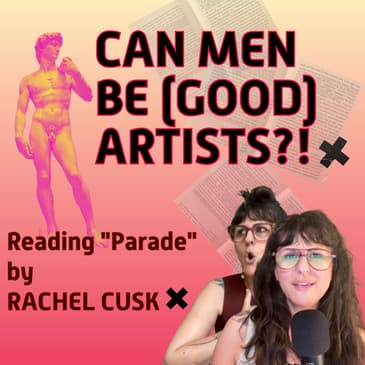
Writer Rachel Cusk asked: "Can a Woman who is an Artist Ever Just Be an Artist?" (NYT). Our host Joana, your favourite contemporary art writer and curator, turns this question of gender and skill on its head: can men be (good) artists? Cusk's book "Parade" (2024) is this Art & Literature episode book of choice to tackle the issue. Can art and life be a continuous flow for female artists, as it seems to be for male ones?
Joana embarks on an art and feminism quest: is gender a prison? Or is it the forceful power of the patriarchy's creative flow? She is helped by living and fictional contemporary artists and writers, intersectional feminism, and philosophy of art via Vilem Flusser and his "theory of gestures".
Did you enjoy the episode? Think about supporting Exhibitionistas by leaving a small donation: https://buymeacoffee.com/exhibitionista
Art and Feminism claim to walk hand in hand, but what if the structure of the art system itself was an inheritance of archaic patriarchal systems? The famous artist Georg Baselitz, who passed away this year, is a central figure in Cusk's book "Parade". Was he a product or an instigator of the system? And what is the patriarchal system? How and where does it manifest? And finally, where are modern men now, within this system that seems to block creative flow and artistic expression?
Sign up for a tiered monthly support: https://www.buzzsprout.com/2624749/monetization/supporter_settings Your contribution keeps us going.
Listen to the Women who Sarcast Episode" Sarcasm and Contemporary Art.
Read Cusk's article in the New York Times (07/11/ 2019).
Jingle: "Wunder", experimental poem by Joana P. R. Neves.
Did the episode stir Art Wonderment memories? Share them via text or voice message.
Created & Hosted by Dr. Joana P. R. Neves, art curator and writer with over 20 years of experience in the contemporary art field. Artistic director of Drawing Now Paris since 2018, she has worked across the industry, from the art market to education. She co-launched the art residency and project space Worlding in 2020. Exhibitionistas’ first year offered exhibition discussions with guest co-host Emily Harding; organically, it grew into a more experimental show exploring art topics, stories and interviews complemented by Joana’s publication Art Thinkosaurus on Substack. She champions ‘Art Wonderment’s’ embrace of complexity against the lure of ready-made opinions. A polyglot, she grew up in Lisbon, studied and lived in Paris, to finally settle in London with her artist husband, four children and two cats.
READ JOANA'S TEXTS:
Joana on Substack: https://joanaprneves.substack.com
Where you find the Exhibitionistas Files, our Newsletter: ...
Intro: can men be good artists - inspired by Rachel Cusk
SPEAKER_01Gather around the fire of art wonderment, fellow exhibitionisters. And if you're a newcomer, a hopeful exhibitionista, we already consider you one of us. I'm your host, Joanna Pianevis, contemporary art writer and curator, and this is Exhibitionistas, my notes on contemporary arts and life, which is to say, your Art Wonderment podcast. As ever, I will start with an art quest. A question, if you will, that will guide us into another art wonderment exploration into our lives via visual arts and material culture. But today is a special episode, part of the series dedicated to art and literature, which was requested as a permanent fixture by many of you. So I'm very, very, very happy to oblige and to venture again into my favorite books where art is discussed outside of its natural habitat, be it in fiction, in anthropology, in philosophy. Today I'm plunging into Rachel Cusk's parade. At the brink of the launch of her new book, which rumor says is about Natalie Portman, or at least strongly inspired by her, you know, the American actress who I think lives in Paris, as Rachel Cusk does, by the way, and their friends. So waiting for that one to drop, it is perhaps useful to go back to parade and to understand how Rachel Cusk takes specific elements from real life, marinates them and cooks them in a very special Rachel Cusk source, written with a style that cuts like a surgeon's knife, and that goes very, very deep into the psyche of whoever she decides to write about, and whatever part of society that she decides to shed her very white and clinical light on. I really love her writing, in case it doesn't sound so. But today's question can men be artists? Recently I was a guest in my friend Kathy Barron's podcast, Women Who Sarcast, and we do love a queen that rhymes, and I've been reminded of how much I love sarcasm. It's a great episode, by the way, and I will link it in the episode description, or for us professionals, the show's notes. Sarcastically, I can ask, can cisgendered men, and heck, men in general, be artists? Or even can men be good artists? I took inspiration, obviously, from our icy queen, icy called British writer, Rachel Kusk's article for the New York Times, which was titled, Can a Woman Who is an artist ever just be an artist? And I want to turn the question on its head to ask, can men really be artists and good ones? Because if they were sold on this idea that their voice was neutral, which is code 4, we have the power, and thus we do not have to negotiate the terms of our identity, it's fair to ask, can they create meaningful art if, as soon as they're cisgendered and straight and white most of the time, they do not seem to grapple with anything specific to them because they are the genius, they are the voice, they are the enlightened ones. And I ask, is it even fun to be an artist in these conditions? I think some would be tempted to say, yes, it is, because you pick up fights with female critics, for example. My last guest in the art etiquette segment, Elizabeth Wotton, who is a reference specialist at the Smithsonian's Archives of American Art, has done a brilliant Insta story where she shows one of the items they have in the archives, which is, I think, Baby Underpants, sent by Clifford Still, so the American abstract expressionist painter, to a female art critic because she dared to denigrate his work. Had he been a woman, he would have just waited for history to catch up with him. Or any other community, by the way, this does not only concern female artists or female creatives. In relation to the previous episode about art critique, art criticism, I think the same question can be asked of critics. Because if you've read Jonathan Jones' article in The Guardian about the new Tate director, Jessica Morgan, called Tate Desperately Needs a Radical Overhaul, but will its new director be an agent of change? Since this special episode has no extra segments, I'll give you the gos about it. So Jonathan Jones often claims to be upset with the Tate. The Tate is doing very bad. And if you read my Art Tynkosaurus Substack page, you know that I've gone into the numbers because from reading that the Tate was doing awfully bad, I thought, okay, I must verify this. So speaking specifically about the Tate Modern, also, this is very aimed usually at Tate. And of course, I checked, and the Tate is the only contemporary art museum making it to the 10 most visited museums in all fields worldwide. It's number nine currently, and the Centre Pompidou, also dedicated to modern and contemporary art, comes in number 16. So not too shabby, I would say. What happens is that, in regards to Jonathan Jones, the museum is not catering to his fancy, which is to have a collection display, so the permanent collection display, as you know, in contemporary art museums, when there's a collection, usually there are temporary exhibitions dedicated to an artist or a theme, and then you have the permanent collection, which is called permanent, but actually the hangs are not permanent, they just are longer, they stay there for a couple of years. Jonathan Jones prefers to have the permanent collection in a chronological order, which is not what the Tate has at the moment. It's thematic. That upsets him to no end, and he keeps talking about it. I see his point, but the way things are phrased in his reviews, there's no explanation. There's just this authoritarian voice that says how things should be. You can ask, can't a man have an opinion? Of course, of course. Opinions are like buttholes. Everybody has one. It's not because Mr. Jones is endowed with a Y chromosome, but I'll take what he says at face value. Neither should you, nor should anyone, nor should himself. You know, we have to also question ourselves all the time. And that's what critical thinking is. To apply the rule to myself, why do I find that chronological displays of the collection are not that interesting? I'm not against them fully, but it's just that if you use a contemporary art collection, a modern art collection to tell history, to teach history, that will be supported by a collection or collections, as we all know, that are lacking female voices, um, minority voices, other communities' voices, and in that sense, what's history are we telling? It also is turning art into a sort of petrified specimen of times gone rather than an active material culture object that actually can interact with the fabric of society and the present. At the end, he states that Jessica Morgan, and I quote, has to totally rethink Tate, unquote. Has to. You know, it's so authoritarian. And you know, you talk about women's emotions and being afraid of female rage. I mean, just read that text. I mean, there is rage in there. I am on his side, we're in the same territory. I commend him for that, and I love him for that, and I'm grateful that he publishes these articles because he does start a conversation. Everybody has the right to voice their thoughts in however way they feel is the right tone. That's what I mean by the neutral voice that is uncontested, and how this has been bestowed on men, and how instead of talking about women as the eternal victims of that situation, perhaps it could be interesting to turn the spotlight on those people. That's what we're doing. And so on with the episode.
What is Rachel Cusk's The Stuntman really about? Inversion in painting?
SPEAKER_01Rachel Kask's Parade was published in 2024. It is composed of four different stories or chapters, however you want to call them. You know that she's not a very traditional type of writer. But I am going to focus on the first one, which is called The Stuntman. The major reason why I want to focus on The Stuntman is that I find it to be an incredibly dense and complicated text, albeit absolutely fascinating. And I don't think I have tamed the beast yet. Rachel Cass considers literature, fiction, creativity to be life itself. And that's why the structure of her books, bear in mind, when I say that I'm going to go deep into this text, and that obviously there will be spoilers, there aren't traditional spoilers, in as much as there isn't really an arc, there isn't character development. She delivers the artifice to the reader, the reader holds the artifice with her. It is true that we have gone heavily back to narrative, storytelling, conceived as sort of hero stories where there's hurdles and obstacles, and then a sort of character expansion and a lesson to be learned. Whereas with her, she delivers everything. You know the premise, you feel that each sentence is weighed or was weighed and worked on through a whole process of reflection that led to that very accomplished and determining phrasing. I am going to read um short excerpt of an interview she did with a New Yorker about what precisely she's going to focus on in this story. Language is essentially incriminating. Writers are identified mercilessly with their works, yet there is an invisibility or almost a protective cordon around the visual artists, to the extent that a biographical approach to the visual arts has been and possibly still is seen as basically unacceptable. My reading of Vazari's Lives of Artists, a Renaissance text years ago set me on a rather awkwardly determined path to find the way of writing about art that stemmed from human character because I believed that the relationship between visual art and human character was more violent and psychologically revelatory than that between authors and their words. The writing in the Stuntman comes out of a deep attempt to imagine the conditions of inversion in painting.
A fictional Georg Baselitz' and Vilem Flusser's theory of gesture
SPEAKER_01And so the first thing I'm going to do is to give you the context and what that inversion is. And I also want to tell you about the gesture. This whole story hinges on gestures, very specific ones, but very mysterious ones. And that's what the whole heart of the story is going to be is to try and penetrate the opacity of these gestures. Precisely because the gesture will always be opaque, because it will always stand out from regular communication. And that's why she says that in reality it's quite bizarre that visual art is so divorced from biographic readings of the works or a life's work. Writing can be quite manipulative because using words as a tool for storytelling, for world building can be quite analytical immediately, whereas with an image or a sculpture or any form of art, there is something quite visceral in the materials used, in the abstract quality of that language that is as opaque as it is hinging really on personal choice. So let's move on to the first aspect of the book. Firstly, The Stuntman, but also all the other stories in Parade have recurring characters that are all named G. G as in the letter. G, probably as in genius, because they're all artists. She really takes head on certain topics, as here the notion of the genius and gender, and she really faces the matter head on. G in the Stuntman starts by being, because there's several G's different in this story, or taking inspiration specifically, from a very famous artist who actually passed away this year, Jörg Basilitz. And the notion of inversion is now going to become so clear as to almost disappear before its simplicity for those who are familiar with Basilitz's work. Baselitz has spent a big part of his career painting works that are figural, if not figurative, to take the distinction that Gilles Deleuze made between a realistic depiction and the exploration of recognizable symbols as living things or living beings and things that you find in the world, objects, so figural, the figural type painting. But then what he does or did is that he inverted the painting and he hung all of his production upside down. She creates a fiction that centers on two characters, Basilitz and his wife. He used his wife as a model and he considered his wife as his muse in the uber traditional way that the twentieth century became increasingly uncomfortable with. So I'm going to read the beginning of the
[Ad] LOTL: Queer Conversation
SPEAKER_01story.
(Cont.) A fictional Georg Baselitz' and Vilem Flusser's theory of gesture
SPEAKER_01At first sight, the paintings looked as though they had been hung the wrong way round by mistake, but then the signature, emblazoned in the bottom right hand corner, clearly heralded the advent of a new reality. His wife believed that with this development he had inadvertently expressed something disturbing about the female condition and wondered if it might have repercussions in terms of his success. But the critical response to the upside down paintings was more enthusiastic than ever, and Gi was showered with a fresh round of the awards and honors that people seemed disposed to offer him almost no matter what he did. They lived in a region of forests some distance from the city, for despite its approval of him, Gi was angry and hurt by the world and could not bring himself to forgive it. His early work had been brutally criticized, and though people assured him that his power to shock was the surest proof of his talent, Ji had not recovered from these attacks. His was the type of strength not to withstand attempts to poison and destroy him, but rather to absorb them, to swallow the poison and be altered by it, so that his survival was not a story of mere resilience, but was instead a slow kind of crucifixion that eventually compelled the world to chastise itself for what it had done to him. It was because of the forest that Gee had found a way out of his artistic impasse, caught as he had felt himself to be between the anecdotal nature of representation and the disengagement of abstraction. He had spent a great deal of time observing the activities of the local foresters, and each time he saw a tree being felled, this question of verticality had suggested itself to him. First he had painted the men and the trees in a sort of joint condition of existence, in which the trunks were interchangeable with the bodies. Then he had seen how the bodies too could be felled, severed from their own root, and likewise turned on their side or cut into sections. The notion of inversion finally came to him as a means of resolving this violence and restoring the principle of wholeness so that the world was once more intact, but upside down, and thus free of the constraint of reality. When G's wife first saw the upside down paintings, she felt as though she had been hit. The feeling of everything seeming right, yet being fundamentally wrong was one she powerfully recognised. It was her condition, the condition of her sex. The paintings made her unhappy, or rather they led her to acknowledge the existence of an unhappiness that seemed always to have been inside her. G made a painting she particularly loved, of slender birch trees and sunlight, and the demented calmness and innocence of these upside down trees seemed to suggest the possibility of madness as a kind of shelter. How had he understood this nameless female unhappiness inside her that made madness such a temptation? Unlike other artists they knew, G could not have been accused of exploitation, he didn't suffer from blind male self importance, and nor had he ever taken any kind of liberty that the public value of his gaze might have seemed to legitimize. He had told her that before he met her he had resorted greatly to masturbation. Was he in fact claiming this marginal perspective as his own? If so, he had had to lay down his masculinity, however temporarily, to claim it. He had approached the marginal sidingly, as it were from a sideways direction, participating in its disenfranchisements, in its new and broken identity, with the difference that he had succeeded in giving it a voice. The early paintings were large portraits, fluid and somewhat naive in style, of recognizable individuals from their region and from the circle of their acquaintance. They were simple and formal, as though G were making a statement about his own honesty at the very moment that he was turning the world upside down. Why were these people upside down? It was all one could ask, yet the answer seemed so obvious. It felt as though any child could answer it, and so the painting succeeded in illuminating a knowledge that the person looking at them already possessed. G began to paint large, intricate landscapes, in which nature seemed to be in its heyday, seemed to speak of its power of recovery from human violence, its vigil through successive dawns to re-emerge perennially into the light. It basked in a wordless moral plenitude, innocent and unconscious of the complete inversion it had undergone, and it was this quality of innocence or ignorance that succeeded in entirely detaching the representational value of the painting from what it appeared to represent. The question of whether G was actually painting an inverted world or had simply turned the paintings on their heads and signed them when they were finished was subject to a curious silence. The first scenario represented a formidable technical challenge, the second was more of an absurdist joke that could be passed off in a matter of minutes. Yet he was never publicly interrogated about it, and the question went unmentioned in the many critical writings about this radical development in his work. Sometimes people asked G's wife about it in private, as though in her presence they were finally safe to risk a display of stupidity. In such moments she felt realized in her role as a repository for weakness. She didn't resent it, because one learned so much more this way. But it summed something up for her, and not just about art, that so enormous a confusion around the truth could remain veiled in tacit muteness. She guessed this was how everything that was noble was eventually destroyed. Gee would have agreed with her wholeheartedly, and in fact she noticed that he began to speak openly about his technique of his own accord, explaining the difficulties of inverted painting that could be resolved only through the use of photographs. Later he rejected the photographic medium and the paintings became even larger and more dreamlike and abstract. The question over what a human being actually was had never seemed so unanswerable in any case. He often painted a man cowering alone in bed, the sullied oceanic blankness of the sheets, with a little tormented man somewhere at the top of the frame. G believed that women could not be artists. As far as G's wife was concerned, this was what most people believed, but it was unfortunate that he should be the one to say it out loud. I wanted to focus on the gesture in a book called Gestures by the philosopher Villem Flusser. He was born in 1920 and passed away in 1991, born in Prague, but then immigrated to Brazil. The word gestures refers, he says, to specific movements. Quote Gestures are movements of the body that express an intention. Certain gestures are codified and they are the way we communicate in a very direct and transparent way with each other. If someone hurts me, I will grab my arm to contain the pain and to signify that I was hurt. That's a very intentional and codified gesture. But that gesture is almost compulsive. If someone hurts me and I raise my arm, it's because I want to raise my arm, he argues. It's not unintentional. I do it willingly. It's my gesture. But there is no satisfactory explanation for it. It's not completely encoded. So here goes the definition, the final definition of gesture by Willem Fluser. Quote A gesture is a movement of the body or of a tool connected to the body, for which there is no satisfactory causal explanation. The inventor of semiotics, Charles Sanders Pierce, uses this notion of compulsion for signifying, which I find really interesting, because usually we define language as something that is a sort of distance that we create between us and reality. And here there's this notion that the leaves of a tree rustle in the wind and thus signify wind, windy conditions. There's something about the way we very conventionally and very transparently communicate with each other that is almost visceral and compulsive. However, a gesture is something that somehow strays from that codified relationship to reality. And so gestures need to be interpreted. They require interpretation. And one could argue, Willem Fluser says later, that all of the art system is gestures awaiting for significance. They imply a certain distance from the first reactive moment of expression and then construct something around it. So the gesture of inversion is very interesting, but also the gesture of Rachel Cusk, the writer, of taking face on this situation specifically, of looking at the construct of inverting a painting, how it appears, how we respond to it, and the silence it creates around it. Because Wilhelm Flusser argues that the gesture that withstands time creates something around it, it creates discourse and it's lacking a theory of its interpretation. So it is still demanding this course to be built around it in order to give it its due reverence, because otherwise it will be destroyed. G says that sometimes people dared ask her what that meant, how the inversion worked. She didn't resent it because one learned so much more this way. But it summed something up for her, and not just about art, but so enormous a confusion around the truth could remain veiled in tacit muteness. She guessed this was how everything that was noble was eventually destroyed. And G would have agreed with her, because G wants validation, G wants recognition. And so to move the scope on to the man, because of course one is expected to read this text from the female perspective, but I think this text is really interested in the inversion. And for him, in the beginning of the text, it is very clearly stated, a little bit like Basilitz himself. This construct of Basilitz in the book is deeply marked by the fact that his paintings were so badly received. And so, however much he receives in terms of awards and honors, it's never going to be enough. There's something, there's a deep wound that he carries that is going to be revisited in his relationship with his father. The father was violent, was absent. And because of this inherited violence, G is a good husband, the wife is happy to be a participant in the adventure of the genius. Basilitz did have this sort of harshness, and to tackle also this notion that women cannot be good artists, he said something very simple that the market is proof that women are not as good as men because they're not as expensive in the market as men. And I love the fact that Willem Flusser talks about the full gesture and the empty gesture. And so the full gesture is a gesture that is so itself, it is so complete that it is extremely opaque because it is extremely powerful. And Basilitz is interesting in as much as he reduces things to such empty signifiers, the market. He embraces modernity in ways that us in the visual art world do not want to acknowledge. But ultimately, Basilitz is dealing not with the curator's evaluation, he's not interested in the reaction of the writer in front of his paintings. However much we want, and I invite you to watch the previous episode if you haven't, the art critic does not transmit power anymore. It is the market that, and this is not as true now, we are in full transition at the moment, and the market is in crisis. But when he stated that very obvious fact of the gender gap, basically, as not something that is unfair, but something that is validating, the problem is that both can be true, but he chose to look from the perspective of the market rather than from the perspective of social justice and gender justice and women's rights. None of the statements ultimately are important. That power, when it's validated by the market, means that most people do not know Basilitz. They know who Picasso is, they know who Michelangelo is, and that is the condition that male artists find themselves in now, which is that this huge power that they may have in a certain context is going to be played within the couple in the parameters that they themselves established. Something else happens in this text, which is that suddenly someone speaks in
Gender, inversed sisterhood and the invisible pain of the female condition
SPEAKER_01the first person singular and says I. And if one digs a little bit into this text, one discovers really quickly that Rachel Cusk is now going to talk about something that actually happened to her in real life. She was brained. Someone hit her on the head in a street somewhere, she blacked out and suddenly came to bleeding on her hands and knees with people surrounding her and in extreme pain. The person that hit her was a woman. She could raise her head and she could still catch the sight of a woman looking back as if the woman was looking at the artwork she had just produced, obviously there's shame in admitting that in a world of intense domestic violence and even murder of women every day by men, she was attacked by a woman. Did I believe that being hit by a woman was my fault in the way being hit by a man could not have been? I could not have assigned meaning to being hit by a man, could have found no reason for him to hit me, and assigning meaning was my duty, just as it was my duty to get off my hands and knees and stand up. Why did it make sense for a woman to hit me? It was as though a violence underlying female identity had risen up and struck. This was the domain of the stuntman, this attack on me that had originated within myself, but now the stuntman seemed to have taken an actual human form and been externalized. Apparently so the woman had hit another woman the day before the police told her. And so she concludes her actions made no sense, were apparently insane, and yet to me they were entirely comprehensible. The question of gender arises, and the question of inversion also happens. There's a sisterhood in this system of and I quote violence and silence. So at the end of the text, she solves that this weird situation, or she understands it or frames it in this sense. Quote Being hit in the head, I now saw, had been both real and unknowable, was the inversion of representation while being ultimately representative. The world is upside down, a friend of mine said when I told her what had happened to me. Yet the reality of violence, painful though it was, seemed to offer a correction to the reality that obeys the laws of gravity. What it offered was a bloody kind of truth. You, I called her, the woman who had hit me, called her in my mind the hundreds of times I thought of her each day. She had replaced my image of myself, the image I had left behind me in the gilded mirror of the lady's apartment. She was my dark twin, the inextinguishable reminder of something that had been denied existence in myself. She herself did not deny it. Her body was the entire limit of her being, and she had chosen to deploy her objectification. She had done her work without making a sound. These were her offerings, the offerings of the stuntman, violence and silence. Is this a perpetuation of the violence and the isolation of the patriarchy? Is visual arts entrenched in silence because it also replicates this formula? This notion that it's not that women can't be artists, she says in the beginning, it's that he would not have been a man if he had not been married and had kids with a woman. So this heteronormative society whereby a man is only a man when he holds a woman in power, even though there's a sort of entente between them, this inherent power system and this violence of the female pain that is as isolated as this gesture of inversion is also isolated in silence and accepted as something that is genial, something that is unique to that artist and is never challenged. And therefore, can an artist be a good artist if they're only challenged within that power system of fights within the art world? Since they always win because whether there's someone challenging their genius or not, they are married, they are in the market, they are in the system, and therefore they will be forever validated and thus never really feeling the validation because it came to them through the system that was created for them. There's another situation in this text. As I said, this text is quite complex or complicated, it is an association of different vignettes in only one text that's brought together, even though they have nothing in common, and that's why I love this text because it holds the contradiction in its very structure. So this woman that was hit on the head that speaks in the first person never crosses parts with this couple. Then there's another situation of other artists that the person who writes in the first person encounters in exhibitions, and a particular painting by a black artist from Harlem that depicts a cathedral. When she is on her hands and knees, she says that the people around her are waiting for her to bring this to representation, to give it life, to make it exist. And so this is all about representation. By subverting the order of the image, Basilitz is claiming abstraction for himself without letting go of perhaps not complete figuration, but at least a figural relationship with reality. For G's wife, the inversion is what describes her condition. And the condition is the fact that there's no place in reality where she is not disconnected, where she is not stripped away from it. There is no real place for woman. And when Basilit slash G paints her, she feels a sense of dispossession. Quote G's wife has a stomach ache, a backache, a shooting pain in her hip when she gets too quickly out of a chair. Sometimes her hands shake in the mornings holding the coffee cup. She receives these complaints of the body mildly, without consternation. In her turn she commands herself to walk vigorously each day in the fields and woods near her house. She attends exercise classes and eats with care. She grants herself things that are warming and comforting, a hot bath, a rest in the afternoon. Often she and G travel to southern places, and she absorbs the brilliant sunlight and the smells and sensations of the sea until she becomes radiant. Through this combination of will and self-reward, her body passes its days. Their accumulation is a sort of secret history, a diary. Unobserved, she pays a more or
Is artistic gesture impossible for marginalised artists and othered communities?
SPEAKER_01less continuous attention to herself, but only hints at a greater lack of significance. Kask writes, quote, to be led by instinct is a preeminent freedom attributed to male artists and to the making of art itself. There is a self-destructive element to that instinct and to the creative act, but in this case, the cards have been dealt out in advance. G was stepping out of a relative safety and into the world of her own illegitimacy. So the fact that she also inverts the trope of the man painting the muse, who is often the wife or the lover, and she paints herself and she paints her own perspective on her body, is illegitimate. And that is going to lead to the notion at the end of this text of obscurity, which I have also tackled in the Chris Krauss episode. She says that once you acknowledge your own obscurity and you accept it, you are free to do whatever you want. In this case, that is not what is shown. And so she writes further, quote, G, so who is called G as well, so this is one of the other G's in the Stuntman. Quote, G lived in a milieu where the offer of equality was really an offer of imitation. Painting schools for women, men who were prepared to teach in them, waves of artistic movements they could ride if they wished. And who could really have seen that there was something wrong in that? Some fundamental falsification that would betray and poison the root of being that is the sole source of artistic worth. By inverting and remaining unchallenged with That subversive act of hanging paintings upside down, G is validated. G slash Basilitz is validated by inverting the roles, being the painter who paints herself rather than being the muse who is painted by the husband, the woman is illegitimate. Because the access to artistic expression is done by entering the institutions that were already there, but that perhaps are not adapted. But then there's another G. There's that famous artist who paints a very big cathedral on a very small scale. And there's something in the painting that attracts the woman who is coming to terms with having been attacked by another woman. At the end of the text, she re encounters this painting. Quote I found out that G was once or another G, another artist, was one of very few black painters in his circle, and he was excluded from most of its exhibitions and galleries. His work was appreciated, but he was accorded no significance. It was exhibited after his death, so the painting, alongside that of certain female contemporaries, as though marginality were itself an identity, inalterable and therefore situated beyond change. The marginal becomes the central only later on, after the wars of ego have been fought, like a peacemaker arriving at a battlefield after the conflict has ended. G came to believe that art was useless as a tool of political change. Instead he exercised the right of the individual to seek aesthetic justification, a kind of morality for its own sake. The recognition will then obviously be posthumous, but more importantly, it will be his own exclusion, his own understanding of the role that he can play in that milieu that will never accept him as someone who can play with the present time. He's not in the market to take Basilitz barometer. Kosk dedicates the end of the story to this painter and this painting in particular. Not to be understood is effectively to be silenced, but not understanding can in its turn legitimise that silence, can illuminate one's own unknowability. Art is the pact of individuals denying society the last word. There in the commotion of the museum, I thought of Qi and of how as a child he had learned to draw by copying pictures in books borrowed from the library in Harlem. His neighborhood later became his subject because it was a subject that was given to him. The marginalized artist, like any marginalized person, is obliged to reckon with reality first. But Xi eventually and deliberately set reality aside. Was abstraction, like imagination or fantasy, merely a mechanism of escape? Was there some debt that was left unpaid in this abandonment of the scene of limitation? It was a question not just about the moral value of freedom in the context of aestheticism, but about the actual nature of freedom itself. And the last paragraphs I'm going to jump over a part where that I've already read about the Stuntman, and she concludes In the museum, I walked through the rooms at random, trying to escape the noise. In a large long gallery, where the paintings had been hung one above the other almost to ceiling height, I suddenly saw it, the small smoldering canvas. It was somewhat lost among other larger works, and too far up the wall to properly see. By painting the obscurity, he is trying not to become angry with it. Instead, he is trying to love it, the darkness in which he moves, the light that sometimes pierces it, and that only his eyes can see. Now you tell me what this means. This ending is interesting because it leads me to that question of obscurity, of this freedom that comes from unsupervised creativity. But here Kask is very negative in the sense that it she hinges that freedom onto the obligation of painting reality, of not having the freedom of a gesture of inversion that remains unchallenged and that immediately places the artist in the role of language maker, of creating new expressions. Remember this quote from the very beginning of the book. The inversion confirms what people already knew. Is Kusk saying that this inversion is a sort of a gimmick? It is easy when you are powerful to feign irreverence. Is this forceful gesture, this notion that just because it's crazy, just because it's in defiance of all the other conventional rituals of communication and of signifying force and symbols and signs, is it good just because it is forceful? Is this the sort of condition that men have created for themselves of utter and total loneliness? To build community around their work in other terms than in opposition, Kask seems to be asking: is it really possible to escape this system that is so firmly rooted and that is so firmly entrenched in everything that we do and in all the roles that we can have in society? Or are we now building something different? And the men who are no longer in need, or who no longer find themselves in this forceful figure, maybe they find themselves in a system that has no place for them, and it no longer is a question of gender, it is a question of the structure itself. For me, this very important sentence, which is quote, it was a question not just about the moral value of freedom. So is the freedom important enough for me as a black artist from Harlem to sacrifice so much so that I can partake in this creative expansion of the self in the context of aestheticism, but about the actual nature of freedom itself. Thank you so much for being an exhibitionista because again, being an exhibitionista
Thank you to all Exhibitionistas out there!
SPEAKER_01alone, just me, doesn't make any sense. I really praise and cherish you are the exhibitionists in Japan, in Germany, in Belgium, in Spain, in Brazil, Americans, Canadians. Thank you so much. This text is this is still a text that I'm working through. I'm not sure that I'm reading it right or that I'm reading it fully. So I'd be so interested in knowing how you read it, how what you thought of it, how you embraced or not Willem Floos' idea of the gesture? Is it something that might be useful to think about art or even to explain it to others? I would love to know what you think. In the end of the description of the episode, the show's notes, through which you can write a message, you can leave a voice message, people are starting to reach out, and it's ever so heartwarming and pleasurable. Don't forget liking it, subscribing, leaving comments, it pushes us up in the algorithm. And if you want your friends to listen to exhibitionists, there's other people to come across it, if you want to support us, that's a really amazing way of doing so. Because the more people listen to it, the more we become monetizable, sponsorable, if that is a word. Um, you know, and then the better I can edit and produce these episodes for you exhibitionists out there. Okay, I've said my piece. Thank you so much. Thank you for listening, and I will be with you very shortly. And I'll have maybe a few surprises along the way. Stay tuned. Bye bye, take care.