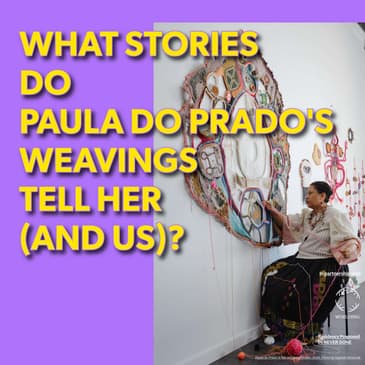
What if weaving released untold stories? And how does textile art with such narrative yet abstract powers fit into contemporary art and its traditionally European systems? Joana’s conversation with contemporary artist Paula do Prado takes unexpected turns and spreads across at least 3 different continents–if not more. What influence did the lost language of the Charrúa people and her Uruguayan past and lineage have on her work? Or, rather, is it even possible to locate the intuitive, dreamt and compulsive patterns and figures that emerge from her fingers, without any preconceived sketches or pre-established patterns?
Did you enjoy the episode? Think about supporting Exhibitionistas by leaving a small donation: https://buymeacoffee.com/exhibitionista
This episode is a partnership with Worlding, a non-profit co-founded by our host, Joana P. R. Neves, in Elephant and Castle, London. Paula do Prado’s Residency is a proposal by Adelaide Bannerman / Never Done. The artist’s residency is supported by Creative Australia.
Paula do Prado is represented by Station Australia and is current a studio resident at Artspace, Woolloomoloo. Following her Worlding residency, Paula will hold her first institutional show as part of the Artspace x Art Gallery of New South Wales Co-Commission as part of the Contemporary Arts Project Space, Art Gallery of New South Wales 28 November 2026 to 14 February 2027. See more https://www.artgallery.nsw.gov.au/whats-on/exhibitions/paula-do-prado/
To know more about Worlding, visit the website: www.worldingproject.com/
Sign up for a tiered monthly support: https://www.buzzsprout.com/2624749/monetization/supporter_settings Your contribution keeps us going.
Resources:
Conversation between Paula do Prado and Mónica Michelena: https://vimeo.com/835732257?fl=pl&fe=sh (Spanish)
Paula do Prado’s website (art / projects / workshops): www.studiodoprado.com
Jingle: "Wunder", experimental poem by Joana P. R. Neves.
Did the episode stir Art Wonderment memories? Share them via text or voice message.
Created & Hosted by Dr. Joana P. R. Neves, art curator and writer with over 20 years of experience in the contemporary art field. Artistic director of Drawing Now Paris since 2018, she has worked across the industry, from the art market to education. She co-launched the art residency and project space Worlding in 2020. Exhibitionistas’ first year offered exhibition discussions with guest co-host Emily Harding; organically, it grew into a more experimental show exploring art topics, stories and interviews complemented by Joana’s publication Art Thinkosaurus on Substack. She champions ‘Art Wonderment’s’ embrace of complexity against the lure of ready-made opinions. A polyglot, she grew up in Lisbon, studied and lived in Paris, to finally settle in London with her artist husband, four children and two cats.
READ JOANA'S TEXTS:
Joana on Substack: https://joanaprneves.substack.com
Where you find the Exhibitionistas Files, our Newsletter: ...
Intro: Partnership with Worlding and Never Done.
SPEAKER_01Goosebumps, literally. Yes. This has never happened to me. A novelty here on Exhibitionistas. I am kind of opening up the door on my other life, the non-profit called Worlding, that I set up with the artist Yoga Pimentel. In that spirit, I am welcoming here to Exhibitionistas to our virtual studio an artist, Paolo Duprado, who is going to be in a residency here in London at Worlding. I can't not mention the person who put us in contact with Paola, Adelaide Bannerman, with her project called Never Done. Never Done is an Itinerant and an intermittent program initiated in 2018 by curator Adelaide Bannerman as a nimble resource response to facilitating peer-to-peer artistic and curatorial research, mobility and professional development. An underlying intention is to create spaces for exchange, collaboration, and the development of practices beyond traditional institutional structures. And that's where Welding came in. And so without further ado, let's go into the conversation.
Introducing Paula do Prado.
SPEAKER_01Paola, welcome to Exhibitionists. Thank you so much for agreeing to have this conversation with me. And I'm just gonna ask you to introduce yourself, maybe. I think that's the best way. Of course.
SPEAKER_00Um thank you and um thanks for having me on the on the on the pod. My name is Paula Lapra, born in Uruguay, and have been uh living and working in Australia since I migrated at the age of seven. Today I'm coming to you from the very beautiful, very sunny uh Gadigal country, which is uh on the eastern coast, so um known as Sydney, close to the shoreline and the beaches.
Paula do Prado's Favourite Art Tool
SPEAKER_01I asked you previously to bring in a tool that would not only be your favorite tool maybe for art making, but also a tool that would kind of be maybe the ex libris of your practice. So, Paula, what did you bring? What is your favorite tool?
SPEAKER_00So um I took a more uh creative uh, if you will, um, interpretation of this word uh tool. So um I actually have brought in um something that I tend to have um or or try to have or take along to the spaces where I'm working or doing, whether it that be the the actual making of artwork or even the space where I think, where I might write, where I might be doing you know, that kind of planning. Um so this is actually uh you can probably see it. It's an amethyst. Okay. Um tell me everything, and I have a surprise for you. Oh no, I had a sense, so I wasn't sure. Um but this is how things work, as I'm sure you're use bumps, literally. Yes. This has never happened to me. Um but yeah, when I was thinking about when you you mentioned a tool, um, you know, I really wanted to choose something that um, you know, has a lot of meaning for me. Um so the amethyst for me really represents um particularly my paternal line. Um, so although I was born um in Uruguay, my dad's side of the family come from the border between Uruguay and Brazil, so the northern part of Uruguay, the southern part of Brazil, um so we're very much um, you know, people whose whose ancestors belong to that river, River Quarain on the Uruguay side, and River Rio Guaraí on the um Brazilian side. So um this is actually from Artigas, which is a northern um area, which is where my dad's family is from, and it was given to me three years ago when I went to to visit. And so I chose this because for me this is very much um what I would describe as an anchoring tool, perhaps, um, something that reminds me of place, um, and um, you know, the this idea of um you know belonging, this idea of respect for place, for ancestors, for lineage, um, and really, you know, for me, a very big portion of I think why I do what I do or why I've ended up doing what I'm doing in the way that I've worked about it. Um, and so I wanted to bring that in because I thought it might be something that might resonate with you, but I also thought it might resonate with your listeners. It's a very beautiful purple um amethyst. Um, it's a nice little size, so it's got the rough sort of side, which is more rock, and then the other more mineral crystal side on the other side. So what for some people might just be a paperweight is really on the whole lot more meaning for me, although it does action as an as a very good paperweight. Um but um but yes, yeah. So um for me, this is kind of a thing that I like to have um nearby. Um and I just find that it just um anchors me in thinking about why it's important to consider um you know the way that we relate to each other, the way that we relate to place, the way that we understand the spaces that we inhabit and what we call to those spaces. Um and for me that's really important because obviously, as a as someone whose experience has been of migration, of being on the other side of the world, and then now thinking about going to to visit you in London, um, I do often think about you know, that movement, but then thinking about this concept of you know, the land that we carry inside our bodies.
SPEAKER_01That's an amazing expression, the land that we carry inside our bodies. I think we're we're gonna have a lot of chats about that, but I am going to do something that I've never done before. So I'm gonna get up. I'm I'll be I'll be back. Those who are listening, I got up to get an amphist. See, I'm back and I'm gonna show to the cameras. Are we gonna break the internet? I don't know. Something's gonna happen. There's a there's some power that you know just I think it was underway already. I I
Paula do Prado's unique use of crochet
SPEAKER_01think. Wow, that's incredible when you showed it. And this was a gift, actually. Same. So let's talk about your practice. You define your practice as being textile-based, but there's so much behind what you do. Why did that practice crystallize so much around crochet?
SPEAKER_00Um, I do predominantly work with uh fibre and textiles, and that wasn't um always the case. I found myself working with those um materials really as an act of remembering. Um I actually had a whole other career in in corporate, um, and I'd always, you know, been creative as a as a child. You know, I grew up with my aunts and my mum, who were very um excellent, skilled uh niches. Um and I think it wasn't until actually I was having a bit of a of a hard time, really, a bit of a transition and crisis in what I wanted to do with my life and how I was feeling about where I was working, I decided to to go back to art school to to retrain. Um, and so I left a very lucrative um corporate role. I went to um you know, art school thinking that I was going to be a painter. Oh, Analyana. Something that was easy to explain, something that everyone would understand. You know, what is she doing? She's going to be a painter. You know, no one questions that. Like, you know, there's no ambiguity there. Um and of course, you know, my first year, um, you know, we we got to try out different things, we got to try ceramics, we got to try printmaking, we got to try um more sculptural um elements. We obviously did painting and you know, perspective and live drawing, and um, I was fortunate that when when I attended um uh this particular course, which was a Bachelor of Fine Art, we had textiles as an option. Um and I never looked back. I do remember though, um, at one stage um I still felt like I didn't have a skill, and I asked my mum to show me how to crochet. So she taught she taught me chain stitch. Uh and of course, me being me, that chain stitch is still the same stitch that I use, so I only actually use one type of stitch in crochet. Really? Uh yes, I am okay.
SPEAKER_01Can you just say because I have had an immersive experience with crochet during the pandemic, a friend of mine in Washington, DC taught me via Zoom. Yeah. And so I know a little bit what you mean by chain stitch. Can you just explain for those people out there who might not know what you mean by just knowing that?
SPEAKER_00Yeah. Yeah. So chain stitch is really kind of your most basic crochet stitch. You can actually do chain stitch without any kind of tool. You can do it by hand as well. Um, but you know, in terms of when you're learning how to use the crochet hook, how to hold it, how to position it, how to manage the tension between the thread and how to, you know, where to put your hands when you're holding the tool and how to create what is essentially a series of loops. Um, so of course, unlike me, you've got one hook or needle, not two. So, but again, your hands are working in concert with each other. Yes. Um, you know, it's so simple. And it's a language that it is not an intellectual language, is it an embodied one? So you someone can tell you over and over again what the steps are, but until your hands are working and understanding the movements, yeah, it's really difficult. And so I think it's really about a way, not just a way of learning, but a way of you know, sort of moving and understanding what the steps are, and it's really interesting because once that programming is in the fingers, it's in there, and then it wants to do its own thing, right? And then you've got a particular way of languaging because it's your hands, not someone else's, and it's your temperament, and it's your way of tensioning, um, and it's your um sensory input and your haptic feedback. And so it is actually, when you pull it all apart, a really complex process that ultimately you're going from thinking about consciously, I have to do this and then I do that, to just doing it. So, yeah, it's it's really interesting because you know, for me, um it's also a bit misleading sometimes, I feel it is anyway, to say that I crochet because again, I won't I only use the one stitch. Um I, you know, people are surprised um because you know, for me it's I I I maybe at some stage I could learn, possibly, but it's not my thing, and that is I don't follow patterns. I can't knit socks, I cannot follow instructions. So, yes, I don't like counting stitches. Wait, wait, wait, wait, wait.
SPEAKER_01Okay, wait, that's even more okay. So the only way I have to actually crochet is really follow a pattern, not explore too many stitches, because I I can't I can't do I I can't do that. But but the the most terrifying thing for me would be to not know where I'm going. So tell me more. Like how why it's like you're saying, okay, I know a language, but I will only say the word yes, or no, not even, or only I don't know what would the equivalent would be. So tell me more. So you improvise? How how how does that work?
SPEAKER_00I think the best way to describe what the experience feels like for me is to say that the pattern reveals itself to me as I'm making.
SPEAKER_01Okay, right. Okay, so that's a a direct connection to ancestors, maybe, or to could you say that the pattern emerges from you because there's still patterns, or do you create a really organic and unpatterned um figures, images, forms, shapes, symbols, maybe?
SPEAKER_00Yeah, so I think over the years it's been a process of actually um interrogating that and trying to understand well, what is actually happening in the practice and in that process, because um the answer is that all of those things are happening. The answer is that sometimes these figures are figures, so it might be like in this case, a bit of um, you know, a monkey sort of lizard kind of shape. Um, you know, and it might be um, you know, it might be a more uh abstract, sort of organic um sort of, you know, piece that might be on the wall or it might be flat. So, you know, really it's it's this um space for me where um I can work in this way, that I can sort of surrender to the thread, to the materials, to um, you know, I'm learning and remembering as I go. Um and it's been a really interesting um process for me, who usually is very organized and quite controlled, likes to control, likes to know what's coming, except in this space, a space where time does funny things. Oh time bends, yeah. Time bends for me uh when you are, you know, sort of immersed in the making. Um, and so it's kind of like hopping on this sort of frequency where you know you're really engrossed in what you're doing and the movement, and you're thinking, you know, you know, I'm almost constantly asking questions. So what colour is next, and do I have that? And what might go well here? And does that belong together? Does that piece fit with that one? And maybe it wants to be bigger. Let's see what happens. And just it's just one thing after the other, but nothing is planned. I don't sketch, um, I don't pre-plan things, I don't know how small or big something is going to be. Um, and it also means that my studio practice is actually quite circular, so there might be pieces like this that might start off as a single piece, or conversely, it might be two or three years from now, and if this hasn't moved on or done something else, then it might be incorporated into a larger piece.
SPEAKER_01You have some sort of mapping, diagrammatic, much bigger works that you either suspend on the space or you hang on the wall. They seem connected to very specific researches that you make. Because you're looking into the iconography, I would say, with the symbology or the meaning of these forms that come through you. How does that work and how do you connect both? If there if there is a connection to be made.
SPEAKER_00Yes, I'm looking at books, I'm looking at um, you know, uh specific texts from you know all of South America. Um I'm looking to our neighbors. There's also the genealogy, so I do a lot of research on our family history, you know, um, and collating all of that and asking the questions. Um and then of course, you know, there is um, I think for me, having uh migrated at the age of seven, um it became clear very early on that if I was not deliberate, if I was not intentional about investigating um these lineages, if I did not physically visit and return and immerse myself in the places that you know my family have inhabited and that we have histories in, that without that um there would be no real foundation. And so, you know, for many years there was a feeling of um you know, slightly being untethered, and I think for me I was kind of reckoning with, well, who am I here on in Australia? Who am I here, you know, amidst the histories that are here, um, and you know, what does that mean for me and for my practice? Um, and then thinking about, you know, when I do return to Uruguay and when I am there, then thinking about what does it mean to return in this kind of very different mode to be both local but to be both very foreign. But for me, what's really has emerged is this sense of responsibility to um really honour all the places, to really anchor in the spaces, you know, to be hyper-local, you know, to be really intentional about, you know, where I am, what does it mean, what's the history here, but ultimately, yes, to when I return, and when to do that research from afar about, well, you know, which places were my ancestors live were living, what what were the histories? Um, you know, why do we look the way we look? What does it mean to have links to um you know all these sort of disparate stories? No one was gonna hand me the story, you know?
SPEAKER_01Yes, no one yes, and that's what I'm seeing. Like I'm looking at a woman who has a family, who has an because I think that it's important for people to realize what you mean by visiting all the places and being hyper-local, because you come from uh Uruguay, and then you arrive in Australia, and I I I read or I heard you say somewhere, so I we flee, my family moves, and then I arrive on stolen land, and you know, I arrive at a place that has I wouldn't say the same history, but a pattern that is very familiar, and paying respect to the ancestors and being very aware of what happened exactly in a place. Is that how maybe and you spoke about anchor, and I understand much better why your tool was the form of anchor? Is that how you manage that responsibility? Because I with that responsibility comes a lot of weight and a lot of um a lot of information, like a lot of told and untold histories and stories.
SPEAKER_00Yes, um, most definitely. And um, you know, for me the question has been how do you sustainably hold that responsibility? And uh what's been important for me, I think, especially as a mother, I've got a 13-year-old son, and I often think about you know what's come before me, and I also look at my dad, who um is a singer-songwriter. Um, and so for me, one really important question has been how do I hold this responsibility with all the seriousness and with all the you know respect um and accountability that it reserves. But at the same time, how do I hold this with joy? Yeah, how do I hold this in a way that I am, you know, almost um undergoing a process of of, you know, kind of lighten lighting, you know, kind of lightening what's there because it is really heavy and it is really intense. And it's not, you know, there's bits of the research that I couldn't do every day. These are things that, you know, I might dig the deonological archive every three months or once every now and then, you know, these are things that, you know, need to be balanced. And so when I say about the the hyperlocal aspects of it, even today before I've sat down to have this conversation with you, I actually came from the beach. There's a little beach that I visit near my parents' home and I dip my feet in the salt water and I say thank you for anchoring me and I just spend some time there, you know, getting refreshed and I've come back and I've not even had time to wash my feet so I'm sitting here speaking to you with grains of sand between my toes. But it's a process that I feel I need that is that reciprocal relationship which is to actually spend time with place, to just listen, to actually you know immerse yourself in water to you know however you want to frame it, you know, where it's like is it spiritual hygiene? Is it what is it venerating? Is it you know it might be all those things at once. But for me it is having a relationship with place. And understanding that these waterways are so much bigger than my mind can hold. And that ultimately maybe dipping my feet on the shoreline here of Sydney maybe connect me to the water that kind of laps at the shore of I don't know of of of West Africa or it might be lapping at the shore of Angola and it might also it might be you know like it's immense it's immense. And so you know it's really important for me to to remind myself of that as well. And so yes the anchors required for this kind of way of being and approaching are multiple so it's it's it's this the rock it's the water it's it's the plants it's the it's all of it.
SPEAKER_01And that's also your work so your work and you thinking about the audiences I think is really interesting and and I find it very you say that oftentimes I read that you have a wall like a sort of research wall that you install in the exhibition how then do you think about the people who are going to visit your shows of course I suppose it also has to do with where you're showing your work obviously but how do you think about people and is do you have um um a concern for informing or do you prefer to find other ways for them to get to your to to come into this network that you're establishing of responsibility and engagement with you know um place and and all of everything that you've been um sharing with us.
SPEAKER_00You know I think for me it's really important to um you know for me to keep myself well in in the making of the work and in the things that I want to do. And so you know there's a lot that goes behind um before work ever reaches an audience. Right? There's lots of ways that artistic practice reaches an audience and so I think we have to be aware that even this discussion is a way for the artwork and you're not seeing all of it or maybe even a little piece of it right but it's a way of putting the practice out there. So I think of it more as a much bigger bigger broader sort of question in terms of you know what what how do you put the work out there and how do you frame it I don't have a particular message as such it's really about you know the relationship so it's really about opening up different ways of thinking different ways of interacting it's about how does art how does looking at art impact on you you know equally I am also often the audience for other artworks in other places. So you know I too am you know kind of interrogating and consuming and looking at art and thinking about how it might move me or not. Yes. You know and I think that's also really important because you know for some people it'll really resonate and it'll be like I want to know more and for others it might just be a a walk past a really lovely colourful thing and then not might not think about it again. So you know that there's space for all of that. But I think what is important is that hopefully when there is a connection it's really important to me that I've stayed or I've you know kind of done the right thing in terms of putting that work out there that I've been able to retain an integrity within the work that says yes this you know if if it you know it's a feeling right you know in your gut you know um when you see something and you think it really speaks to you and you're like there's something there then you know it in your body before you actually can really kind of maybe articulate it or you know would have seen it and walked away and not gotten it but then two weeks later you might still be thinking about it. Yes yes that's the best that's the best one. Yes oh it's haunting you oh yes oh I remember that thing last year and she's you know doing something again oh interest like so there is that and you know and and the question is when you receive that sense that feeling it's almost like do you answer it? There's always the invitation do you answer the call to being more curious? Do you go further or do you leave it at that?
SPEAKER_01Yeah yeah I read in an interview with Tasha Mallet so director at Verge which is a space at Sydney um university that you said that you were an artist even before you were born and you will never cease to be one and the the specific quote was uh you said I don't see it having a beginning and I don't see it having an end.
SPEAKER_00Look it's not something I've arrived at totally on my own um you know yeah I think it's um just a a function too of of the the familial ties that that are so important in my life so you know with my dad being a singer songwriter someone who you know is working with a very a different kind of artistic medium if you like um you know for my mum it was more um you know in in the ways that she you know she's quite an animal lover and um you know likes to take photos and um you know loves design and you know the simple things and you know um plants and and so you know to to grow up with that you know for me I think part of my process was to understand where I sit within all of that um because you know my my artistic leanings were so different to everyone else in my family.
SPEAKER_01But also in art school if I'm interrupt I'm sorry.
SPEAKER_00Yes but it also everywhere basically everywhere everywhere it's like what I can't don't I don't fit in like I'm not exactly like I don't see myself anywhere. I don't see you know and um you know that's always been kind of an interesting thing for me and I think over the the years and I think that idea of it having no beginning and no end is really just understanding that I had to actually just broaden where I was looking right because so often when you're thinking about ancestry you're thinking about that that that line right you're thinking about the bloodline you're thinking about kind of the the rational straight line you're thinking about you know dots that connect and you know whereas really you know the way that I have come to think of it is really as is being part of uh what's a continuum you know this idea of there being no beginning and no end you know almost gives me comfort when I think about it it gives me comfort because I think you know I think now then you know after becoming a mum as well I think of of my son and how you know he's he's very clear with me. He's like you do that textile stuff the fiber stuff is you I am a painter the same the wheel turns again the wheel turns and I'm like how does this how does this happen I mean nothing against painting by the way I mean this is not Zig at all yeah but it's just this idea of like being able to call it something solid something you know that's got like you know that's part of a long established tradition and I think you know when we when we really investigate things further you know like I I do often tell him you know maths began with string so yeah um you know if you want to go there we can go there.
SPEAKER_01Have you ever thought about why art and contemporary art as we call it which is a a ridiculous way of saying it when you think about it you don't say contemporary literature you say you know books that that people are writing nowadays you know why have you as ever wondered why you found your place in there and is it a or then did you or is it or is there a little friction in there?
SPEAKER_00That was not in the script no that's fine that's fine yeah no it's a it's it's a super interesting question because um you know so often we're kind of um maybe conditioned um to think that anything really worthwhile takes effort that it should be labored right that it should cost you right yeah um and I would say that for me this kind of journey that I've had into predominantly working in this way has been one of increasing ease and almost um no not almost I would say there was a lot of work for me personally around being uncomfortable with the ease that I felt because suddenly I was not um you know dragging my feet about getting to work. Suddenly um you know opportunities came about differently I didn't have to chase things they just appeared and it was just well exercise that muscle of discernment.
SPEAKER_01Yeah and it's that's interesting because well we're now um you know anchored in the present right living artists living contemporary curator whatever you want to call it and I'm interested also in asking you about syncretism there's an expectation of I don't know reawakening lost histories recuperating restoring but I wonder I mean and I don't know if syncretism is the right word for it but because you bring about these creatures these figures these ramifications these networks these materials these colors um these trees that you talk about um was it the jacaranda the the tree's one yeah yes and so you know the tree is like a really anchoring again uh element but there's these this connection also that you suggest with far away communities that were looking at similar shapes and that were organizing the world in a similar way so in the present how do you engage or how do you expect people to engage with the the present time the present existence of indigenous culture and practices and thinking?
SPEAKER_00Um I might start by um you know that that word secretism you know it's is a tricky one um and I know obviously particularly you know within different cultures but particularly within South America there's this there's this tendency and particularly within you know uruguay brazil Argentina there is very much there was very much a uh deliberate um sort of appropriating of indigenous terms and practices particularly around you know Christianity and forced religious conversion so it's got a really heavy history um and so you know and for me kind of the way that I sort of understand secretism is kind of like trying to make the the bits fit trying to unify what perhaps um or trying to massage one thing into another or so you can look at it in lots of different ways. I think for me what happens um for me in my work um in relation to a lot of the histories that are tied to the places that that I have a connection to is that it's it's really more about you know I've often referred to it as a kind of an unearthing a pulling up at the roots because you know there is very much an expectation that when you are out in the world as an artist that you define yourself that you say who you are in some way shape or form and you need to do that either in your bio either your name says something your surname will ring you know certain people will clock that um people will clock how you look how you dress how you you know um and so you're you're saying a lot already without even you know saying you know even having a conversation and so um for me it's been you know something that I've aware of and it is something that for me I feel like I navigate on the daily um and to a certain extent there's a lot of it that I don't have control over and you know I've had to learn to sit with that um but I suppose what I can do from the agency that I do have is that um you know for me I sort of do insist on not oversimplifying you know my connections and not having to necessarily put a label on it so you know I don't call myself um you know I don't even use the term Afro-Uruguayan I don't use the term indigenous I very deliberately you know acknowledge my ancestry and my lineage without then entangling that with identity because you know I walk this world in this skin and I walk this world as a woman and I'm a migrant and and so there are so many different ways that the world encounters me that you know and that I encounter the world and so you know this idea around well what's the work doing and you know I think from my perspective um you know you can read so many things into artwork right and that often comes from your own positioning from your own context and so for me this is why it's really important to um that it's you know for me this isn't just a nice thing to do in my studio and hang up the work and not show it to anyone and just I you know that would be one way of being an artist. You know you don't have to share it. But for me there is a an intent there to have these conversations and to see how work is read to see how people respond to see how I feel in different contexts and I think that's why this space is very important. I think that's why this welding residency is very much at the center of that question of where is that space that we can have this conversation where we don't feel like we need to have a ready made answer or an outcome or a solution where can we just be with this? Can you share a little bit what the research you're doing at the moment is and do you would you like to share a little bit what you're looking into, what you're drawn to at the moment or what you're bringing to London to Worlding particularly so I'm never working on just one thing but um you know for for the works that I'm uh taking with me to London and this particular project it's called Lades of the crossroads um and I was really interested um in kind of exploring a little bit further this this concept of the spirits of place um and thinking about how when you navigate through um different geographies different timelines different um spaces and places and their um you know the histories that are held there um sort of thinking about you know how do you you know who who you who are you building relationship with in place and um for me you know um that that discussion around syncretism was interesting because for me obviously I don't sort of see my work and and it for me it it doesn't come from a place of um religion or belief um it's very much more I suppose you could describe a more of a spiritual uh practice I'm often having to respond to things as they come out and then I'm like oh okay that's that's that I've made that and then I I often have to work backwards because it's like okay I'm looking at this what is that symbol where you know are there references within any of my immediate cultures that I can understand and so it's a working backwards I'm working backwards from the work um and and often in that working backwards I might find that same symbol or um that same form or concept or character that might come up in a lot of my different cultures but it might just be slightly different. Yes. So there's that and you know I think it's also about being careful not to necessarily uh draw too much of a quick conclusion as to what's going on because um I think for me again time is such an important factor in my work that um you know I oftentimes I might get to the point where I'll take work to Welding for example and I'm like well here's a series of nine works and it's about the spirits of place and then I might get there and then I might show them all together and then realize oh actually It's about this other thing too. Or someone might come to visit and say, Oh, did you know that? Have you seen X or have you? Yes. You know? And so for me, it's this very humbling experience of actually, I don't know. Right? And being comfortable sometimes with the not knowing. Because all I'm doing is kind of opening up a proposition, opening up a theme. I mean, I imagine it's almost like your script. You know, I might be laying down some broad brushstrokes, points that we might want to explore. But then ultimately, it's not until we're having the conversation and even, you know, afterwards, once we listen back, once it's edited, once it's recompositioned, that we might actually be actually thinking, oh, that's you know, that conversation might sound slightly different, or it might be, you know, what's left in kind of gives it a different context, had certain things not been cut out. Or, you know, so I think for me there's also it's also really important um to kind of humble myself with the work because um, you know, I might start off with a concept, and in the case of you know, the work that I'm taking to London, it is about the spirits of place, but I'm excited to see well, what is the full story? And I won't know until I'm there because it is about place, it's about this place, it's about the lands where I come from, and it's about well, what happens and when I meet, you know, where you are, and what happens when they're in this space where a lot of interesting things are happening and a lot of interesting people are moving through there, it's almost like I have I'm wondering who am I there to meet? What spirits of place am I there to speak to? You know, what you know, and it's often, you know, for me, you know, having an exhibition is always really interesting because it's not until you have that audience, it's not until you have those interactions and discussions and conversations that really the work is doing what it's supposed to be doing.
SPEAKER_01But speaking of transitory and more ephemeral, I asked you, I don't know if there's something that you want to do, uh, because I saw that you uh mentioned shapes and words, and I'm fascinated with words, and I'm really into um wild and maybe even sometimes kind of wrong etymology association, you know, because I'm not a linguist, but did you think of uh words that you might want to bring or a word?
SPEAKER_00Um let me think. I always find it so hard to just come up with one word. Um so gilaí is uh is a charrua word and it means moon. When I say charrua, what I'm referring to is um the um indigenous people of um that inhabit not just Uruguay but parts of Brazil and parts of Argentina. Um the charrua movement, if you will, really um is is often argued to be a kind of re-emergence. So we had a a a military dictatorship in Uruguay, which uh which is why you you have to leave, right? Yes, yeah. Um so that kind of um ended in 84, 85, was kind of the tail end. Uh yes, my family was directly impacted by that, and as you can imagine, having a singer-songwriter father who, you know, um had to like many of his friends and and and fellow musicians, you know, a lot of um his lyrics were often poetically infused in ways so as not to arouse um attention, but um but yes, nonetheless, both but attention was aroused nonetheless, right? Nonetheless, nonetheless, just by by virtue of existing really. Um and um yeah, and so that that whole history is there. But really what happens is um obviously we leave Uruguay in 1986, and it's really just uh it's at that time where things are starting to turn, and so the military dictatorship is ending, democracy is is coming back in, we're getting a little bit more stability in Uruguay, and that is really when we have the charrua re-emerge in many ways, um, along with a really strong movement against those that were disappeared and who were missing as a result of the dictatorship. All the indigenous people of Uruguay and parts of Brazil and Argentina really kind of band around the name Charua. There are different um language groups and different family groups identify, depending on where they're living, identify with different um sort of indigenous cultures and identities. Um, but you know, we have Chana, we have Genoa, we have Arachan, we have Boan, and obviously there's also a very big contingent and influence through Guarani, which is more often associated with Paraguay. Um, but we have a very big um sort of influence from the Guarani people, um, and obviously, again, within Guarani, there are separate groups depending on where they're located and how they identify themselves. Um, and so really, as we've left and come to Australia, this kind of there's this indigenous resurgence around you know, reclaiming uh sacred sites, reclaiming uh language, reclaiming um identity, and really this really strong push for the indigenous peoples of Uruguay, the Charrua, to be um recognized, you know, from the government. That's something that the Charua are still uh very much um you know fighting for.
SPEAKER_01Um when you say recognized specifically, does that mean um you know searching for the missing people, the disappeared people? Is it the status, the land? Does that manifest politically and socially in in specific forms?
SPEAKER_00I think definitely. So I mean the main thing that you know in recent years there's been lots of um activity around has really been around um the um uh this particular um convention or political instrument um that would that if the Uruguian government were to ratify would recognise the human rights of the indigenous people of Uruguay as you know, and doing that would essentially say yes they exist. And yes, they have rights. So yeah, just a minor minor detail. So um, you know, and so I mean I'm not you know, it's something that I've kind of you know written about in in my thesis when I did my PhD and you know did a little bit around that in 2021, 2022, and 2023. Um look, it's it's uh um how to say, you know, there are a lot of kind of elements within that Charua movement. Um so we've had a lot of political sort of movement around, you know, working with government to get recognition. Um, and there's also been a lot of work around um, you know, the archaeology recognizing, you know, rock art, recognising certain um archaeological sites and um finds that really need to be protected. So we don't actually have protection of our rock art in Uruguay. A lot of it is on private um farms and properties, and it's so again there's no system there. So gradually over time, a lot has been done also around DNA. Um we did have also some um indigenous uh remains returned to Uruguay from France. So there's a whole host of things that have happened um since we left to the present day. Um, you know, we've now we're going to be um we've just um recently hit 40 years. Um, my family and I have been, um my parents and I have been in Australia. And so in that 40-year period, um obviously so much has happened in Uruguay around acknowledging the fact that a lot of the Uruguayan population actually represent um, you know, there is a strong um Afro-descendant community. Um we've got, yes, we've got a lot of European, but then we do also have a huge indigenous population that, you know, has previously really not gone acknowledged.
SPEAKER_01Um by the DNA research.
SPEAKER_00Yes, yes, and so um, you know, and obviously that also intersects with our family history and our understandings of where we're from. Um and so it's been, you know, really interesting. Um, I think for me that doing the PhD was really about having the time and space to really investigate that um and to delve into that in a way um, you know, to kind of acknowledge those ancestral um connections. Um, you know, and I did travel back to Uruguay and um, you know, it was it's it was a really intense process, and I think to a certain extent that's something I'm still kind of unpacking, um, and it's continuing to impact on my thinking and and my work. Um, but one of the main things to have come out of that was to reconnect with language. And we're not talking about Spanish. No, so it's Charua language, um, and often it is mixed um with Chana, and then look, there are, you know, different uh people have different ideas about you know doing purely Charua, doing purely Chana. I should acknowledge that, you know, um a really important speaker of Chana language just recently passed away. His name was Jaime Blas. Um he actually helped to write a full dictionary of the Chana language and left to us, which is unique because then that came actually from someone who did identify and was recognized as someone with that indigenous lineage, whereas a lot of the Charua language has actually come to us through anthropological records. Anthropology, yeah, of course, which is different. So, you know, it's a you know, that language is a big thing. Um, but for me, one of the really important things um, you know, 2021 was a really amazing year in many ways because you know there was still the pandemic, um, but one thing that pandemic gifted me was the fact that it meant that everyone was on devices, it meant that everyone in Uruguay was also on a device, and suddenly communication was possible because everyone had WhatsApp, you know, and everyone had you know the all the different apps, and suddenly everyone was okay. We, you know, I'm like even some of my family were finally comfortable being on like a doing video chat. And so that the language, yeah, and so yeah, and so I got to connect with um you know a few different people, um, in particular, you know, Monica Michelena, who's a very well-known Charua activist and um and sort of you know very much active within that, and we got to record a a sort of similar interview together, and you know, for me exploring that part of my heritage has been really rich and amazing, and you know, really confirmed so many things, you know, my relationship with particular trees and um with particular ways of doing things and practices that my family had done for so long that finally had a context and I could understand practices. So things like yeah, so um Monica Michelena actually wrote her master's thesis, and in there she spoke about a lot of the practices that um were done predominantly by women within Charua um, you know, within Charua society, and and so one of them was like, for example, keeping the umbilical stub of the baby. Really? And mine was kept, so my auntie kept mine. And when I went back at the age of 40, yeah, she'd like just the stub, like the little stub that you know that was tied to a piece of.
SPEAKER_01But do you dry it?
SPEAKER_00Because then it's organic. Yeah, it was dried. It was dried. So she had kept yeah, she had kept all my baby teeth.
SPEAKER_01That we do that in Portugal a lot.
SPEAKER_00So there's a lot of a lot of yeah, a lot of these practices are kind of combined with others. Um, but the umbilical stub was a big one.
SPEAKER_01Umbilical stub is that there's a there's certainly a reason for it to keep it. Why why would you keep it? Yeah, so apparently there's an explainable reason, obviously.
SPEAKER_00Yeah. Um you know, when when I asked, and obviously anytime I'll ask my aunties or anyone, like they very dismissive. Oh, this is just what we did, you know, like um it's always like that, isn't it? And you're like, you know, you thought this is weird, right? I just happened to have these particular crystals and minerals on my shelf, and I just happened to have this charua um weapon that's just it's and literally she was using it like a paperweight and a hammer. Um, little practices like I'm just gonna burn these herbs and I'll show you how I do it, and it just cleans the space. And I was like, you know, so it's all elaborate, exactly, exactly. And I'm like, it's it's interesting, you know, like how these things, these practices survived. So my mum's the youngest of 12, um, and they're all mostly women, and so it's just been interesting to so as I've kind of researched and I read Monica's um uh thesis and you know, all these practices, I was like, oh, we did that, and oh, we do that too, and yes, we do, you know, and then telling my aunts about it or telling my mum about it, and they're just like really, well, yeah, that's you know, or even on my dad's side, you know, certain things, and you know, every time I'd find something, I'd be like, you know, feeding it back to them, and everyone's like, but yeah, that's how it is, and so you know, it's all it just was a really interesting thing, and then you know, it explained a lot of things, um, and a lot of the stories that my dad's dad um had had passed on to me. Um, but yes, one of one of them, obviously, that's very big is is the you know uh the relationship with the moon. Um so um charua babies were often presented to the moon when they were first born. Wow. Um so that was um you know a practice that was considered really important, and um, you know, certain things like keeping that umbilical um stub was also so that it could be um you know either buried or kept for the child so that that that child would always have an anchor and access to those um they called cellulas madre, you know, your mother cells. Um so you know, all these, you know, really sort of what felt like slippery anecdotal sort of passing sort of nothing that you like it didn't feel solid, but at the same time like it felt true. And so, you know, what do you do with that, you know? And for me, you know, I sort of see different people deal with that kind of um, you know, that journey of reconnection in different ways. Um, and so for me it's really still something that's very much ongoing, but one of the really lovely things has been to continue to explore language and continue to explore those meanings and relationships. Um, and I've just loved learning more about words like yidaii or even oshendao, which means memory, because it feels like just with one word, it's like it's there's a whole universe within that word. And to have that word back in your mouth, you know, to say it um openly and without fear of, you know, um, and to think, well, you know, it might have been very many generations ago when that was the the the you know the common language amongst many of my ancestors, and to think that um, you know, how do I, you know, explore that, how do I honor that, how do I acknowledge that, as well as being really respectful of the fact that I am so removed and separated from that context, not just in terms of time with generations, but also geography. I mean, most of my life I've grown up in a very different place, in a very different context.
SPEAKER_01Um, why are different gestures and different habits and different language?
SPEAKER_00And yeah, absolutely, and and so one thing that's been really important for me is um, you know, particularly within the Australian context, is um you know, being really clear and really being in my lane about well, what are the forms, what are the symbols that I'm dealing with, where do they come from? Why do the way they look why do they look the way they do? And so often, you know, language um is a really good sort of connector.
SPEAKER_01Um I was hoping you'd say anchor. I was thinking that what is fascinating in your story is that language is lost very easily, whereas habits remain. But they kind of lose the ability to be told.
SPEAKER_00Even um thinking about the nine works that I'm taking to London, and then after that I've I've got a another big show. Um, I suppose in my work I'm often looking for um maybe the word, maybe the practice, maybe the the place, the tree, the plant, the reference that provides that bridge um to to continue to kind of walk um myself through what it means to hold again these different kinds of this inheritance that is, you know, essentially this messy, very messy, complicated history that doesn't fit neatly anywhere, that often is easily misunderstood because you know, people can't help but look at things and say, Oh, that looks like X, and are you from A, B, or C? You you also'd feel like some creative responsibility about the way that you're making and the forms that you're making, and making sure that they are, you know, that you are staying in your lane and you are being respectful around, you know, if you're making work that looks very similar to another culture's work, then you better have a very clear kind of understanding in terms of where that's situated and how that might be interpreted, and then being You know, ready to be generous about your understanding of where that comes from and how there might be interconnecting storylines or timelines that can sort of support that. And I think you know that is there, and I think we do see it across so many different cultures and even different artists. And I think particularly as the fibre and textiles has become infiltrated the mainstream, like even if we just think about the Sao Paulo Biennali, I mean the amazing work that's there, and I think about suddenly I think my work can be understood, hopefully, in relation to this other work that we're seeing being shown. So if we think about Lydia Lisboa with her beautiful crochet um kind of cocoons, if we think about Sonia Gomez, who's suddenly a huge name within the art world, you know, and she's having these amazing shows at these like absolutely like pillars of the art world, commercial galleries. Um, you know, if we think about um Rosanna Paolinho, you know, like suddenly there are names, suddenly there are references. Whereas for me, maybe 20 years ago, I you know, it was a lot harder. And and people were often like referencing, you know, perhaps African American artists, and I'm like, well, but I'm from not from there, like further, you know, and it's like, well, where are the Uruguayan artists? And it's like when when I do name my works and you know, give Charua um names to certain works, um, you know, I did name a work Giday, and it was the story of my grandfather who grew up in Artigas in the countryside, and a lot of his you know, stories about him being young, you know, he he was basically he grew up away from his parents, he was kind of um brought up in a in a big estancia, a big cattle farm, but actually they had goats and he had to look after the goats. So he had he was doing a lot of naked eye sky observation to navigate all of his stories. Were like, you know, it's like the importance of that moonlight, right? When there was nothing else in terms of the guiding. Yeah. Yeah, yeah. Um and so, you know, and it's kind of like weaving back those personal stories with broader stories. Um, and I think that's why for me, you know, when like I think my email signature has it, you know, instead of sometimes now instead of visual artists, it's tejerora, weaver. You know, because it is about weaving, it is about weaving these threads, and it is about weaving these stories, and it is about weaving the words. Um, and so it's this much broader practice. Um, and again, like I said, you know, even just a word like widai for me feels like to honour means moon.
SPEAKER_01Moon, right? Yes, moon. Exactly. Yes, yeah. And you did say, I I I don't I didn't copy the text, but you did say you connected it at a certain point with the word guide, right? Yes, yes, italian, girare. In and in Italian, um, and in Portuguese is guiar. I believe Spanish is yeah, or does it exist in Spanish? Guiar? Yes, guiar to guide, to direct. Right, which is the same. Uh well the the sound is the same, but the root is not the same, which I I love this serendipity. It's really beautiful, it's not etymology, as you said, it's not a rational connection. There's another kind of connection which I I particularly love.
SPEAKER_00A lot of Charua language is already embedded in a lot of familiar things, even at the basic level of street names. Oh right. And so this is what happens when you study the history and you understand that obviously when the colonists arrive, you know, there were already established roads, paths, places for things. So often churches, crucifixes were installed in places that were already places of gathering and worship for the indigenous population. As to sort of you know, and so that these histories are real, and so a lot of rivers retain connections to indigenous language, a lot of materials, a lot of towns, so taquarembo, which is next to Artigas up north, means bamboo. Takwara, taquarembo. Uruwe is a from Guarani origin. And a lot of people argue what does it mean, Uru and why, and you know, and it's often um related to, you know, the the translation is often like the river of painted birds or the river of snails. So, you know, like there's a lot already embedded midst almost those residues that remained without the context are still there.
SPEAKER_01The excerpt I'm about to read, dear listeners, feels like a very straightforward way of presenting things, but the intricacy of the way it is phrased for me was really subtle and told me a lot of things about the way you think. So this was for Garland magazine, and it's interesting because they just wrote, Tell us about your story, and they didn't say history, and that struck me. And so I I my attention was tickled. And then you wrote, so I'm quoting from you, my family story is still unfolding and revealing itself. It's complex and made up of multiple narratives. I am one of the family archivists and genealogical researchers, where we come from, where we came from, why we moved, why we stayed, and what were the events that impacted on these this or those decisions. I know that our family story is one of movement by force, necessity, and desire. Very interesting words. It is the story of North and South America, Western Europe, and the Bantu-speaking people of West, Central, and South Africa. That means we've covered a lot of ground and sea. So, of course, the first time, so unquote, this is the the first time I read this, I was uh again, and I think I said this so many times, the the the spread, the widespread, you know, um history that you have in your family. But then when you said it is the story of North and South America, Western Europe, and the back, and I love that Western Western Europe, you said that it is the story of Western Europe, and as a European myself, I thought that is so beautiful that to be ensconced in there, first of all, to be just a tiny little grain of sand from your perspective, but also not to you don't let it get away. You know, it is the story, and I love that you said story and not history, and the the difference between both is fascinating to me, and it made me think a lot about uh the European and the Portuguese perspective, the English perspective, you know, the French, my experience is also of Western Europe, and it made me think about how the way Europe deals with colonization, expansion, slavery, um, the horrors that were perpetrated onto other peoples, but also extractivism, exploit uh exploitation of resources, etc., is dealt with in terms of history with a capital H. It's not our story. And until we connect that, I feel it's gonna be very hard to, you know, not dismiss, not uncomplicated, you know, as you as you suggested. Um, yeah, so I would love to for you to just maybe tell us a little bit more about um this little excerpt and then we'll we'll wrap it up because this was very enriching and we traveled a lot already.
SPEAKER_00Yeah, we traveled a lot. Um, but yeah, look, I love this um question because um you know, maybe I think um I wasn't always able to articulate my story in the same way. And so again, you know, for me it's been a very intentional, deliberate process, um, not always pleasant, um, you know, of kind of uh trying to um unearth um the multiple stories that are there, and I think that's why I sort of describe it as something that's still unfolding. Um and you know, I think it's really important. Um and again, I think this is something to do with being a mum as well, and in terms of how do I teach my kid about you know our story. Um, when for him, you know, again, he's born in Australia, and then you know, his dad's Italian. So again, he's gonna have this whole thing, he's gonna have to work out and figure out, right? Um, but I think you know, the the the piece around um, you know, for me in many ways, I think I kind of did my honours and my masters kind of more focused on the the intersection of the African and the Uruguayan um history, and then you know, obviously the PhD was more about reconnecting with the with the indigenous sort of charua histories of of Uruguay, but of you know, still, you know, with the with the the African, you know, acknowledgement of you know the Atlantic slave trade, and then Monte Montevideo was, you know, where I was born was a major port for that and what that meant. Um, but then I also think you know, really very much about like those elements of of that those that European influence, and you know, and since writing that part of the story, we I mean I found that um my great-grandparents on my mum's side actually um you know were in the Canary Islands and part of that whole sort of journey. Um and you know, like the North African Yeah, yeah, the North African connection, you know, the Canary Islands, the Azores, Lansarote, you know, all these amazing places, and um, you know, for me that it's so important to kind of also see your your family story within that broader human movement. Um and yes, of course, there are really kind of heavy histories there, um ongoing uh violent and heavy histories and stories, and you know, these are still um, you know, they're they're still all kind of you know in progress. Um we won't know how we'll look at some of these things that are happening right now and how they've impacted us and how they will continue to impact us until you know we've had some some space between. Um, but I think already in the moment, you know, for me it makes me think um, you know, about how important it is to understand and to know a little bit about the movement within your own family, and that, you know, um it's not as clear-cut. And even though like I do feel yes, okay, it's very unique to have um such a broad and diverse connection to all these um places and and times in history, but then I think don't we all don't we all once we start to investigate our stories have these multiple points of you know unexpected movements and reroutings and um you know and the further that you explore the more of those branches that you start to go down, the more sort of complex and interesting that story becomes. And so for me, you know, in a way, I kind of hope that for me to speak up about these things um in a way that you know tries not to oversimplify and to acknowledge that there's still a lot that I don't know and don't understand, um, but to say to allow space for that, that we're all you know very um interconnected and also we all have um you know unique stories that also have multiple strands and branches to them. Um and I think maybe that comes for me from you know arriving as a seven-year-old here in Australia with what appeared to be uh a mixed-baced uh parents, a father who was very visibly black, and a mother who was who looked more European um and then me, um, and then people not quite understanding that I could have this skin colour but speak fluent Spanish. Um, and so all of those things like were quite jarring when you arrive because I was the norm back in Uruguay. Like all my cousins are like this, and um, you know, uh, you know, and here suddenly it was like, you know, um, and then growing up a little bit more, it was like you get the oh, that's very exotic, what a what a cocktail of you know, all these kind of what might seem like to that person like a compliment to say, wow, you know, you've got all these exciting, you know, interesting mixes. And um, you know, but the the lived reality of that um, you know, is is quite different. And um, you know, it's like I think it's it's also about a choice. For me, I make a choice every day to to acknowledge all those strands that um you know that in my work I feel I often describe as the one space where all of that can be at the same time, without having to put it into percentages, without having to say that is solely from here, and you know, without having to put it into boxes. Um, you know, my art practice is that space where I don't have to divide myself into a million little pieces, um, you know, where all of that can be in the one space at the same time without having to censor, without having to, you know, question before it comes out, you know, and I think for me that's been such an important space to to make for myself and for that story. Um because so often for me there's this tension between putting words to the experience, whereas some of this is just not possible, at least in my you know, experience or so far, you know, for me those those those lizards that are both chameleon and lizards, and maybe monkeys, and maybe crabs, and maybe stars, and maybe landforms, and maybe, you know, hybrid figures that we haven't seen before. Maybe, you know, for me that's the language that allows me to to express that in a way that words, you know, don't come as easily to me in the same way. And so um, you know, I think that's why I keep coming back to that space where I can be.
SPEAKER_01Beautiful. What else is there to say, honestly? I think we need to wrap up and beautifully like this. Thank you so much, Paula. This has been really just a beginning, I think, of a conversation between us, I hope, but also with you out there, my dear listeners, viewers, wherever you are, whether you're listening or watching. Um, this is also a beginning of a conversation with uh Paolo do Prado because there's a lot still to discover about the work. And if I understand correctly, this proposal of keep keep going, you know, keep trying to react to what you see in the work and to pull up, pull the thread, if I may say, you know, and and keep keep keep it with you and and carry it with you in some way. So I hope this is the beginning of a conversation for those of you who don't know power, um, uh an ongoing conversation that is going to last for a long time. And I say that for myself as well. I hope we keep on talking. I know that we will keep on talking here in London. Um, so yeah, if you're here in London, tune in to Welding Project on Instagram, sign up for the newsletter, and you'll know when the open studio will take place. Well, we already have a date, don't we? We can say it. Yes, we can say it. Yeah, so the date is the and I don't know what the date is. So I have to check. We have um an open studio date already in the books, so 7th of October, and the residency is from the 28th of September to the 10th of October. So not a very long time. So yeah, to really make sure that you're there on the 7th, which is a Wednesday evening. That's it. Thank you so much, Paola. This has been delightful, and I hope to see you very, very soon.
SPEAKER_00Thank you so much. Looking forward to it.