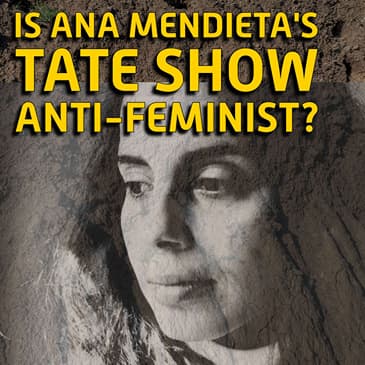

Biography enlightens the work of an artist but, in rare occasions, it can obliterate it. A polemic curatorial choice in Ana Mendieta's exhibition at Tate Modern illustrates this puzzling question. This unexpected curatorial twist may lean into anti-feminism if we stay on the surface of the discourse. Dive into it with our host Joana P. R. Neves, a curator and an art writer. What decision did Valentina Umansky and Michael Wellen, the curators of the show make, and what third person, instrumental in delivering the work, helped them?
To tell or not to tell?
Did you enjoy the episode? Think about supporting Exhibitionistas by leaving a small donation: https://buymeacoffee.com/exhibitionista
Have you ever wondered what it's like to curate a big, blockbuster exhibition? If you have, this episode is for you. It unveils certain ethics of curatorial work, an extremely important aspects of the job, especially when the artist is no longer alive.
Sign up for a tiered monthly support: https://www.buzzsprout.com/2624749/monetization/supporter_settings Your contribution keeps us going.
Jingle: "Wunder", experimental poem by Joana P. R. Neves.
Did the episode stir Art Wonderment memories? Share them via text or voice message.
Created & Hosted by Dr. Joana P. R. Neves, art curator and writer with over 20 years of experience in the contemporary art field. Artistic director of Drawing Now Paris since 2018, she has worked across the industry, from the art market to education. She co-launched the art residency and project space Worlding in 2020. Exhibitionistas’ first year offered exhibition discussions with guest co-host Emily Harding; organically, it grew into a more experimental show exploring art topics, stories and interviews complemented by Joana’s publication Art Thinkosaurus on Substack. She champions ‘Art Wonderment’s’ embrace of complexity against the lure of ready-made opinions. A polyglot, she grew up in Lisbon, studied and lived in Paris, to finally settle in London with her artist husband, four children and two cats.
READ JOANA'S TEXTS:
Joana on Substack: https://joanaprneves.substack.com
Where you find the Exhibitionistas Files, our Newsletter: ...
There is a very specific and potentially poemic choice that was made in the current exhibition of Anna Mendieta's work at Tate Modern. So, what was this curatorial twist that had New York Times' Emily Labarge accusing the exhibition of being somewhat formalist and not really paying attention to essential elements of Anna Mendietta's biography? Well, it was to omit quite an extraordinary thing, not mentioning the terrible circumstances of her death. For those who don't know, there is reason to believe that Anna Mendietta may have been murdered by her then husband, the very, very revered minimal sculptor Carl Andre. The arguments against this decision are indeed convincing because it is or it seems to be an erasure of domestic violence. I mean, in the UK, more or less a woman a week dies from or as a victim of domestic violence. But you can also argue that there's the question of the invisibility or the erasure of the issues that were important for Anna Mendieta, namely female rights, the female condition, etc. So I understand why this decision may appear anti-feminist. But what if I told you that I believe this to be the most feminist decision that you could possibly make in regards to this particular circumstance, to this particular artist, Anna Mendietta? Stick around, stay with me, and I will guide you through my reasoning after the break. Are you an exhibitionista? Being an exhibitionista is not only looking at art, it's actually practicing art wonderment, which is the association between ancient knowledge and wisdom with new technologies. Being an exhibitionista means that you navigate life with the knowledge and the wisdom of many artists, but also many authors and many of the mediators that help you navigate the waters of creativity and life. So, all of you exhibitionists out there, we want to hear from you, but we also need your support. So please go to the episode's descriptions. There's a lot of links where you can donate your support, especially if it's a very small amount, means a lot because it means that you practice art wonderment. Also in economy, because economy is part of contemporary art, it's part of creativity. You're not going to ruin yourself by supporting exhibitionists, but maybe you can take some time of your day to make a small gesture. Go, go, click, click, click, click, click, click. Negotiate your relationship to the things that you love and the things that you listen to. Thanks for being here. And now let's move on with the episode. If you're new here, I am Joanna Pionevus, creator and host of Exhibition, Mr. Notes on Contemporary Arts and Life. So welcome to your Art Wonderment podcast, which is precisely this what we're doing here combining a real life experience of art of aesthetic wonderment, and then articulating it in the digital space. Amendietta had gotten married to Carl Andrei eight months prior to her death. And the Mendietta was a very energetic, powerful, ambitious young woman. She was 35 years old, 36 when they got married. And Carl Andrei was already an established artist. He was a curmudgeon. He was 49 years old and they drank quite a bit together. They had lots of fights, but so far so innocuous until she fell to her death from the 34th floor of a New York building, which was in fact Carl Andrei's flat. Carl Andrei was suspected of her murder. He was trialed and he was acquitted. And the fact that he was considered innocent had a huge influence not only on Anna Mendieta's reputation as hysterical, angry, Latina, you know, all the cliches, but also on the invisibility of her work, especially at a time when female artists weren't really included in exhibitions and didn't really have the range of success. Even when they were starting to show their work as Anna Mendieta was, they never had the power that their male peers had. And proof is that in my 20-year career, the works that I have seen continuously the most in group exhibitions, even in solo exhibitions, have been the works by Eva Hesse and Anne Dalboven. So these two artists also died prematurely, which seems to be a sort of a criteria to suddenly acquire some sort of reputation and to finally be included in the pantheon of recognized artists. But Anna Wilkie, for example, she was 53 years old when she passed away. Well, because she talked about the female objectification, she was often nude in her work, as Mendieta was. So she didn't really have the same recognition as someone like Eva Hesse, who was a sort of a minimal sculptor artist, or Anna Dartboven, who was a German conceptual artist. So there is a difficulty for a certain kind of female work to have existed and still to this day, even much more less so, to exist and to be recognized and respected. But there was also this difficulty for women in general, especially also in terms of market representation. And so when you see the choice of very consciously and with determination not to mention the erasure of a female artist, you can start being a bit alarmed. So after Anna Mendieta died, Carl Andrei was on trial for her murder, and his friend Frank Stella paid for a very, very good, very powerful, very expensive lawyer to defend him. There was a gathering around Carl Andre to protect him and to protect his reputation. He was acquitted. The immediate consequence was that her work was tarnished. But it was tarnished because of the way that the defense articulated an analysis of Anna Mendieta's work as constantly depicting suicidal ideation and a sort of a childish relationship to life and to art. And therefore, Anna Mendieta's work was maligned and was diminished. And so she was not taken seriously as an artist. And the body of work that she dedicated most of her adult life to was diminished and rendered a sort of a diary, a sort of a footnote. And very quickly, Racqueline, so Anna Mendieta's sister, and other people, Anna Mendieta's friends, curators who admired her work, and then people who knew of this situation and who ended up knowing about the doubts that were immediately cast on the decision of this trial, they all started organizing themselves and trying to elaborate ways that would render the invisibilization of her work impossible. So for those who don't know Anna Mendieta's beginnings, her life story is quite peculiar. So what happened was that in Castro's regime, a few rumors started about the fact that Fidel Castro was thinking of taking away parenting rights. And so that meant that parents had no say in their children's education or anything else really. They didn't know what that was going to amount to. They became terrified. And so there was an operation called Peter Pan Operation, led by the CIA on the American side and by the Catholic Church on the Cuban side, in order to take as many children as they could take to American soil, so to safety, away from the regime and so away from their families and from Cuba. 14,000 children ended up in American soil, in orphanages, and then eventually living with American families, going to American school, and Anna Mendieta ended up going to university, to art school in the United States, and she became a Cuban and American citizen. Her mom joined her later. They were an affluent family. She had a very good life and a very good Catholic education. She lived very comfortably until, of course, she was separated from her family, sent into the United States, where her mom would, as I said, join her a few years later. Her father, he was imprisoned for a long time, but eventually he ended up joining them. So she was torn away from her family in her early childhood and in her teenage years. And then she ended up going to university, studying to become an artist. She was a very committed and very serious artist with a very specific status in the US. So she was other, obviously, as soon as she arrived. It was quite difficult times for her, and it wasn't always easy, and they weren't always treated with kindness in orphanages and in the families that they lived in. So for Racqueline, it was important then to rally against the invisibilization of her sister's work. And so they very rapidly organized. And whenever Carl Andrei had a solo exhibition, for example, or her work, his work was shown somewhere, they would demonstrate outside of the premises, they would leave pamphlets behind. So there was an effort, because this, mind you, has gone on since the 80s. So there was a fight, a continuous fight, and a huge effort in bringing to people's minds the memory of Anna Mendieta, but above all, the memory of Anna Mendieta's body of work. Because the danger, obviously, was that Anna Mendieta, the hysterical woman, the crazy young, beautiful Latina, would have been just a footnote in Carl Andres' history. So they did everything they could and they managed. In 2026, here we are, there is a solo exhibition at Tate Modern that is curated by very respected curators, and Tate is a very respected and powerful institution. This exhibition, this traveling exhibition, crowns the efforts of this family. But now we're in 2026, and now it's no longer Rakelin who is leading these fights and this movement and preserving Anna Mendieta's body of work and having it restored. So the videos, the films were restored. The work is now represented by famous and powerful galleries. So she is now in a good position, or at least her legacy is now protected. And now it is no longer Rakelin, it is Raquel Mendieta, Raquel Cecilia Mendieta, the niece of Anna Mendieta, who is at the helm of the Anna Mendieta estate. She is the person who is responsible for the artwork and the legacy of her aunt. Raquel is one of the people who decided not to talk about the death of her aunt in the exhibition. So the exhibition was curated by Valentina Umansky, who is international art curator at Tate Modern, and by Michael Wellen, who is a former senior international art curator at Tate as well. They worked in conjunction with Raquel Mendieta, and they all decided to organize the exhibition in a way that is, and as a curator, that's something that I'm very passionate about and that interests me utterly, which is how to condition the work and how to organize the work in the space. So as the spectator can have a very quick access to what makes the work what it is, to the core of the work, as opposed to just a superficial observation of it. That's a really important thing. And so they organize the exhibition, not in chronological terms, but in little areas that bear different names. And so to give you an example, you go into the exhibition and suddenly you're in a darker space, so it's not a huge room, is called the cave. So it starts in the cave with works that are later works, the works produced in the later stages of her life. And they are very specifically concerned with rapestrian art, with prehistoric art, with cave and rock art. And so you enter the exhibition space and you are gifted already a very specific perspective of Anna Mendieta's research. So another thing that you discover in the exhibition is that Anna Mendieta was very mobile. She went to places, to locations that she chose very carefully because when she would produce her series that was ongoing throughout her life from starting from 1973 called Silhouettas, which were these anthropomorphic shapes dug into the earth, into the rock, into different materials, but always, almost always, in the landscape, she was doing a very oriented and very thorough research in deities, in spirituality, when finally a space is given to Anna Mendieta, the priority is to provide a discovery of the work that goes straight to the artist's preoccupations. And as you walk through the exhibition, it doesn't mean that the topics and the issues that were so important for Anna Mendieta at certain moments in her life, such as being torn away from her country, such as the violence against women, such as the political violence that is endured by and was endured by people who were of color, by people who were marginalized. All of those issues come about in the exhibition within the spaces that were created and the very specific angles that are given into those spaces and those artworks, the identity is marked in the exhibition. And it is marked in a very specific way, which is through her own voice. So at different moments in the exhibition, you have vitrines with texts that Anna Mendieta wrote herself. There aren't many. The scarcity of information about her life is quite important because the elements that she dropped, the little nuggets of information that she dropped that addressed in direct and very frontal terms the notions of nationality, of racial profiling, of homeland, of the female body, they're all in there, but they are given a little bit like the thematic approaches are in the exhibition. They're there, they are offered as an entry point into the work within a greater, a bigger, a wider spiritual search. I describe and I talk about all those elements in her work in the episode that we dedicated to her a few weeks back. And she says very specifically the story of being torn away from her homeland and the effect that it had on her and on her work. And then later on, she addresses political matters and she talks about being othered and how she connects and she relates within the feminist movement to that othering that is reinforced by her status as an immigrant and as a woman of color. And then later on, you will also have domestic violence that is a feature of a certain aspect of her work in the beginning, and you can correlate it with elements that become far more abstract later in some videos and some um actions in the landscape. And so all of it is present in the exhibition. All of those aspects that are important for people who are critical of the absence of the circumstances of Anna Mendieta's death and the doubts that are cast on the acquittal of Carl Andrei, the topics are all there. So my first feeling was that if the topics are there, is it then necessary to bring in the circumstances of Anna Mendieta's death? That's my first question. Simply because during the fight, Mendietta's death had to accompany the fight for the visibility of her work and the respect of her reputation. But once an exhibition space is given to the work and finally a survey is organized with the whole body of work for people to finally encounter Anna Mendietta, time to put the circumstances of the death in their right place because they are not part of the work. The issues that were dear to her, that are found ironically in in a sort of a really fateful turn of events, are at play in the way that she died. But the issues that are present in the exhibition until the moment where she was taking the lift to go to Carl Andre's apartment are all elements that even if they weren't her choice, such as being torn away from Havana and going to the US without her parents, those events in her life, even if she didn't have complete control over them, she had the agency to think about them and to make decisions in regards to them. So the exhibition presents her agency and it stops right at the moment where she stopped having agency. Because if she was allegedly killed, that's the moment where her agency was taken away from her. She cannot think about the circumstances of her death, and that's the tragedy of it. And so the exhibition presents many aspects of her path into her own language, up until the point where she was in Rome in 1988 when she died. So because she was going to New York to go back to Rome, she was just picking up a few things and then going. Back to a newfound place to work in Rome. She was bringing materials to the studio and she was starting to make sculptures. And the sculptures are also in the exhibition space. So until the very last moment in her work as an artist, she is represented in the exhibition. And I felt personally that she was finally taken seriously. Because most of the works that I've seen of hers are in context of ecofeminism. And the way in which she is believed to have been murdered is invested in that introduction of her work in eco-feminism, which is something that she's never mentioned in her life. So it is a liberty that curators and other artists take, which is fine. It is a reading of the work, but it's not her agency. It's someone reading her work and presenting her as a sort of a proto-eco-feminist. But the reality is that in ecofeminism, there's this association between earth, between mother earth and the female body as being disrespected, attacked, used. And besides those circumstances where I've seen her work in my 20-year experience as a curator, the variety of her body of work has seldom been presented. Even in books, in publications, it's very rare to come across Anna Mendieta's drawings on leaves, for example, that I discovered for the first time in her exhibition at the Tate, her current exhibition. And in visiting this exhibition, I had the feeling of finally meeting her, finally knowing her, regardless of the impulse that one man had of hurting her allegedly. The biographic aspect of Anna Mendieta's work is to be treated elsewhere. And the reality is that with four decades of fights, what has happened is that there is a lot of articles, essays written about the death of Anna Mendietta. There is a podcast called The Death of an Artist by Helen Molesworth that is extremely well investigated and very, very beautifully argued for and measured, all things considered. Mendietta was first and foremost an artist. And sometimes, and that's the irony of violence and the horror and the stupidity of violence, is that it can not only kill, it kills a woman a week approximately in the UK, but it can also kill the artist and whoever the person was, if we yield totally to the fate and the very quick moment that ended their lives and disempowered them. And that's the biggest tragedy, probably, which is to have people who are have good intentions, that you know, to have people like me, you know, if I hadn't read about the reasons why the death wasn't mentioned, maybe I would have been also surprised and frustrated and even angered. But it is so important to really go into the intricacies of a context and dismiss the basing tendencies of society nowadays, which is to solve matters within the space of discourse. The space that you and I are sharing here now is the space of discourse. And discourse has to be structured by research, by listening to others, by due diligence, basically. And I think this is such an interesting case whereby a very extreme decision seems to have been made, but it is alerting to the fact that the more we narrow down identity and the more we believe that stating identity is enough to understanding it, the more we continue to perpetuate the tragedies and the violences and the annihilations of what really empowers us. There's a precipitation sometimes when we go forward with our principles, instead of being structured by them and be strong enough to be in the enemy's territory or what we presume to be the enemy and really examine the case that is being made. This little bonus episode was a promise, and a promise is a commitment. I hope you enjoy it. Let me know what you think. Do you agree? Do you disagree with this little curatorial twist? Tell me all about it and report back. Until then, take care. See you very, very soon. Or we'll be in your presence very, very soon. Bye bye.