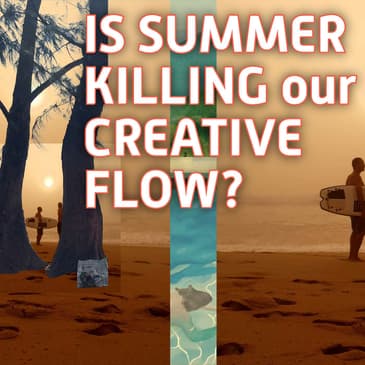
How and why do art and Summer join forces? Art, and visual arts especially, show imminent change–but so does Summer and its ideal of creative flow. How did–or did not–art speak of the climate emergency, gender policing, the war–in short, of loss? What role does this hot and luscious season play in the hubris of conquest, or the black hole of grief? Art curator and writer Joana P. R. Neves, our host, reminisces about Agnes Martin and John Cheever, and their opposing ideas of Summer and of creation, touching on two paintings by David Hockney and a poignant text by Luigi Pirandello. Joana loved a text sent to her by its author, Vittorio Zappa, on Substack, that guided the last part of the episode, leading to its denouement.
Is Summer the season of creative flow of life and art making, full of light and sensorial stimuli? Is creativity about desire or meditative art? Or are all these myths, perpetuated by capitalist simplifications? Has art contributed to create them? Or has it always been alerting us to the cruelty of change via Art Wonderment, the art of paradox?
Did you enjoy the episode? Think about supporting Exhibitionistas by leaving a small donation: https://buymeacoffee.com/exhibitionista
The painting A Bigger Splash, 1967, by David Hockney, is the epitome of hubristic summer. But it hides another painting, Portrait of an Artist (Pool with two figures), 1972, with a far more poignant story: they both tell the extremes of summer, and investigate the very special artifice telling a story of desire, change, loss and healing?
Sign up for a tiered monthly support: https://www.buzzsprout.com/2624749/monetization/supporter_settings Your contribution keeps us going.
Joana P. R. Neves reads a text by Vittorio Zappa: https://substack.com/@vittoriozappa/p-209760240
Other references include:
The Swimmer, John Cheever, 1964, New Yorker.
The Swimmer, a film by Frank Perry, 1968.
Did the episode stir Art Wonderment memories? Share them via text or voice message.
Created & Hosted by Dr. Joana P. R. Neves, art curator and writer with over 20 years of experience in the contemporary art field. Artistic director of Drawing Now Paris since 2018, she has worked across the industry, from the art market to education. She co-launched the art residency and project space Worlding in 2020. Exhibitionistas’ first year offered exhibition discussions with guest co-host Emily Harding; organically, it grew into a more experimental show exploring art topics, stories and interviews complemented by Joana’s publication Art Thinkosaurus on Substack. She champions ‘Art Wonderment’s’ embrace of complexity against the lure of ready-made opinions. A polyglot, she grew up in Lisbon, studied and lived in Paris, to finally settle in London with her artist husband, four children and two cats.
READ JOANA'S TEXTS:
Joana on Substack: https://joanaprneves.substack.com
Where you find the Exhibitionistas Files, our Newsletter: ...
Greetings, dear exhibitionistas. You have arrived at Exhibitionistas Notes on Contemporary Art and Life. I'm your host, Joanna Piernevas, and this is your Art Wonderment Podcast. This is a special space and a special episode as well. It is one of those narrative, shorter episodes where I sort of create or weave an art story. I am going to devote it to summer. I think that when things are changing, when there's something in the air that is directing us elsewhere, it is really in summer that you feel the change in a much more intense way. Quite a few things are affecting deeply our sense of time, our sense of commitment, the way we work, the way we exist, and the choices that we're making. And summer is one of those moments where that is felt in the utmost intense capacity. I am feeling it anyway. Is summer a trick of our imagination? And is summer also inherently creative? Because summer for me has always been about this continuous flow. There is really no transition to be made in summer if you're outside, if you want to go inside, or vice versa. There is something very fluid, there is a flow. And therefore, summer is often associated with a sort of hubristic form of creativity. You and I know, we all know, that things are changing, that change is in the air. Whether it is good or it is bad, something is very different. How do we feel ourselves changing? This is really truly the underlying question of this episode. When things are changing, when the times are shifting, what is left of who we were? What happens to the person we're becoming? And do we have any say in this? Is there a type of creative flow engineered by the Summer? And is that an illusion? And how does art support or perhaps even create or challenge that situation? Is art responsible for our idea of summer? Have we been manipulated by it? And now it's just a question of picking the question and running with it. So enjoy this new episode. I blame this question on the river Lucinda. It features in The Swimmer, a short story so incisively written that I kept reading it over and over. It's one of those pieces of literature that follows you in life like a painting's eyes across the room constantly gaze at you. It was written by the same author who inspired the TV series Mad Men, John Cheever, and published in The New Yorker in 1964. The River Lucinda is a stream of swimming pools leading to the house of the protagonist, Ned Merrill, who decides to swim back home. Like a modern Odysseus, this aging suburban man goes from villa to villa across the valley, swimming from pool to pool. This will eventually throw him into another time frame, but I won't say much more about its denouement for those who haven't read it. All you need to know here is that in the beginning, Ned Merrill is described as summer itself. Quote He might have been compared to a summer's day, particularly the last hours of one, and while he lacked a tennis racket or a sailbag, the impression was definitely one of youth, sport, and clement weather. He had been swimming, and now he was breathing deeply, sturterously, as if he could gulp into his lungs the components of that moment, the heat of the sun, the intensess of his pleasure. It all seemed to flow into his chest. His own house stood in Bullet Park, eight miles to the south, where his four beautiful daughters would have had their lunch and might be playing tennis. Then it occurred to him that, by taking a dog leg to the southwest, he could reach his home by water. It's circuitous to think that the American painter Agnes Martin, in the same year of 1964, produced the water colour summer, a square drawing of a black, thin grid, mid with ink and a ruler, over a square of sea blue, irregular at the edges. The grid by virtue of its interconnecting lines formed small rectangles, like adjacent swimming pools, where she placed, in the centre, a white dot. It is an abstract language, not supposed to represent anything, which is why the subconscious is immediately stimulated, but also involved in an atmospheric summer haze. It's a mere twenty three centimeter square sheet of paper, but as it often happens with Martin's work, it engulfs me totally. Martin's life was very different from Ned Merrill's. In 1967, she left New York, when her great friend, the painter Ad Reinhardt died, which was presented as the major cause for what can only be described as her disappearance for a few years. She resurfaced in New Mexico where she'd already lived before, but her almost three-year voyage will always be unaccounted for, it seems, and has created a myth around her. Well, I see no big mystery there. I can imagine how a gay woman alone, she had just parted with her girlfriend at the time, who lost a good friend and her home, and who suffered from schizophrenia, could potentially feel that the pressures of making a living from her art would overtake her creative flow. I have tried existing and I do not like it, she wrote. So she left in a far less romantic way than the myth that persistently disembodies and desocializes her want us to believe. She explained the matter in her typical guarded way as having started to suffer from, quote unquote, an overdeveloped sense of responsibility. But then my own myth of creative flow takes over. To me, she seems to have built a space of total creativity by having halted her production for almost a decade, built with her bare hands a home and studio with Adobe Bricks, writing and meditating. She had encountered Buddhism at an early stage in her life. In reality, the gallerist Betty Parsons had plucked her from Taos in New Mexico in 1957 to represent her, under the condition that Martin moved to New York, which was at a time a deeply competitive place burgeoning with artists seeking to build a professional career. Back in New Mexico, she seems to have created a place of continuous flow in eternal summer. She seems to have created a space for what Virginia Wolfe longed for in her essay The Mark on the Wall, an uninterrupted line of thought. At least that's what my heart tells me when I think of her, when I see her work blindingly white often, with a soft pink or blue layer over it. Meb Merrill, on the contrary, was trapped in the idea of summer. He was devoted to existing, as Martin would perhaps put it. His life orbited around houses with swimming pools, buffets and gin tonics, work in the city during the week. This trap was eerily rendered in Celluloid in the film version of Chiva's short story, also called The Swimmer, written by Eleanor Perry and filmed by her husband Frank. Someone on Reddit wrote about it, quote, something about that summertime feeling it brings out, indescribable, unquote. The music alone, composed by a 24-year-old Marvin Hamlish, is an exercise in 60s nostalgia, was used for the exhibitionist's previous jingle by my son Arthur, credited as Saturn. Mem Merrill is played by Bert Lancaster, who was then a well-preserved 55-year-old with a waterphobia, which he had to get rid of before the shooting, and who wore a speedo from minute zero until the end credits. Lancaster was a disruptive element for the film, trying to change each line. Frank Perry didn't think he was right for it, and Lancaster didn't think Perry was either. In his view, someone like Fellini or Truffaut should have taken it on and made it apparent since the beginning that what happens to Ned is imagined and not real. However, Lancaster said, quote, it was played in a realistic sense, so when you come to the end of that film, instead of being sympathetic and heartbroken for the man, you were surprised and shocked, unquote. Forget that Perry's wife had written the script, and that in the story itself, you follow Ned with excitement, you are in on the joke, and you're a total believer in this strange but logical swim. Lancaster wanted summer as a dream, a projected anxiety of the impending end of the creative flow. Because summer is creative for all. Whether you're working or on holiday, its exceptional heat and light from a northern hemisphere perspective, away from the equator, turns reality into fiction, suspended.
SPEAKER_00I'm a very special human being. I'm a very special, I'm a very special human being.
SPEAKER_02Between 1964 and 1968, a cultural shift occurred. The square, as the expression went, highly consumerist and traditional postwar culture of the 50s clashed against the Eastern philosophies that started to permeate the younger generations, as it had Agnes Martin and other artists. The Beatnik, drug adult innovative literature, the liberation from gender and family structures promoted by a counterculture that was nevertheless televised, broadcast, and therefore yearned for by the younger population. Perhaps, come to think of it, the real continuum of creativity is the strange socioeconomic hold that certain periods have on culture, such as the one we're traversing now, where there is no escaping the challenges or freedoms, depending on how we see them, of female bodies, ecosystems in turmoil, global tech takeover, and the military influence all over. Perhaps Agnes Martin's summer, a drawing still produced in New York, subconsciously uses the grid as a minimal reference to the city structure, not unlike her friend Ellsworth Kelly used to do. Between nineteen sixty four and nineteen sixty eight, Agnes Martin left New York. The children of suburban families ran away from home to join the hippie communities. Joan Didian wrote slouching towards Bethlehem, the center no longer held. I discovered the Perry's film about ten years later than the short story, in the first decade of the century. We were by then living in Paris with two children who would equate summer with Portugal, a place where they were born but never remembered having lived in. We watched it with them, thinking they'd find the images beautiful and the prowess funny. I didn't know what to expect. As Lancaster says, the end languishes abruptly, and Arthur to my surprise, cried. I was astonished when he used a soundtrack for one of his musical projects and asked him if he could adapt it later for the podcast. Summer then for me was a continuous flow between inside and outside, because even if you keep the house dark and still, holding the pressure of the heat and the light away, stepping out doesn't require a change of clothes. No protection or preparation is required. In summer there are no transitions. I find transitions hard. The definition of maturity and coolness are for me the same thing. All aspects of life become seamless. Wisdom is knowing how to navigate the waters of life. Wisdom is the ocean, accepting the waves that come and acting accordingly, diving, swimming over them, grabbing onto the sand at the bottom when they're too powerful, letting them wash over you. In advance of the broken arm is Marcel Duchamp's whispering in my ear that I'm a fool. This piece is a snow shovel hanging from the ceiling and is part of his early ready-mates, but despite having been produced in 1915, Duchamp created a fourth version of it in 1964. He signed it, Marcel Duchamp, 1964. It speaks to me about the vicissitudes of transition because, as always, the words and the objects are associated in a continuum that disrupts their categories. The object becomes conceptual and the concept lives in the real world. The snow shovel is a gesture, and Duchamp was interested in gestures in motion, in dynamic relationships. The gesture of the snow shovel speaks of the necessary transition from the inside to the outside, of the caution associated with extreme cold weather. The arm makes a gesture to remove the snow that might break it if the gesture is not accomplished. But there is another aspect of the title, which is the impossible English grammar. While referring to the transitional state of the inside and the outside, the danger and the removal of the danger, Duchamp is in the studio, looking at an object as a precipitate of urban management, active life, weather, and vocabulary. But he is also thinking in English like a Frenchman, for whom the first language is not a mother tongue, and he seamlessly lets the French language echo in the title Ambra Cassie, French for broken arm, is a lame duck, an incapable worker. Duchamp was deeply immersed in modernity as a phenomenon affecting the way we live, the way we create, the way we see the world. He famously contemplated the propeller with his friend Constantin Brancuzi in the aerial locomotion salon in nineteen twelve and said to his friend, painting is finished. Who can do better than this propeller? Tell me, can you do that? Interestingly, he became the importer of Brancuzi's work in the US because Brancuzi could do something not better, but equally stunning and modern. Nevertheless, Duchamp invented a year later the notion of ready made, another English language slight of hand expressing the industrial reality of an indirect relation to making. Even a tube of paint is a ready made, he argued, and therefore painters do not have a say in the colours they use. Industry picks them for them. There is no stronger continuity than that of the mind. Is the summer ready made? Is it squeezed out of a tube for consumption? Ellsworth Kelly, according to the exhibition currently on show at the Foundation Matt, titled Ellsworth Kelly at the Edge of Water, quote, was drawn to aquatic environments from Berlill and the Coute d'Azur to New York and the Caribbean, where experiences of looking at water gave rise to drawings, collages, paintings and sculptures. Rather than depicting landscapes, Kelly translated the perception of water itself, its shifting colour, light and surface. In his postcards that he did not exhibit, and rather Sanchez's friends, he used ready made magazine cuttings, a lot of them with shimmering seas layered with naked tan bodies all found in magazines. He took all his abstract and uniformly coloured shapes from the city, the windows of the Muse d'Armoderne in Paris being a famous original iteration of this. So he dismissed Duchamp's anxiety about painting, and rather embraced its derivative nature by distilling them. What I've tried to capture is the reality of flux, to keep art an open, incomplete situation, to get at the rapture of seeing, unquote. Perhaps that's one of the characteristics of the summer's enchantment, the delight of the senses, seeing perhaps for painters, of the smells, both dizzyingly perfumed or intensely putrid. But when I think of summer, it's David Hockney that comes to mind. He moved from London to Los Angeles in nineteen sixty four, and from there on became fascinated by swimming pools, a luxury in the UK, a normal fixture in LA. In nineteen sixty seven he painted a bigger splash, perhaps his most famous painting to date. It's a view of someone standing at the edge of a swimming pool, watching someone who has just dived into it, with a house in the background. You don't see the body, just the water splash, the hubristic dip left in the air for a split second, captured by the painter, as he said, quote, in a very, very slow way. But the splash I also see as ejaculate, and the perspective is that of those who didn't swim. Someone is on the outside looking, a person lasting over everything, because the orgasmic pleasure of summer is drenched in all the hypersensations of heat, the slight burn on the skin, the pine trees, the rotting fish in the marina. Summer is socio political. I holidayed every summer in resorts where there were swimming pools that I didn't really like, preferring the ocean, but in which I practiced swimming underwater and many of the prowesses I took to the sea. The painting is the image of my childhood. The house in the background can emulate, if you squint, any summer experience in hot weather. Because the title, a bigger splash, is so great. I can never remember the title of the painting I prefer by David Hogney, far more traditional, even boring compared to the latter. It's called Portrait of an Artist, Paul with Two Figures, and it's from nineteen seventy two. This is the painting I've been thinking about since the beginning, ever since I started scripting this episode. The perspective is cinematic, someone is watching or remembering a scene from the wider side of the pool, whose left side further corner is framed by the image. The person you can't see in a bigger splash, perhaps, is swimming underwater, toward the edge of the pool. That person I often think has been underwater for five years. There, outside, and dressed in autumn clothes is a man, conspicuously looking, it seems, but the more I look at the image, the more it seems that he has his eyes closed, as if he didn't want to see the spectacle of summer. But this is where the episode cracks Lady Serendipity make an appearance. She materialized late one night, or perhaps it was early morning, it's summer, after all, and the continuum of time blurs everything, especially in the UK, where the sunlight takes up about twenty hours of the day. I open my Substack app and see a message from a writer I follow, Vittorio Zappa, sharing his latest text. The image jumps at me as if emerging from my subconscious. It was portrait of an artist, pool with two figures. The painting that hides the other painting, a bigger splash. That says a lot about my feelings regarding the summer lately, and how the summer is an artifice, a device, a trick even, perhaps a ready-made ideal of capitalist surface level ideas, about how, as far as legends go, it is a sort of collective conceptual work of art that I've been trying to deconstruct by thinking that holidaying is a recent thing, that summer was a season where lots of things had to be done, like jams and harvests, but also a bit of love and poetry. This painting told me more about my childhood summer from an intergenerational perspective. While I swam in the pool, conquering feats, swimming underwater from one side to the other, had stands, sitting at the at the bottom of the pool, somersaults, my father arrived dressed in city clothes. We were staying in a southern coastal town because he had work over there. I remember wondering how it felt to work during the summer, to not dip into the pool, or rather to not want it, because he could have. How was life on the other side of summer? The story of this painting is an answer to this, but I was having trouble organizing my thoughts, which were crystallizing around my own enamorment with my work, and with the progressive indifference toward what summer had meant for decades before water, swimming, flux, living artfully, as opposed to creating syncopatedly. Zappa's text elaborates on the accident that led to this eerie painting, where two seasons merge in such a perfect way that we, the onlookers, are the ones who question the notion of an artifice. Zappa writes two photographs had tumbled together on his studio floor, one of a figure swimming underwater, the other of a boy gazing downward. In their accidental pairing he glimpsed something he had not yet managed to say aloud. He had tried once before in the autumn of nineteen seventy one, the very year Peter Schlesinger left him after five years together, but when the composition refused to yield, he destroyed the canvas. The following April, with the New York exhibition looming, he flew to a borrowed pool near Saint Trope. He photographed a friend swimming underwater, then returned to London and took a photo of Schleshing in Kensington Gardens, pink jacket, eyes on the grass. One of these borrowed fragments in a fortnight of eighteen hour days, he assembled a scene that never existed. The swimmer was a stand in, the garden pretended to be Franz, and the man at the pool's edge was already gone whereas for me the invisible swimmer of a bigger splash appears, for Zappa he is dissolving. He writes Notice what he did with the arrangement to the one who left him he gave everything the painting could bestow dry land, upright stature, a profile cut clean as glass, and most of all the only eyes in the picture. He kept himself out of the frame, though the frame is nothing but him. He named it portrait of an artist, and the title suggests where the artist has gone, not at the edge where love stands, crisp and intact, but in the water, where the one who was loved is quietly dissolving. Then, unexpectedly, Zappa introduces another form of loss seen through the eyes of the Italian writer Luigi Pirandello back in nineteen fifteen. That's what I was experiencing too, a sense of loss, loss of the ideal of creation, of the ideal of continuous flow, but also of acceptance of the quantum existence we lead, a life of love and friendship, of everyday rituals, of obligations and their opposite perks. Zappa writes There is a page in Italian literature that explains this geometry of loss and love. In nineteen fifteen, in the first year of the war, Luigi Pirandello lost his mother, and instead of writing an elegy, he wrote a conversation, the second of his colloquique personaggi, in which her shadow returns to him and he tells her what her death has actually changed. Not her presence to say viva, viva commerci, he tells her, alive exactly as you were, alive with the same reality I gave you for years from far away and alive for as long as I live. Her image in him has survived her completely. His grief has left it untouched, vivid, in focus. What has died is something else, and he finds it with terrible precision Io non sono puerte mai pu I am no longer alive, and I will never again be alive for you. She keeps existing in his eyes, he has stopped existing in hers, and then the sentence that opens like a trapdoor under every mourner Quiliques no vivicredono anke di piangeri loro morti i piangono in vece una loro morte those who believe themselves alive believe they are weeping for their dead and are weeping instead for a death of their own. Something that has been in the back of my mind is that the loss of Sama is a precipitate of a bigger loss, of freedom of seasons as we knew them, of the call as we knew it, of the exercise of democracy as we knew it, of even the idea that the past we're losing was safer than what we're facing now. But I'm also mourning the loss of the present time, of those who are refusing to establish a dialogue with their ancestors, like Pirandello did with his mother, the loss of the opportunity for change by those I see frantically vacationing, building their swimming pools, grasping with anxiety their books who no one, they exclaim, reads anymore, the loss of innocence that isn't happening. Zappa calls the wisdom of the artifice of trying over and over again to mourn through a painting something that is irredeemably lost, the quote geometry of the pool. He writes This is the geometry of the pool. The man in the pink jacket stands clear and whole because that is what love does with its object. Five years from the beginning and the year past the end, Hochney could still keep Schlesinger upright, dry, every hair in place, just as Pirandello held his mother. Nothing of the beloved is lost when the beloved leaves. The image lingers, pitiless in its clarity. What dissolves is the other thing, the self that lived in the beloved's keeping, the version of you that existed only in eyes that have now closed. That is the figure in the water, the artist as he survived in Schlesinger's withdrawn gaze, a body losing its outline in the element that once bore it, a face that cannot be found because no one is searching for it anymore. When we mourn a love it is not the person who remains that we mourn. We mourn ourselves, the one they carried, the one who drowned when they turned away Pirandelo, Zapa reminds us, remains attached to the world that the person who passed held and created for him. Perhaps the condition to hold change is accepting that change is precisely the world we must build ourselves, that Agnes Martin's way of life came from hardship, even though it became lovely and perfect for her, and that we must endure our own hardship, our own void. Still, what Pirandello writes is the perfect encapsulation of summer's past. They were sacred and beautiful in the Colloquio before she fades, Pirandelo's mother leaves her son a single instruction Guardale Cose anke diqueli kenoledonopio look at things also with the eyes of those who no longer see them, and the sorrow of it, she promises, will make them more sacred and more beautiful at the end of her life the Lebanese American poet Edel Adnan painted luminous images, even when they're dark or have heavier colours, deeper hues. She talks about hypersensitivity to light and the sun, be it the summer, winter, morning or evening sun, central to what being here is We owe life to the existence of the sun, therefore light is a very profound part of our makeup. It's spiritual in the way that even DNA is spiritual. What we call spirit is energy it's the definition of life in one sense light as an object, as a phenomenon is magnificent. I am talking to you and the light coming in through the window has already changed. You go on the street and you look at the sky and it tells you what time it is. We are dealing with it constantly and obscurity is also maybe its own light because it shows you things. Obscurity is not lack of light it is a different manifestation of light it has its own illumination unquote I guess that the illusion of summer is a consumerist notion smelling of sunscreen and grilled food. But the artifice of summer may be a good reminder that making, as Etel Adnan says, whatever your craft is, be it a hobby, a strategy at work, or a film or a poem, is a perception of the continuous flow of life, of its inherent artfulness. And the artifice is not a gimmick or a manipulative contraction. It's the movement where we step aside from everything else to make and therefore letting in what we've stepped aside from in a strange position of being both outside and inside. A big thank you to Vittorio Zampa for letting me read his marvelous wonderful text. A big thank you to Arta for having composed a jingle for most of the podcast episodes that are out there. The jingle that we have now was composed by me and I will tell the story of this one one day. Thank you all for listening. Thank you for sticking around I hope you enjoyed this little writing slash voicing some thoughts about summer and about the state of the world today. Don't forget follow exhibitionistas on Instagram exhibitionistas underscore podcast or on our brand new TikTok account Exhibitionistus podcast and as ever follow me on Substack Joanna Piernevis or simply look for Art Thinkosaurus. Have a good one see you in a fortnight take care of