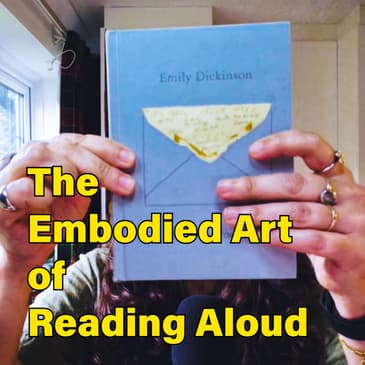
There are pockets of creativity in our everyday life. The embodied art of READING ALOUD is an overlooked source of joy, containing so many aspects that contemporary art and artists explore in their practice... Performance, drawing, text, breathing patterns... It all starts with Joana P. R. Neves, our host, asking what the body can do by itself, or with very little assistance, inspired by the last episode dedicated to artist Ana Mendieta. This is also our way of introducing the upcoming bonus mini-series POEM DELIVERY SERVICE, a poem-per-episode... with a twist.
Mentions of: #anthonymccall #eteladnan #emilydickinson #gerhardrichter #rebeccahorn #jimjarmush and more...
KEEP US GOING:
Support the research for this podcast with a coffee, or a book: https://buymeacoffee.com/exhibitionista
Become a paid member: https://tinyurl.com/5d9kj5m2
Donate: https://donorbox.org/support-exhibiti...
Sound residencies
WORLDING SOUNDINGS RESIDENCY TICKETS: https://tinyurl.com/52yjtu2r
WORLDING SOUNDINGS JAM TICKETS: https://tinyurl.com/yey2sdyrFind out more about WORLDING: https://www.worldingproject.com/
Jingle: "Wunder", experimental poem by Joana P. R. Neves.
Did the episode stir Art Wonderment memories? Share them via text or voice message.
Save the World PodcastIn-depth lectures and interviews on issues affecting the continued survival of human...
Listen on: Apple Podcasts Spotify
Created & Hosted by Dr. Joana P. R. Neves, art curator and writer with over 20 years of experience in the contemporary art field. Artistic director of Drawing Now Paris since 2018, she has worked across the industry, from the art market to education. She co-launched the art residency and project space Worlding in 2020. Exhibitionistas’ first year offered exhibition discussions with guest co-host Emily Harding; organically, it grew into a more experimental show exploring art topics, stories and interviews complemented by Joana’s publication Art Thinkosaurus on Substack. She champions ‘Art Wonderment’s’ embrace of complexity against the lure of ready-made opinions. A polyglot, she grew up in Lisbon, studied and lived in Paris, to finally settle in London with her artist husband, four children and two cats.
READ JOANA'S TEXTS:
Joana on Substack: https://joanaprneves.substack.com
Where you find the Exhibitionistas Files, our Newsletter: ...
Intro: Mixing up genres, Poem Delivery Service, a Workshop
SPEAKER_00Welcome to the Bonus episode, The Embodied Arts of Reading Aloud, which is a way to introduce a new mini series titled Poem Delivery Service. In this episode, I'm going to make a case for the existence of little pockets of creativity in our everyday lives that overlap different artistic languages such as literature, sculpture, performance, poetry. A friend gave me a book one day that completely cracked my idea of what the world of writing is. I'm talking about Emily Dickinson's envelope poems. And when you open the book, on one page you have the photo, real size of an envelope with little scribbles in pencil on it. And on the other page, you have the drawing, the lines that make up the structure of the envelope, and you have the words printed and readable, really, of the poem that was written on them. And I had a colleague who was doing a PhD on Emily Dickinson's poetry when I was doing my own PhD on the line, and she talked about her poetry as being created through substraction. And so here you see that writing is sculpture, because sculpture traditionally has been defined as taking out material to reveal a shape or to shape an idea. But the envelope poems are also a sort of a graphic promenade through and across these borders that make up these envelopes. And if I haven't convinced you, I will only tell you that in this book there's also a facsimile image of the pencil that Emily Dickinson sent to her friends, the Bowls, writing, quote, if it had no pencil, would it try mine? And quote, write. Right with this tool of mine.
The Poem is not Silent or Immaterial
SPEAKER_00Which is many things, including not being held and constrained by artificial separations between artistic languages. Here you won't learn anything. You will grow without even noticing. But will you grow in the right direction? There's no guarantee of that. You come at your own risk to your Art Wonderland podcast. Welcome. I'll start by making a case for the fruitful articulation between one the almost banal act of reading aloud, two creativity, experimental art, performance even, three, the format of the poem, and four the podcasting form. What can I say? I love a challenge. Then I will introduce the twists of this poem and episode mini-series called Poem Delivery Service. And finally, I will also tell you about a workshop that I'm doing that involves words and sounds, and I facilitated in my arts and residency space called Welding in London. For years we've had these proto multiverses, which are books with little short forms that blew us away. I'm talking obviously about the poem. Someone wrote them by hand with their quill, and boom, suddenly they were in everyone's houses, everywhere, in a way. And although I love them, books detached us from the materiality of the technical act of writing. A Finnish artwork, in general, not only the book or the poem or writing in any form, might be the crystallization of a happening into an act of communion or at least of communication. The same goes for words. If we take them as rules and stable definitions, we imagine them as writing a sort of a linear history, especially when we're talking about etymology. But look at the words painting. The Indo-European origin of this word, Peg, so Indo-European, being a sort of an artificial language close to what we think would have been the language of those regions, which are very far apart, it's a wide territory. So it is a sort of a speculative language. It is based in real concrete findings. And therefore, we can say and we know that the word pag, well, painting has become a nasal nasal version of the word, meant to mark by incision. And that takes me to the Greek words graphane, where graphic comes from. So when we talk about something that's very graphic, it's something that is detailed, like a drawing. But graphane in ancient Greek meant to mark as much as drawing and writing. And so graphane, the origin of the word, didn't segregate between drawing and writing, which we now take to be very different art forms. But overlaps sometimes occur, and that's what I'm making a case for today. If I
Poetry leads to Many Art Forms
SPEAKER_00dig deep into the origin of my artistic overlaps, I quickly find a knot between different artistic languages tied up by the action of reading aloud. So my first love was writing and reading. This led to literature of all kinds, from murder mysteries to poetry, still today. But an interest in literature may lead to other art forms, and so it did for me. Maybe also the times, my generation, maybe also my inclination to theory and to speculation. But somehow I ended up being fascinated by the whole realm of experimental poetry, dance, cinema, you name it, which made me aware of something that has stayed with me ever since. Structure. This made me appreciate creatives that stick to the traditional form of their discipline, of their artistic language, but make us feel as if we're experimenting it for the very first time. People like Gerhard Richter, I would say, T.S. Eliot's poetry, or Jim Jarmus's cinema. It also made me aware of those who challenge it, who reinvent it, who even break it, such as Anthony McCall's cinema, for example, without really projecting a narrative image on a screen. Rebecca Horne's performance drawings, for example. That's another really great and really formative artist for me in relation to the potential overlap of disciplines that will almost break them and create something else, but without wanting to state it as a discipline or a genre of any kind. There's a little bit of freedom in there, and also the creation of a territory where we don't know quite how to behave because there are no established rules. Marguerite Duras' film Baxter, Béra, Baxter, that's something that also broke me completely. I also must say that I watched it at 1 a.m. during some holiday in Portugal where I went to rest after a whole year of studying abroad. And I was mesmerized but also fell asleep to it. Another thing that I discovered in my work as a curator is that artists do not compartmentalize. They are true life and art wonderment specialists. Like me, they are stimulated by different art languages and even spaces where they talk to each other. Etel Adnan, for example, was a painter and a poet. Marguerite Duras was a writer who made very textual films. Richard Huttle makes drawings, textiles, sculptures, and is also a poet. It's the critics and the curators who establish borders with their obsession of finding aesthetic rules. It is possible to lay down some parameters. It's even important to do so, think of the aforementioned structure. But it's also important not to lose the subjective side of art and also the possibility and the elasticity that art has always had and will always have. Greeks did not have a particular word for the discipline of sculpture. They separated sculpture into different categories, but there wasn't an overall word to define all of it. But
Reading aloud: an Unassuming Performance
SPEAKER_00anyway, I've been talking for a while, and I also have to be a bit self-reflexive and say that maybe what attracted me to contemporary art is that it might be the most discussive of all art forms, sometimes to its own detriment, because reading and writing was and still is my deepest love, and that's how I engage with the art that I see and the life that I live. So inevitably, podcasting gripped me because it associates these two forms. I don't think that a lot of people are aware of how scripted these episodes are, and I have my text in front of me that I default to when I am losing the thread of my thoughts. So I have some guidelines in front of me, but I also am improvising and I'm talking to you based on those notes, going somewhere else because I'm here somewhat performing. But first, as a listener, podcasting came to me as an art form, as a potentially experimental art form. Podcasting happens in the recorded moment. It is not writing, it is not quite TV, it is certainly not film. For sure, it's a lot of editing and a lot of play with words and sounds weaved into arresting patterns, but it is an experimental art form if we want it to be. And that's what I claim for myself and for exhibitionists, as you probably noticed. So I've laid down the context for you. But what does this have to do, reading aloud, you may
Embodied Technologies
SPEAKER_00ask, with the new mini-series Poem Delivery Service, which I'm yet to introduce. But my tagline on Substack is, and I quote, I go straight to the digression and therein find the thesis, unquote. So stick with me, I'll get there. And it's going to be pleasurable, I promise. I'll start by stating the obvious, which is that poem delivery service associates the podcast format and the poem format. If you look closely, both can be very, very long, they can be short format, they are declaimed, they're embodied, there's a lot of reading out loud. And if you listen to the podcast regularly, you know that I'm fascinated by reading out loud. I think there's some sort of magic in it. And I ran a little investigation on Instagram, a lot of people responded, so I'm surely not alone. But the answers that really stayed with me were those who said, I do not read out loud, but now that you're saying it, I'll give it a go. That's really interesting to me because, as far as I'm concerned, what really gets me, what really draws my attention is when there's something one embodied, two, slightly awkward that forces you to pierce that layer of ego and then get to a place where you're suddenly behaving in a way that you would never, never, ever, ever behave anywhere else. And that thirdly, thirdly, gives you a unique kind of joy. Today it's all about performance and it's all about the perfection of performance, the visible perfection of performance. Because if you look at athletes today, they look strong, they're not surprisingly resilient as football players were back in the 80s, for example. They were skinny and they had big moustaches. Reading out loud is an unassuming performance. It is a generous gesture because you can be reading out loud for other people, you can do it in a community of people. Of course, you're going to think about religion. And it's not a coincidence that certain religions are heavily based on text that is embodied by someone or several people together. On a personal level, it's also a physical activity. There is a stance, there's management of your breathing patterns. You breathe differently, and the air that goes in and out of your body is also building the projection of your voice and the rhythm of your declining. Another thing that fascinates me is what you can do with your body only. I don't know if it's a generational thing, but since I was a child, back when I was discovering reading and writing, I had this other idea of what I can do with my body. What is it that can give me pleasure besides from sex? What can I do that will keep me entertained, that will bring me joy, that will help me meander and explore running, walking, maybe, singing, for example. Well, reading aloud certainly is in that category. You can say, Joanna, to read out loud, you need a book, you need an object, it's not just your body. But until very recently, we all knew long exits of texts by heart. And again, think of religion. We're now living in different times, and that's also what art wonderment is all about. Back in the day, it was all about machines. So a machine is a mysterious object that does something for you, usually a mechanical structure that is automated in some ways. Technology is different, it's an articulation between different devices, different bits and pieces that together make up a reality. That's the world we live in, between virtual and real spaces. The book, if you think about it, was already promising that virtual reality that it could take you to. And you could, and you still can, and most people do, I do it all the time, spend a long time with a book. But you can also go back to it over and over again for a very short form that you end up incorporating. Within this technology, where we live and to which we're connected in different points of its structure, the body, your body, is the marker of every experience that you have. And no one, not even a technology, can extricate you from the fact that whatever you experience, you experience within your own body, either alone or with other people who are going through the same thing. That's my art wonderment ethos. And here we're touching upon digital hygiene. I've dedicated a whole episode to it, and I will continue doing so because with this new structure, with these new behaviors, there's a different management of whatever happens in our minds, in our bodies, and in our engagement with other people in a community. There are virtual communities out there. And to be more precise, my art wonderment ethos is a conscious emphasis on the conscious combination of the experience or the embodied experience with all the further discussions and explorations with books, with podcasts, with films, with documentaries, anything that can prolong your experience or challenge it even through technology, oftentimes, but without forgetting the embodiment of all experiences in real life and technologically alike. Most importantly, the articulation between these new technologies and ancestral scopes of communication through sharing, performing, repeating, perhaps even ritualizing, because aren't we creating our new rituals? Aren't we all of us who engage on a daily basis with a form of knowledge, the keepers of that knowledge? And therefore, aren't we responsible for the communication of our own special type of knowledge? In a society where everything is available, it isn't, but let's pretend that it is. It's impossible to be everything, to know everything. And therefore, that brings us a responsibility for the kind of knowledge that we have. And we all, all of us, have some sort of knowledge. But the problem is that we are often taught that the kind of knowledge that we have is not the good one, is not the right type of knowledge. And that's why I'm interested in creating this awareness of these pockets of creativity that we all have, which takes me to the purpose of poem delivery
Introducing Poem Delivery Service
SPEAKER_00service. Finally, we got here. So it involves my access to other languages and other cultures than the English language. Let's say other mother tongues. And I'll let you in on one of my biggest frustrations, which is going to sound, I you will be warned, as a humble brag. But sometimes when I'm writing for my page, my publication, Art Thinkosaurus, or when I'm scripting an episode, or even when I'm talking here for you, when I'm embodying the idea that I had for an episode, I'm frustrated because sometimes I think of a poem, but the translation into English of this poem does not convey the meaning, the profound, deep meaning that is important to me, and that I want that poem to help me structure in my communicating with you. You may ask, how can that be? The poem is translated by professionals. Well, simply because not only does poetry convey ideas, it makes the ideas. And how does poetry make ideas? Well, a particular turn of phrase, but also a particular rhythm, the musicality, the dance that it makes your body, your mouth, your addiction, your voice instrument do is also, and I would even argue, a lot of the time, mostly the thing that conveys the meaning of the poem. And that's why reading aloud becomes so important because not only does it deliver the meaning of a poem, it also delivers one person's singular, unique interpretation of it. So when you listen to someone reading to you, you're not only grasping a new meaning, a new story, listening to a new narrative, or going on an unexpected path into an idea or a feeling. You're also receiving that person's embodiment and perspective on it. I was unsure of this personal conviction of mine. I really was, because I don't know, sometimes something that is magical to you is boring to others. But I was worried particularly because I was engaging in reading aloud long excerpts of texts in the exhibitionista's episodes. And so this worry of mine was also a professional form of caring for my listeners until I came across a message by Jan Hopkins, very interesting artist who I became friendly with in the Exhibitionista's YouTube channel in the episode that I dedicated to Virginia Wolfe's essay, A Mark on the Wall, and where I read the whole essay. So that episode really brought some trepidation until I read Jan's comment. And you see when I say that when you leave a comment, that's important and it allows me to engage with you and also to tailor my episodes to you. You'll see why. So she wrote I've really enjoyed these episodes where you read texts, your own and others. There's something about listening to a text that reveals it in a different way. Reading is mostly a solitary, interior experience, which of course is powerful. But I also know that I don't always hear a text's wider potential when I read it silently, alone. I miss things. Sometimes I misjudge the tone, especially when the writing is difficult or unfamiliar in some way. And when I hear it read aloud, it can become something else entirely. Hearing you read gives the text a body and a voice that grounds it. What I love in these episodes is that the reading doesn't feel detached from life. You situate the text in your own experience and thinking, and that gives it a new texture, something I wouldn't encounter alone with the page, and it deepens it. And it's a bonus that I might never have encountered this particular text without your video. And it's exactly the kind of intrusion into my meandering creative inner dialogue I crave. I really hope you continue with this format because it feels like a form that can keep on evolving if you get my drift. Lots of things to say here, and I while I was reading it, I noticed that I am now reading aloud her comment about me reading aloud in the podcast. You know, it's one of those things. Meta, meta, meta. But she was right about the form, and that's what I mean by uh being very happy that if you feel a compulsion to share an impression that you were left with with one of the episodes, because I am listening. And she I I got her drift and I did create another format. And one of the things that defines my relationship to podcasting is that I am almost I am almost drunk with all the possibilities that you can have with this format that involves only sounds, but it can also be sound in image, and it can also be valuable as an image in itself. So there's a lot of aspects to it, and the connection between image and sound, writing and speaking, and speaking and sound are very intricate and they're not like film, they're not like video. So it's a really compelling art form, but she was also alluding to something funny that happened in that episode. And if you haven't listened to it, I would really urge you to do it because it's a lot of people's favorite. I was reading the essay A Mark on the Wall in two different books, and so I noticed that from one version to the other there was a missing paragraph. So the title of the episode is Virginia Wolf Creative Flow and the Missing Paragraph. So that's also uh what she uh what Jan was alluding to. But anyway, this reassured me in my resolve to keep on reading aloud, and as I said, it took me to another idea of other formats that I can deliver to you as bonuses, shorter formats, shorter episodes, because we don't always have time to sit with an hour-long episode, or sometimes you listen to the episode and you're waiting for two weeks for an episode to come. So why not work on shorter form? For me, it's very difficult because I am hyperverbal, uh, in case you haven't noticed. I think probably most people with podcasting are. So, poem delivery service. It is a poem per episode format, but it has a little twist. I only read poems that were not written in the English language. But I just told you that I'm frustrated with the translations. So I will read the poem in its English version. I will contextualize the poet and the poem, I'll explain what meaning is lost based on the meaning that does travel from one language to the other. It's not a complete catastrophe. And then I will read the poem in its original language. So the poems will be either in Portuguese, in Spanish, or in French. And I really urge you to listen to both because, especially if you don't understand the language, you will be able to hear the rhythm and you will sense the difference in rhythm between the English version and the other original language of the poem. And since this is a recording, you can go back and forth. I will mark the readings in chapters so you can go and hop from one to the other if you want to. You don't have to, obviously. That's what Art Wonderment is for me. The relationship to all art forms via experiences, direct experiences, and then mediated experiences through different kinds of technologies. You have Emily Dickinson's pencil, which was also a technology. And Art Wonderment is also about being playful, being experimental, without any goal in sight, because that may lead you to surprising places where you will have grown painlessly. That's maybe the exact opposite of the self-help society we live in. For me, I must say, and I know this sounds completely cheesy, but art has always been my self-help. I've always thought about particular experiences, particular stories. Whenever I'm thinking about something, as much as I think about conversations that I have with my friends, or talks that I go to or speeches that I've listened to, everything feeds you. Everything feeds the soul, and that's what it's all about, ultimately, beyond any specificities that people like me, curators, art historians, art critics, hang on to. Because for us, specificity is also important. I'm not saying, remember, I said that I'm as fascinated with people who can hold on to a traditional form as to those who break it and play with it. Both are important. There's always a Naxis that you evolve around. And there's also the change and the development of different art forms, as we've seen with the etymology of the word painting, but also of the word sculpture in ancient Greek. What can you expect? So episodes will be released monthly if all goes well. In terms of languages and authors, I will start with Luis Tamois, the Portuguese epic renaissance poet who wrote an exquisite sonnet about change, as exquisite as it is untranslatable. Then I will venture into Argentinian lands with Roberto Juajos, whose vertical poetry is absolutely breathtaking. Then I'll move on probably to Charles Baudelaire with his poem Correspondences, which I find to be extremely resonating with our current times and more. And I'm happy to take suggestions. If you have any other poets that I may not have in mind, because of course this is a very subjective list. I go back to my formative years with poetry. Please let me know. If you want me to read a poem, revisit it, let me know. Happy to look into it for you. You're gonna give it a go to reading aloud? Is that something that tempts you? Or maybe do you enjoy being read aloud to you? And if you give it a go, how does it work for you? What do you take out of it? Does it change the way you engage with
Workshop at Worlding
SPEAKER_00the text? Let me know. Right, and as promised, I am going to talk to you about the workshop that I'm organizing for Welding, which is in Elephant and Castle, a borough in London. It's an arts and residency space, it's also an event space. We have lots of things going on there from music to spoken word to exhibitions to open studios. We also have workshops, and this particular workshop was proposed by Jakob Rakita and explores sound in all its forms. We're calling it a whole day sound residency. There's a beautiful communal moment where we all eat together. You can also be on your own if it was a lot, because those workshops are very diversified. They associate sound with other artistic languages, there's drawing practices, there's moments of some theory, voice, and writing and text and words associated with sound that I deliver after lunch, usually. And then in the evening, there is another part of the residency open to whoever wants to come and jam with us. So from 6 p.m. onward, there's another ticket on sale on Eventbrite. Usually, what we do is that we kind of gather everything we developed during the day and we apply it in the evening as a concert of sorts, as a performance, as a delivery. We use a lot of objects and devices that are not instruments. And I wanted to talk about this workshop particularly during this episode dedicated to this overlap of different disciplines and also the pleasure and the speculative power of these moments of togetherness or alone time with a certain practice that is a bit unassuming, that doesn't have a specific goal and doesn't need to produce an outcome as an artistic object. But I must say that the jingle that you are listening to was produced by me as a sort of um sound poem after precisely those workshops. Jakob is an amazing person, so Jacob Rokita is the person who suggested this workshop to World Inc. And we're very happy to have taken it on. So that's it. That's my duties performed and done and checked. Now it's time to say goodbye. Have a good one. I'll be in your presence very, very soon. Let us know what you think. Sign up, subscribe to the newsletter, follow us, leave comments, become a member, you know what to do. Everything is in the show's notes. Take good care of yourself. It's a pleasure to be in your presence, and I'm looking forward to doing it again. Bye bye.