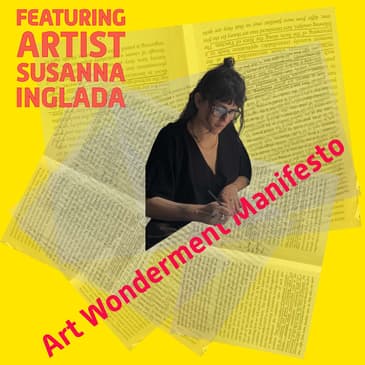
AI is forcing us to define what being human is. So, did our host, an art curator and writer, dare to create a Manifesto? Awkward? Or are we not used to women proclaiming things? How can art–seemingly at the brink of commodification–bear new forms of being human? Or is does it spotlight you, art wanderer? The self-help book "Tiny Experiments " by Anne-Laure Le Cunff sparked this art question: why did it excite such a meditative exploration of the role of art, and its urgent proclamation? Tune in to find out.
Did you enjoy the episode? Think about supporting Exhibitionistas by leaving a small donation: https://buymeacoffee.com/exhibitionista
What else to do when we live in a society of images, but don't know what they are? In Joana's words: "Art Wonderment is me, howling, in recognition, in celebration, in fear, in respect, in defiance." Read the rest of her text here because a podcast episode is not the same beast as a text. The complete experience combines the two.
Sign up for a tiered monthly support: https://www.buzzsprout.com/2624749/monetization/supporter_settings Your contribution keeps us going.
With the wonderful Catalan artist Susanna INGLADA; the timeless wisdom of LAO TZU's Tao Te Ching translated by Ursula K. LE GUIN–, the most innovative Portuguese poet, Fernando PESSOA and his mind blowing creation of more than 100 heteronyms (poets he invented with a persona, a life, and their own authored poetry), amongst which the most extreme of them all, Alberto Caeiro.
Art Etiquette Segment guest:
Spencer Moore, Creator and host of The Hairy Chin Podcast
Art question: why is contemporary art not considered art?
Soon: Bonus – full length Art Etiquette episodes.
Come for the art, stay for the creative writing–segment, Brainstorm in a Teacup, where Joana reads short texts from her notebooks exposing her inner thoughts and strange fictional flash writing.
Jingle: "Wunder", experimental poem by Joana P. R. Neves.
00:00:00 - Intro: A Different Start + Featured Artist Susanna Inglada
00:02:06 - The Self-Help trap
00:13:36 - Art Wonderment Manifesto
00:19:26 - Art Etiquette with S. Moore: why is contemporary art not considered art?
00:28:25 - Art Wonderment Manifesto – Holding the paradox wit artist Susanna Inglada
00:33:07 - The mysterious life of Portugal’s most intriguing poet, Fernando Pessoa
00:42:06 - Brainstorm in a Teacup
00:43:55 - A message, a rant, a call for voice notes, a see you soon
Did the episode stir Art Wonderment memories? Share them via text or voice message.
Created & Hosted by Dr. Joana P. R. Neves, art curator and writer with over 20 years of experience in the contemporary art field. Artistic director of Drawing Now Paris since 2018, she has worked across the industry, from the art market to education. She co-launched the art residency and project space Worlding in 2020. Exhibitionistas’ first year offered exhibition discussions with guest co-host Emily Harding; organically, it grew into a more experimental show exploring art topics, stories and interviews complemented by Joana’s publication Art Thinkosaurus on Substack. She champions ‘Art Wonderment’s’ embrace of complexity against the lure of ready-made opinions. A polyglot, she grew up in Lisbon, studied and lived in Paris, to finally settle in London with her artist husband, four children and two cats.
READ JOANA'S TEXTS:
Joana on Substack: https://joanaprneves.substack.com
Where you find the Exhibitionistas Files, our Newsletter: ...
Intro: A Different Start + Featured Artist Susanna Inglada
SPEAKER_02Do you mind if I start with a story? This week something somewhat strange and puzzling happened which led to this episode, which is kind of an important one for me. This is Exhibitionistas, I am your host, Joanna Piarnevis, and this is your Art Wonderment podcast. Stick around for the art question, although I do start with a personal anecdote, and then for the art etiquette bit where I invite guests who do not work in the art field to bring in an unprompted question that we discussed for a few minutes. And if you enjoy these conversations, they will be released in full as bonus episodes very, very soon. Stay tuned. And then to close the episode in Beauty and in Wonder, Brainstorm in a Teacup, which is where I read very, very short texts from my notebooks that are too nice to ignore, but probably too weird to build an episode around. This episode, for the first time, has a guest artist. I will be talking about her work. Her name is Susanna Inglada. She's a Catalan artist living in the Netherlands. And she was kind enough to allow me to use her images across the episode. There's a video and an audio version of each exhibitionista's episode. If you want to see Susanna's work, then I would highly recommend to watch the episode on Spotify or on the Apple Podcast platform, which now also has videos, or on our channel on YouTube, which is also called Exhibitionista's Notes on Art. Her work will be discussed in the second part of the episode. If you prefer audio, you can sign up to the newsletter because I will also be sharing a few images. So now, without further ado, on with the episode.
The Anti-Manifesto: I'm not a prompt
SPEAKER_02Today the episode will be about wonderment. Art wonderment to be more precise. Wonderment. Do you notice the little acceleration that happens between the d and the m celebrated by the te at the end? I booked a talk this week to listen to a neuroscientist because I'm fascinated by matters of the brain. But when I got there, I realized that it was a promotion for a self-help book. The writer, a lovely French Algerian woman, started with a story. So I guess this is a story within a story. She said that she worked relentlessly in her youth to a high achieving level, which landed her a dream job at Google, Silicon Valley. She devoted herself to its quote unquote codified career plan with a specific ladder, with specific skills flagged up to climb it, until one day her arm turned purple. Which flagged up two things for her. So firstly, how disconnected she was from her body, and secondly, that there was a blood clot in her system that could have killed her. At the hospital, she didn't fail to reschedule her operation to accommodate work. So high flying career, high strung worker, close to burnout, terrible healthcare, quits job, builds a startup. The failure of her startup was the last step of this paint by numbers self-help book structure that leads to the breakthrough. Realizing that something was wrong and that then will be applied to all of us. And in this case, the author realized that she had never asked herself, how's life? Which it turned into, we never ask ourselves how is life. Well, I constantly see people asking themselves that, the less money and the more overworked they tend to be. It's a question that pops up in my mind personally quite frequently. But then the moderator asked, who knew what they wanted to do with their lives, and I raised my hand. I didn't mean by that that I have a predetermined plan that I need to hit every step of the way until a particular goal, but simply that I have a sense of what I enjoy doing, uh, where it can potentially take me, and also that I have a few things brewing that I hope will come to fruition, and if they don't, other things are possible as well. And the moderator said, Oh, someone here knows. And I jested, don't single me out. To which she responded, You are the only one to raise your hand. Story of my life. So the book is called Tiny Experiments and it presents a simple theory. In it, the author, Anne Laure Le Campf, tells us to act like scientists, a world she discovered when everything else failed and she embarked on a study of psychology and neuroscience. So she said, Become a self anthropologist, find out what works, what doesn't, and then start applying what she calls those tiny experiments to different areas of your life, one at a time and simple tasks. For instance, send a nice message to a friend every day for ten days, meditate for ten minutes every day for a whole month, and then like a scientist, there are no failures, just experiments that are evaluated in terms of what's learned, good or bad. This is presented as a solution for a goal-obsessed society advocating for a nonlinear life. This surprised me for two reasons. Firstly, it sounded awfully familiar, you know, echoing the sort of quote unquote codified and extremely linear narrative of the self-help book, despite the non-linearity of the method. But the second reason was deeper and more important. It was that the experimental mindset, the tiny experiments, a delightful idea really, is how I live my life and build my work. I have ADHD, and that's what the ADHD mind does. It disconnects your sense of self. You don't associate yourself so much with your ego, you pay more attention to interests, to life, and your person is a tool, and if it's not working, it's fun to change. It wires you to be inventive if something is not working, which often means boring. We get bored very easily, and therefore we're curious, we're relentless, but we're also kind of addicted to change. It can go very, very far. So imagine how disconcerting it was to learn during the QA that LeConf is studying curiosity in ADHD at King's College. So I asked to speak, I shared my story and inquired whether the book looked into neurodivergence. At the time I hadn't purchased it, and jokingly I said, still not knowing quite how this made me feel, are you using us as lab rats? She laughed and she said, Oh, actually, I've also been diagnosed myself whilst I was doing these studies. So the next day, I understood my concern. You see, my husband is wired differently than me. It's a neurodivergent household, one of my kids has been recently diagnosed as well, but he's dyslexic. And so we've had to work together for our behaviors not to collide. He could not live like me, and vice versa. ADHD brains can produce a sort of entrepreneurial mindset, but not every ADHD works in the same way. For instance, LeCamp's behavior seems somewhat devoid of colour to me. Testing, mapping, keeping a logbook of endless tiny experiments on myself. But the real issue here for me is that it still sounds prescriptive. I must say I don't really enjoy takedowns, but I do relinquish honest critique. And if I didn't believe that there is something wrong with the system that produces endless books about people who turned a bad work fit into a business that is then supported by TED Talks, newsletters. She has more than a hundred thousand uh people signing up to hers. So maybe I'm a bit jealous as well, private membership clubs and more, rather than a world where neuroscientists work in their labs and then bring to the full their findings with care and caution. I wouldn't flag this up. So I will say from a place of compassion that LeCamp seems a full-rounded human being. This is nothing against her. She is actually very interesting. And I was really more compelled by the story of the framework she started her life with. In France, having an Algerian mother, for example, is a charged inheritance. And she does say in her book that for her mother, when she was choosing her class subjects, it was about survival, whereas for her father, it was to have a good job. And so I decided to watch her TED talk. And I saw a vulnerable woman, you know, turning a very singular experience into a third person we all do this kind of experience and narrowing down the scientific method, which yes, of course, it works with her favorite word, which is maybe, mine is perhaps, but also comes with huge biases. So in her TED talk, she explains that her bad behavior, for example, came from a control mindset, and she concluded we all resort to control when we're in a crisis, which is not true. You know, humans have a spectrum of behaviors. And this need to turn our singularity into absolutes, our specificities into generalities puzzles me, and it reminds me of why I fell in love with so many authors and so many artists and so many creative people and thinkers particularly. It made me think of the way Siegfried Krakauer talks about Walter Benjamin, which you read in the last newsletter that was sent by the exhibitionist as Files. So Walter Benjamin, on the contrary, says Krakauer, accepts quote, no generalities whatsoever, pursuing instead the unfolding manifestation of ideas in specific and really or presently perceived situations throughout history where they ceaselessly evolve and never stabilize, unquote. So this notion does echo nonlinearity, and that's why I was also puzzled because in principle that presentation had everything to be compelling for me. But the generalization of nonlinearity as a method is a contradiction. So from a more contextual point of view, Le Conf for me is still serving the Silicon Valley model, which is so problematic nowadays, with its jargon of control, productivity, hacking your brain, simple rules to apply for a better life. She constantly speaks about what the world has to offer you. As if, you know, the world was here to give us anything. It's a sort of an AI-powered life where we live by prompts that feed our singularity rather than us understanding what that is and what in fact it means to be human. So to finish on a positive note, I'll say that the direction in which Le Campf goes resonates with art wonderment. It promotes curiosity over instrumentalizing purpose, it advocates for a liminal life, so a life in between things that is more important actually than the things themselves. So it focuses on dynamics over static positions. Which takes me to the question of this
Art Wonderment Manifesto – Practising with those who practice it
SPEAKER_02episode. What is art wonderment? So consider this episode as my art wonderment manifesto. So first, how do we find it? Well art wonderment is taught by those who practice it through the enjoyment of any art form. It comes to us by way of encounters, casual transmission, and a personal awareness, which can be gradual and it can be also an epiphany. The recent episode that I did about Marcel Proust talks precisely about that. And if you haven't listened yet, I think it's worth going back. There is no prescribable way to go about it. We each have our own progressive practice and encounter with art wonderment, and we take pleasure in sharing it, hoping that the people listening will enjoy its story. I didn't invent art wonderment, so I simply locate it with an expression, a word that grips me, and hopefully you too. So let's start with someone who practices and describes art wonderment. The two chapters, very short, that I'm about to read of the Tao Te Ching, so Lao Tzu's Tao Te Ching, 2500 years old, they talk about words, actions, and knowledge. So art wonderment is an expression, but it's not a slogan or a prescription. It will not teach you anything. It's an action of looking at the outcome of other people's actions, art, in whatever form it comes. And finally, it can be knowledge, but of a very specific kind that the Tao Te Ching describes very, very well. I'm going to read number seventy and number seventy one. They're very, very short chapters, so hold on tight. Being obscure. My words are so easy to understand, so easy to follow, and yet nobody in the world understands or follows them. Words come from ancestry, deeds from a mastery. When these are unknown, so am I. In my obscurity is my value. That's why the wise wear their jade under common clothes. And now number seventy one called The Sick Mind. To know without knowing is best, not knowing without knowing it is sick. To be sick of sickness is the only cure. The wise aren't sick. They're sick of sickness, so they're well. This is a translation by Ursula K. Lewin and there's a little note below that says What you know without knowing, you know is the right kind of knowledge. And the other kind, and this is the important part for me, conviction, theory, dogmatic belief, opinion isn't the right kind, and if you don't know that, you will lose the way. Capital letter W and capital letters. This chapter is an example of exactly what Lautze was talking about in the last one obscure clarity, well concealed jade. So this is the important bit for me, which is the question of dogma. Dogmas can seem flexible, but they're always prescriptive, they're static. So as I said, this is a translation by Usler Kayleguin. And in the introduction, to illustrate this idea of encounter, she remembers how she saw her father reading the Tao Te Ching very often, and how she asked him one day what she was doing when she saw him taking notes from it. He said that he was choosing the chapters that he wanted to be read at his funeral. And not only did Le Guin also read the Tao Te Ching all throughout her life, she also chose her favourite chapters to be read at her own funeral. So this book and the translation were passed on to me casually during an episode of the podcast by the curator Katherine Lee. So in the episode where I ask Catherine to pick a book that is not related to contemporary art, but nevertheless that was useful to her as a curator, and she picked the carrier back theory of fiction by Usler Kayleguen. So secondly, what does art wonderment do? It embraces paradox through its widest vehicle, artistic experiences, as a thing made by someone placed in a space, be it virtual, like a book, or immersive like something in an art gallery, for someone else to engage with in a sort of reverse mirror dynamic, a thing rooted in its own time and culture, but also potentially awakened later in other times and cultures or even before, illuminating past occurrences, a specific thing that speaks to many, a multilayered intentional object that acquires unintentional meanings in each encounter that we have with them through art wonderment. So that state of art wonderment is perfect to
Art Etiquette with Spencer Moore, Podcast / host Hairy Chin Podcast
SPEAKER_02introduce yet another person, Spencer Moore, who is my guest for this next art etiquette segment. She's a podcaster, she has a podcast about women's health called the Hairy Chin Podcast. And if there ever was an amazing name for a podcast, I think that is it. And so without further ado, enjoy. Art Etiquette. Today I'm really, really chuffed to say that I have a female health advocate here in the podcast. Her name is Spencer Moore. She has a podcast called the Hairy Chin Podcast. And honestly, I think it wins the name of the best podcast ever.
SPEAKER_01Thank you so much for having me. I'm so excited to chat about this with you. My my work right now is in female health advocacy, but I am a lifelong creative and I absolutely love contemporary art. So I just jumped at the chance when you graciously invited me. I'm so excited to chat. Tell me a little bit more about the podcasts. I was starting my mammogram screenings for breast cancer, my gynecologist recommended it. And my first mammogram came back with early stage breast cancer. So I went through some treatment and I became a breast health educator. That spring in 24, I decided to launch the podcast. Second season is really going into the how of self-advocacy because so many women, after some horror story or some terrible thing that's happened, they say, Well, you really have to advocate for yourself and your health. But no one teaches us how. What a life story that you have. So, what is your question? Okay, my question is: why is it that some people think that contemporary art is really not art at all? I like this question.
SPEAKER_02You are often confronted with this idea that contemporary art is not understandable, that it is difficult of access. But because I say I'm a curator, people very seldom tell me, Oh, contemporary art is not art. I guess I would sense It back to you? Like, what led you to ask that question?
SPEAKER_01As a contemporary artist myself, I've had um as kind of an abstract artist, I would say I've had a lot of feedback of my art of people saying, like, I don't get it, asking more, can I do more traditional things? You know, I learned traditional art. I mean, I was sketching hands and eyeballs and you know these things that you learn when you're kind of learning like portrait. I can feel that you love it. I mean, things are really hard. You don't know. They're really hard. I've had people say to me, like, I don't, I don't like your work, and I would never have it in my house. I don't get it. I think that people think they need to get it. And if they don't get it, then they're the problem. I love Rothko. And and and I love him so much because I've seen his work in person. When you sit in a chair in front of a bench, in front of a Rothko painting, and you just absorb that it changes with the sunlight and everything. It's like it's such, to me, it was such an experience. But I think people think they should look at it and understand it.
SPEAKER_02I'm always fascinated with the moment where people feel licensed to be a bit aggressive. And typically, abstract arts is where it goes. Kids could do that. Have you looked at your kids' drawings? At a certain point, you're gonna watch your kids draw. And I think there's nothing more fascinating than seeing kids experiment with materials, discovering mark making. You know, there's a moment where they're controlled by the by the tool and they let it speak to them. Bring me your kids' drawings because I will love them. Tradition of saying this is good, this is bad, obviously has hurt art because people feel immediately judged. I think I was writing about it the other day and I was looking, okay, let me look at how the Tate talks about their works. So there's always either the word pioneer, the expression extremely innovative or something akin to that expression, one of the most revered or one of the most important, greatest. It's always a superlative. And then you go in there and you think, this is crap. I don't like this, I don't connect to this. Even if you are open to contemporary art, a part of you will feel somehow excluded from the game.
SPEAKER_01Branding and marketing has played a really big role in the evolution of how art has been perceived. I mean, I'm here in Spain, I'm in Barcelona, I visited many times the Dali Museum. It's um in an area that I go to quite often. I mean, Dali was the master of personal branding, and he just did these outrageous things, and everybody knew him. And his art became kind of this extension of this personality. You know, in terms of contemporary arts, especially the connection to the artist, I think helps people understand the work maybe a bit better. And I think that really challenges a lot of people. They don't want to be challenged, they want to see the art, they want to understand it and enjoy it and move on. And so perhaps the connection with the artist gives them a little bit of a bridge. You know, is it a woman? Is it a man? What did they look like? How are they dressed? I mean, a lot of that could maybe connect them to understanding a bit more about their pieces. Because you're a female health advocate.
SPEAKER_02So you know about advocating, right? So, how do you advocate for abstract art or for your pleasure in being challenged by art?
SPEAKER_01I have a piece of art that I did. It's above my sofa. I had this blank canvas, I gessoed it, a white blank canvas, and I was going through a lot of emotional things at the time. I was having some transitions and I just really didn't know what I wanted to do with it. So I ended up taking a knife and just cutting it up. And I thought, well, what am I doing with this now? And I have loved sewing, I've loved needle pointing. And, you know, I've been through a lot with my health, and I have a lot of scars on my body and physical, emotional, all of it. So I decided to buy some really big needles and some thread, and I started stitching the canvas. I didn't stitch it all back because it became this kind of like wound healing process. And it's an important piece for me because it really, every time I look at it, I think of it as these are my scars. Some of them healed really well and they're stitched perfectly. Other of them are like wide open and gaping. I mean, they represent all of these kind of wounds and traumas that I've had. I had somebody come to my apartment and they saw it and they said, Yeah, I just don't, I don't get it and I don't like it. And I said, Well, I mean, that's completely valid. I I completely understand that you don't like it. Would you like me to take it down? You know, like if it, I mean, I can remove it. That's and and I said, you know, it's an emotional expression for me. This was a process that I went through. It was very cathartic for me. I love having it over my sofa because I see it every day. And they shifted a bit in terms of like, oh, well, I mean, I I can see that. I can understand it. I I explain art as it's all expression, you know, all of it. There's just this barrier of discomfort when people don't understand it right away, or when it's kind of aggressive, like somebody took a knife to a canvas and you're like, well, what was happening at that moment? Are you okay with Rothco? I get, I get sometimes I get kind of not defensive about it, but when people say like it's just boxes. And I say, like, yes, but every time you look at it, it could be something different. Like this one, perhaps it's the one behind me that I love, it's it's orange and pink and red. And I think like it could be a sunset on Mars. Thank you so much. This was so, so lovely. Thank you. It was. I've loved it. Thank you so much. It's been an honor to chat with you. And I would say I love speaking with people that have these really knowledgeable backgrounds. And I mean, you really open my mind to, you know, different, different things about art. I I love speaking to curators and, you know, people in these fields that just devote everything to art. I mean, you you really do open up these perspectives, and I really appreciate that. That is so funny. I was feeling the opposite.
SPEAKER_02I was feeling she brought so many things to the I wasn't even thinking about what you brought, what I brought, what I could have, you know, is just like she gave me so much. I mean, this was uh yeah, this was lovely. Thank you so much. Art etiquette. I hope you enjoyed the art etiquette segment as much as I enjoyed recording it, and don't forget, um, the whole conversation will be available soon as a
Art Wonderment Manifesto – Holding the paradox wit artist Susanna Inglada
SPEAKER_02bonus. I would say that the third point that I wanted to make is that Art Wonderment plays with the endless cycle between materials and poetics, letting the meaning happen in the space between symbols, between words, between lines, colours, between the shape and what it represents, between the viewer and the image. It prevents us from worshipping technical skill over randomness, the object over its relation with the space, the idea behind the work or the history it engages with. It's the invisible mesh that brings all of these things together and doesn't allow any of them to prevail or to take ownership of the whole aesthetic experience. Its complexity, its nuance. So visual art practices this nuance state by being both extremely practical and extremely spiritual. I recently worked with an artist who I've mentioned in the beginning of the episode, Susanna Inglava, who handles those two facets in a fantastic way. We worked on two shows together, one at the MCA and the other at the Frac in Amiens in France, while she also produced a new body of work for the drawing lab in Paris. Dosanna practices life-sized collaged drawings of people entangled in each other, as if in a constant state of conflict or loving togetherness. It's often hard to settle on which is which, and that's one of the powerful aspects of her work, especially because it is drawing, a discipline relying on more fragile materials than painting or sculpture, at least traditionally. When you see her immense drawings and even the smaller ones, there isn't a single visual quotation of a known work of art, and yet they stimulate memories of so many artists and artistic eras, and even other artistic practices. Her images are so specifically hers, full of her own drawing gestures and the attrition of the material she uses, of all the stories that inspire her and the art that she has closely studied. The bodies she works with are composed of fragments made with different colours and even materials suggesting our own patchwork existence. They do remind me of the mesh that holds everything together that I was talking about before. Susanna's work holds many paradoxes class, gender, past and present, fidiver, historic memories, by being a sort of writing with ciphers of her own made up visual language, a unique language. Her human figures, but also her objects are so specific that they tickle certain parts of our brains that spark a flood of memories rather than just a vague sentiment. They haunt you way longer after you've seen them or been in their presence. In the space, the drawings, albeit having a considerable dimension, have a strange, compelling instability. A woman from the security team of the art space, where we did one of those shows together in March of this year, came to see the show before the opening. She stayed for quite some time. She loved it, she said. And then she looked a bit more, and she turned to me and said The drawings move. Susanna has a punk way of putting the drawings on the wall by holding them with small pins or nails. The paper, the glue, the gravity acquire a sheen of resistance, of stubborn ethics that do not need to be communicated in any other way than how they stand there in the space, spinning.
Art Wonderment closing with Fernando Pessoa and heteronyms
SPEAKER_02So this takes me back to the memory of a poet that is very important for us in Portugal and also I think famous worldwide, but known only for one of his books called The Book of Disquiet. Fernand Psoa, Fernando Pessoa, the poet that had a very specific characteristic. He had heteronyms. The Book of Disquiet was not really written by Fernand Psoa. It was written by Bernard Swartz, a heteronym, so not a pseudonym. A pseudonym would be a nom de prun, so a name under which an author publishes their work, but certainly not for the reasons why Fernand Psoa used heteronyms. And then looking at Susanna Englada's work and when writing about these figures that she composes with fragments from different drawings that she keeps in her studio and goes into a sort of a very focused state to associate. I was thinking about Fernand Psor's heteronyms. So a heteronym is the name of other poets that have written under the body and existence of Fernand Psua himself. When I was studying Fernand Psua at school, we had a way of referring to him and to the heteronyms, which was that each time we were studying a poem by Fernand Pessoa, we would say Fernand Psua Ilmis, Fernand Psua himself. And when it was a heteronym, such as Albert Caer or Ricard Reich, we would say their names, because these were people for Fernand Pessoa. He drew their astrological charts, they had a DOB, so they had a life of their own, and they had their own profiles. And that made me think of holding contradictions and also of creating people, of creating figures as images. Who are those figures? I said that they were specific in the beginning of this episode, but what is that specificity? What kind of specificity is it? They're not human beings, they're not living beings, which is creatures that are born, that have a certain time of existence and then who pass on. They are eternal in some ways, and yet they are specific. They emerged at a certain moment in time and then became something, an object in space, as I like to say. Which led me to think about the heteronyms, specifically one heteronym, Alberto Cairo, this poem, which was haunting for me because it sort of seemed to negate art. Alberto Cairo, he was the master, the Greek one. Ricard Reich was the Latin one. Albert Camp was the futurist. Albert Cairo had a very interesting philosophy. One of the poems that fascinated me and also unsettled me is a poem that starts like this. The only inner meaning of things is that they have no inner meaning at all. I don't believe in God because I've never seen him. If he wanted me to believe in him, he would doubtless come and talk to me and walk in through my front door, saying here I am. This may sound ridiculous to the ears of someone who, because he doesn't know what it is to look at things, doesn't understand someone who speaks of them in the way that noticing things teaches us. So his philosophy was all about contentment and drawing from the world around us a relationship that ultimately would not separate us from anything based on vision, based on seeing things. He also talks about the senses. He goes on to say But if God is the flowers and the trees and the hills and the sun and the moonlight, then I do believe in him, I believe in him at all hours, and my whole life is one long prayer and mass and a communion with the eyes and the ears. But if God is the trees and the flowers and the hills and the moonlight and the sun, why do I call him God? I call him flowers and trees and hills and sun and the moonlight, because if so that I might see him, he made himself sun and moonlight and flowers and trees and hills. If he appears to me as trees and hills and moonlight and sun and flowers, it's because he wants me to know him as trees and hills and flowers and moonlight and sun, and that's why I obey him. What more do I know of God than God knows of himself? I obey him living spontaneously. Like someone opening his eyes and seeing, and I call him moonlight and sun and flowers and trees and hills, and I love him without thinking about him, and I think him by seeing and hearing, and I walk with him at all hours. In another poem he says the mystery of things is that they bear no mystery at all. That's a contradiction, that's a paradox, because the distance created by language makes it so. We mustn't forget that while advocating for a complete linearity, not in the sense of a goal-oriented life, but an absence of separation between things, a world that is not organized according to categories. He cannot speak. Language creates a distance. So then what he is saying is that any form of art is fixing language in the distance that it creates between things. And so language itself, any language, Susanna Inglater's language, Lautze's language, any artist's language, even perhaps any thinker's language, any philosopher's language is about holding contradiction and ultimately to understand that whatever we do, whatever language we create, it was already here before. The line is in the skies when there's lightning, nature draws, when we listen to the water flow, nature, if we can call it that, or God, as Spinoza would say, sings or orchestrates some sort of symphony, or is the symphony. It is hard to explain this into words, that's why we're here together, you and I, trying to practice art wonderment in the best way possible, without instrumentalizing ourselves, without instrumentalizing art, but by paying attention, by being open, and by holding divergent states together or divergent perspectives onto a same specific point that someone is making in a much more beautiful, compelling, magnetic way than I could ever do.
Brainstorm in a Teacup
SPEAKER_02Well, this is it for today's episode. Stick around for brainstorm in a teacup where I read something from my notebooks. Well, let me try to see if I can put myself at ease, comfortable, readjust my chair. So I don't know in what mood I was in when I wrote this. It's very different from what I usually write, and I don't publish this kind of text, so I really wanted to write it, I wanted to say something, which I think I did. I'll let you be the judge of that. The participant When the software crashes and the image lags, when the crown keeps falling off your devitalized tooth, when the sharp eyed cat meows with their self-possessed devotion, when someone outside trumpets into their phone like gaffer tape to life, whereas you're not feeling that video call, that signature, worlds apart from you, in a distant galaxy being sucked by a black hole. You're distant enough not to be sucked to, but witnesses are also participants. And in this relation, you may just be a star that they can spot from afar, but in your solar system you're already dead. Which is not true. You're not there, you're here. I mean here, here. But sometimes some people will not let you be alive. There it is. I don't know, I don't know.
A message, a rant, a call for voice notes, a see you soon
SPEAKER_02Art wonderment as a sort of manifesto. I thought a lot about it. Should I do it? Should I not do it? But heck. You only live once, and you know what kind of a legacy do you want to leave? Mine will be art wonderment for the lonely art historian, or just simply a historian in two centuries, who will wonder what people did with their technology. You can now watch the videos on Apple Podcasts. We've just been accepted. You can support us very, very easily now. There's a link that leads you straight to lots of modalities to help um build these episodes for me to have a nice life. I think that's a good cause, isn't it? You can send me text messages or leave me voice messages on the Exhibitionistas website, exhibitionistaspodcast.com. I want to know what you're thinking about. I want to know what you're wondering about contemporary art. So that's it. I hope you have a good one, and I will be in your presence very, very soon. It's the highlight of my week. So there you go. I'll see you at the other end of the bridge between the two episodes. Take care. Bye bye.