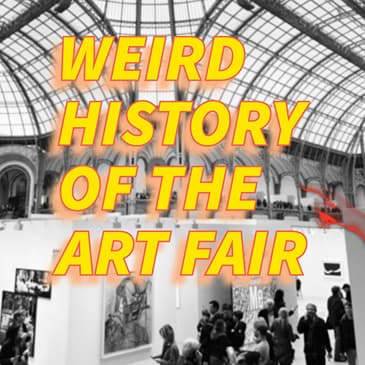
Ready to plunge into the depths of art history to resurface with weird art fair histories from Prehistory, the Aztecs to today? Which is a way of asking: is the compulsion to buy rare goods and exemplary artefacts immemorial? How have we evolved into the format of the art fair?
Art fairs seem to defy romantic visions of creativity: artists: the art wonderment necessary to free oneself from conventional ideas and dusty traditions while reinventing them. Art works require freedom, Their art etiquette can puzzle: selling art works feels deeply contradictory with the creativity and meditative explorations that we expect from our contemporary artists.
You wouldn’t leave your favourite coffee shop, flat white in hand, without paying for it, would you?
Indie media like Exhibitionistas is free of access. That leaves you with a responsibility-dare I say, an ethical obligation– to pay for what you consume if you can. You can drop £3 if you enjoyed the episode here:
: https://buymeacoffee.com/exhibitionista
Or you can sign up for a tiered monthly support if you’ve been listening for a while:
https://www.buzzsprout.com/2624749/monetization/supporter_settings
Your contribution keeps us going.
Read the article by Christian Monger The Evolution of the Art Fair: https://www.jstor.org/stable/0671e890-72d2-323b-964e-767f655980fe?seq=3#page_scan_tab_contents
Visit the page about The Birth of the Art Market: Rembrandt, Ruisdael and Van Goyen and the Artists of the Dutch Golden Age: https://www.codart.nl/guide/agenda/birth-art-market-rembrandt-ruisdael-van-goyen-artists-dutch-golden-age/
Caroline Monnet's website: https://carolinemonnet.ca and gallery page: https://blouin-division.com/en/artists/34-caroline-monnet/overview/
The Venus de Renancourt (the Amiens Museum Prehistory female figurines): https://fr.wikipedia.org/wiki/Vénus_de_Renancourt (FR)
Jingle: "Wunder", experimental poem by Joana P. R. Neves.
Did the episode stir Art Wonderment memories? Share them via text or voice message.
Created & Hosted by Dr. Joana P. R. Neves, art curator and writer with over 20 years of experience in the contemporary art field. Artistic director of Drawing Now Paris since 2018, she has worked across the industry, from the art market to education. She co-launched the art residency and project space Worlding in 2020. Exhibitionistas’ first year offered exhibition discussions with guest co-host Emily Harding; organically, it grew into a more experimental show exploring art topics, stories and interviews complemented by Joana’s publication Art Thinkosaurus on Substack. She champions ‘Art Wonderment’s’ embrace of complexity against the lure of ready-made opinions. A polyglot, she grew up in Lisbon, studied and lived in Paris, to finally settle in London with her artist husband, four children and two cats.
READ JOANA'S TEXTS:
Joana on Substack: https://joanaprneves.substack.com
Where you find the Exhibitionistas Files, our Newsletter: ...
Intro: Is Art Compatible with its Market?
SPEAKER_00Try please. Don't meow. Hello and welcome, Exhibitionist is out there. We're in between Artfares at the time where I'm recording. Freeze Art Fair is on the go and very soon Art Puzzle Paris will open. But here at Exhibitionistas, your Art Wonderment podcast, we like to ask untimely questions. I'm the creator and host of Exhibitionistas, Joanna Pianevas, Artwriter and Curse for the Best and Worst of Times. And what is it exactly, Art Fair season? Is it the best of times? Is it the worst of times? You'll find out after the break. Can Art Wonderment be practiced in an art fair? And if you don't know what Art Wonderment is, there is an episode about it. Just Google Art Wonderment or look for it on your podcast browser and you'll find it. Art Wonderment. Can it coexist with sales, with the economy of creativity? Can creativity coexist with the need to sell itself? Full disclosure, I was not planning on uh dropping this episode on this precise topic today, or ever really. But going to Freeze Artfare and kind of diving into social media and seeing all the common reactions to artfares, I'm compelled
Common reactions to art fairs
SPEAKER_00to do this. So I'm going to share two Instagram posts. They're very different, but for me, they kind of encapsulate the general reactions to art fairs. Then I'm going to dive into the history of artfares and maybe even go into the Aztec civilization to come back and look at the context of an art fair with a bit more distance. And then I will tell you about the experience of being in an art fair and analyze it from within. I have worked as director of different galleries. I was there for the first Freeze Art Fair in the booth selling art. Yes, there was also one of my million jobs in the art sphere on with the two Instagram posts.
SPEAKER_03I went to Freeze yesterday, and honestly, the peacocking, it's basically fancy dress for people who think that they are far too sophisticated for fancy dress. The outfits, the air kissing, the name-dropping, everyone looking terribly, terribly cultured. But the funniest thing is the mutual surveillance. Everyone's watching everyone else.
SPEAKER_02Alright, so here's my notes from the first day of freeze, and honestly, I was a little disappointed. Which, given how much I love art, it's awkward to share. But before I get there, let me tell you how much I loved wonderful work on relationships and intimacy by indigenous peoples, living stories called by within, and the absurdity of modern life, and the skill, how the texture, embroidery, mosaics, plenty to love. But there was something missing from me. I walked through pretty much all hundred and seventy-something galleries, maybe stop to look at 70 or 80 pieces. There's only so much you can see in a day. But with the works I explore, I didn't see anything grappling with the huge forces of our time. The growing tension between individual freedom and collective responsibility, an increasingly divided world, our lack of the shared purpose as people, a growing wealth gap, and democracy under strain. Now you might say people don't want those questions hanging on the walls.
The Purity Obligation of Art
SPEAKER_00The first video is really interesting because it has a sort of demand of purity. There is this exposure of the art sphere compared to, say, linguistics. For some reason, contemporary art, fine art, even, has a sort of demand of purity upon it that we don't ask of other areas to have. It seems to me that contemporary art or visual arts, to be more specific, is one of the sectors where we are the most plagued by wealth. So in this video, there's also this annoyance with the peacocking around the art fair. It's a place where people not only look at art but are seen looking at art. And this person is actually talking about observing by observing other people, which is interesting. It feels meta, but it really isn't. When you work in the art sphere, you're always very conscious of how you present. Some people are there because they are really eccentric, and an art fair or any art space is an opportunity to express themselves, and other people are there to show off their latest, I don't know, Prada, something bag or whatever coat, jacket. So there's a bit of everything in contemporary art spaces, and when there's wealth added to it, obviously things cannot be pure. They cannot remain untouched by venal purposes and by the impurity of having to introduce creative processes in a way that people will understand them, or maybe in a way that will make them seductive. That is the history of time in any spiritual area. Think about religion, think about philosophy, think about wisdom, even, sapience. I mean, there's always a way to package things, and you know, it is no accident that Eastern philosophies have become so appealing at a certain point in the 60s, 50s, even in the 20th century in Western spaces that were dedicated to creativity. They were packaged in the way that Western people could find appealing. You know, yoga practices in the Western world are not the same as the ones practiced where they came from. So packaging in this purity that this person seems to demand of this particular context is, I would say, a trap in terms of desiring it. And it is, I would say, as well, almost impossible because never will you be as conscious of people looking at you than in one of these places. I mean, I think this kind of reaction comes from a sort of an anxiety-ridden relationship to maybe something you really love. The second video is really
Art fairs and political art
SPEAKER_00interesting and compelling because it does talk about what you expect from art in general. And there's a comment by someone I really like reading. He has a substack called Slow Looking. His name is Ben Street, and he's worked in many capacities in the art sphere. And he does ask the person, may I ask, why would you look for such a thing in an art fair? Which is a fair point. Because an art fair is a place where galleries pay for a booth, as we call it, a certain limited area, 20 square meters or even 30 square meters if they have a lot of money, and they will present an aspect of a few of the artists of their artist roster. So we we won't be looking in depth mostly, except the galleries that will do a solo show at the work of a certain artist. Art fairs are there to poke you a little bit, you know, to kind of draw your attention in. And so they have a tendency to bring the most seductive works, the most recent works of a very well-known artist, the unknown and historical works of a certain artist who has a very long career. The art sphere has a certain difficulty with presenting art in the way that will attract your attention. And that's good. You know, we live in a society where there's something called clickbait. I suffer from it immensely. I have analytics, I know what draws your attention. So I know that it is good to have an area where we're kind of preserved from sensationalism. But at the same time, it doesn't mean that you're not going to think about the presentation of your artists. Of course, you are packaging something in order to attract attention because you are in competition with all the other booths around you. So of course, art fairs are going to introduce their artists almost even in an unsubstantial way, which doesn't mean that the artists that they're showing lack depth. But I think there's a bigger problem in here, which is this notion that art needs to be political, and political art is very hard to produce, to create, and to make it withstand the test of time and not just being a contextual thing. Nothing against that. Why not produce art that is ephemeral? There has always been ephemeral art anyway. But the question here is also what is considered political and what is considered tackling the problems of our time. And here I would say that it's not always what the artwork is talking about. It's always a bad sign if art is very visibly talking about something specific. It's more about the presence of certain artists that didn't used to be there. That is also political. And in that sense, even gallerists are playing a political role. Take the case of Blue In Division, a gallery from Canada, who was showing the art of Caroline Monet. Well, of course, from this name, you wouldn't say there would be anything specific to her. But actually, uh, Caroline Monet is part of the Anishinabi community, First Nations community in Canada. And so her art is a contemporary pursuing of certain traditions of her heritage. But because her name is Monet, so she is part Anishinabe and part French, no one would say, even from her features, her facial features, no one would say that she's part of that community. And those things can be completely invisible. I only know of this because I stayed listening to the gallerist present the work to a few collectors who were there, and then I ended up talking to the artist who is incredibly interesting. And so, what is political really, and how are we tackling political issues? There's even an underlayer to this question here, which is that we cannot keep on ignoring the period that we're living in. To ask of art to produce something that will appear immediately to tackle the insecurity that we now feel in even having a conversation, what is happening, who is right, who is wrong, and the rise of white suprematist extreme rights movements in Europe at the moment through the positioning that is deeply economical and therefore deeply entangled, whether we like it or not, with the commerce of art, as we will see, is really naive if we don't acknowledge this, if we don't talk about the elephant in the room, which is that there are so many interests tied with the wars around us, with the destruction of many, many ethnicities or even communities and people, through war, but also through cyber attacks, through specifically erasure of certain topics, we won't be able to understand the art that is being presented in art fairs. For example, the presence of quite a lot of First Nation art, the presence of Embajada, a gallery from Puerto Rico, who was there in a very specific sector of Freeze, which is a sector where artists choose other artists, that is paid for by Tiffany, by the way, is something quite interesting and something quite more political, I would venture, than artists sometimes clumsily producing slogans for very rich people to feel good about themselves and take them home and keep on living the lives that they live. Basically, we are all at this point not even in a flight or fight mode, we're on the free in the freeze mode, unintended, or maybe pun intended. So this is a very difficult thing to ask of art, but I also think that sometimes we deem a certain kind of art to be political when really what we should be looking at is the knowledge imparted by First Nation artists, for example, not only of their heritage, but of how in contemporary times we are making space for that knowledge and interlacing it with other kinds of knowledge. So Caroline Monet's work is a very interesting example. I didn't have time to go deeply into it, but through our conversation, I realized that she is also looking at new technologies and how these networks of these technologies are producing a sort of a third metaverse of the very specific kind of cartographies that First Nation peoples have across different cultures, which is this notion of looking at the earth as you look at the sky and how they correspond to each other and how they mirror each other. And now suddenly there's another network that is kind of an interface between both in her work that I found really compelling to look at and really interesting. And also the materials that she used. She used um insulation materials from houses, which again, when you talk about indigenous people and when you talk about the erasure of the culture, sometimes the nomadic or um seasonal nature of um these cultures, and again, I'm not suggesting that that would be Caroline Monet's uh culture specifically, it is an interesting material material to choose. So, what is political? I would ask you. Is it something to make you feel good about yourself, then leave, go home and think, oh, I thought about Gaza for five seconds, or is it something deeper? And I would ask even a more difficult question, which is, and I quote from memory, so apologies to the James Joyce aficionados, but that sentence that I really love in Ulysses, where um the main character says that history is a nightmare that he would like to wake up from. Scars, intergenerational trauma, is something that freezes you into the obligation of addressing issues. There are issues that were imposed on you. And isn't art freedom to take to places, areas, questions, quests that other sectors such as science or industry take to a certain point, but where they need artists to actually bring in a different kind of relationship to the specific type of knowledge that they use? Because aesthetics, it's not an empty word. It means much more, it means embodiment, it means presence, it means dynamic relationships with each other. And at a certain point, you do end up in an ethical form of thinking through art. So isn't that the role of the artist rather than just giving us a good consciousness about something that we're worried about, something that is depressing us, but maybe that we're not doing really anything about. For me personally, the question is always to ask what is my power? What is it possible for me to do? The power is in the power of action and of contribution and what is the responsibility of that power. I think that's far more important than really art illustrating whatever's wrong with the world currently. It also does that, by the way. But here I am back to talk about the history of art fairs. Maybe I overstated what I'm going to do a tiny little bit, but stay with me. I went into JSTOR, which is an academic website, to look for investigative papers about artfares. Unsurprisingly, there were none. And that's something that is really important to me and that I really, really want to emphasize today, which is the fact that oftentimes in academic research about artists, about production, artistic processes, of creativity, the economic side is not mentioned and not included in the exegesis of a certain particular movement or even artist or practice. And that is a real problem because the market and economy is part of creative
Weird history of art fairs
SPEAKER_00work. To start with, fair comes from the Latin fairiae, which meant holiday, which is to say holy day. So art fairs were festivals that were organized around religion very early on, and I'm talking really very, very early on. It's as old as time. And these festivals were the opportunity to gather and to even organize a network of producers, of creators, of certain trades, very different trades, that would bring goods, luxury items into one single space and present them to an elite that could buy them. And of course, the other social classes would also attend these festivals and would maybe be able to buy certain things, be able even to observe what was being bought and try to emulate it somehow, or at least be touched by those specific items, goods. I took this information from uh the only article I really found about the history of artfairs concerned specifically with contemporary art fair. So this is uh to bring into focus what fairs do today. Um, and the writer of the article is a scholar called Christian Mourner, and this person is specialized in networks and communication. So it's interesting that at a certain point they were interested in this project or in this format of the art fair that he argues has existed since the dawn of time, and that led me to a memory which was of being in the Musée d'Amiens, so the Amiens Museum in France, in the region of Picardie, and spending some time with the curators over there who were curating an exhibition about prehistory. They have some of those little Venuses, those little statuettes that are very, very, very, very small of women that were deemed to be by male scholars a long time ago as fertility little sculptures, portable sculptures. They are indeed very, very small. Some of them are like less than five centimeters. And I was able to look at them, even to hold one in my hand, and to think about what they might have been. And the curators really enlightened me. First, they told me that the introduction of women's colours in prehistory was crucial because they look at these statuettes in a different way. These statuettes depict uh women with um hairdo sometimes. Um, they have curvy hips and they have big breasts sometimes, a bit saggy. So to me, it does make me think about an elder. It doesn't make me think of fertility. And this is not a pregnant belly. This is to me an elder woman. Back to Artfest. Fear not. My brain works in mysterious ways, but it gets there. You know, my handle is, I go straight to the digression and therein find the thesis, or was on Substack on in my page of essays. So, what I mean by this is that what they told me is that most of the little statuettes that they found were broken. So their theory was that they find they found quite a few and they found other items over there. So they think that this area in Picardie was a place of a seasonal or annual festival or marketplace or fair where people would present artifacts and maybe even perform some rituals. Who knows? So the fact that these items were broken to them it meant they were left behind. They weren't good to sell or to exchange, perhaps. They were talking about what this author is also describing, which is these gatherings where you introduce artists. Artifacts, which were historically, as far as we can tell, in the beginning, religious. In prehistory, God knows. Goddess knows. That goddess, maybe, of the statuette. So we don't know exactly what those uh figurines were meant for, but they do look portable and they do look like items that you would have on you, maybe, or that you would place somewhere in your household, whatever it was. If it was a nomadic kind of life, so maybe you would place it in wherever you would set camp. I'll quote from Christian Mogner's texts right on page three. Fairs are thought to have originated from religious festivals, pilgrimages, and other gatherings of worshippers in which religion was blended with commerce. In ancient times, religious festivals occurred on particular days of the year and were related to seasons or the name days of specific gods. These festivals were known in virtually all of the great ancient empires, including the Roman and Greek empires, the Aztec and Inca kingdoms, and during the Han dynasty. These civilizations were each marked by strong social differentiation, including the division of labor. I did promise a reference to the Aztec civilization. So, what is really interesting in this text is the absolute lack of purity in relation to spirituality and commerce. These religious festivals were rooted in spirituality, so all attendants believed in the values that were celebrated in these festivals, but they also developed a central platform of presentation of valuable goods. And so, therefore, they were gatherings of a great number of people from distant lands and even of powerful elites. And so he says the religious event not only provided a structure from which more businesslike structures could develop, but also brought a context of religious symbolism to the very actions of business. This religious quality persists in the buying and viewing of art to this day. For example, and he quotes Sarah Thornton and her very famous book about art, published in 2008, that defines the art market, and I quote Christian Mogner as a group of believers. Quote, the contemporary art world is a loose network of overlapping subcultures held together by a belief in art. Unquote, unquote. So Sarah Thornton and Christian Mogner, um Christian Mogner's text, sorry, my cat, is again disrupting my recording. So in the 12th century in Champagne, so the French region, fairs attracted merchants from all parts of Europe, North Africa, Palestine, Syria, and Asia Minor. They were visited by Russian and Chinese merchants. They installed a financial system of credit and money clearing. So, and I quote, members of the elite that could afford luxury items were present at the festivals to acquire them for social distinction. So the art fair and art, really, I'm really saying art fair, not trade fair, but art fair, were slowly evolving within these international networks, this interest and intent on luxury items, not only in Europe, but also in other distant civilizations. So these were practices that high society people have led for centuries and centuries and centuries. And by the way, there's another affiliation to this structure before the art fair, I mean the contemporary art fair, which was the book fair. So those two ramifications between the art fair and the book fair stem from these festivals that actually were, from a commerce point of view, the trade of spirituality through its objects of worship, which then slowly got detached from religion and became, as such, art fairs, trade of artistic items to high society consumers or middle class in some contexts. One of the aspects that Mogner also describes as being a really important aspect and activation really through these networks and these events was the observation aspect of it. Meaning that these trades being all together in one place and coming from distant places meant that, of course, there was the money balancing that I spoke about earlier, the money aspect of it, so the currency aspect of it, but there's also the pricing aspect of it. And so this observational quality of the fairs also meant that traders were looking at each other and were seeing what each other practiced. There was a value calibration, and in that sense, Mogner states very clearly that these art fairs were the model of pre-modern economies. Antwerp, meanwhile, so going up to the 16th century, became one of the most organized and important fairs. So in this same context, the first art galleries appeared in the Netherlands. So parallel to these art fairs that were starting to organize seriously and to create a real trade with ramifications all throughout the year for those spaces, specifically in Amsterdam, that were art galleries. And I found something really interesting, which was that not only these merchants started buying booths in fair, so exactly like what happens at Freeze Art Fair, but they also created sectors for types of painting. So you would have the landscape painting, you would have the portraiture, and therefore, you know, after the Renaissance, which in Italy was, of course, in Italy, and then obviously the contamination of Italian Renaissance all throughout Europe created a lot of, created a context, a historic context, and um sameness um in behaviors and types of painting and the expectation of what painting was and did in society, but it wasn't established enough. And Modner doesn't say this, but it makes me think that the fact that art galleries appeared and inherited the power that was attributed to the figure of the artist, they gave it ground because the economy of an artist is what will allow them to detach themselves from commissioners, as in the Renaissance, and actually have a business and present themselves as artisans of higher culture, obviously. So I found something even more interesting, which is that Willenberg, I'm not pronouncing it this right, is one of these um art gallerists that appeared in um the Netherlands in the 16th, 17th century. And that name is very well known because Rembrandt's first wife, Saskia, was a member of that family. And so the other name at the top of the Amsterdam market, Johannes the Renalmi, Renail Me, I don't know how to pronounce this, is less familiar. Um, but that was also another important arts gallerist in an era where a lot of art galleries were also painters. So these two were just traders, they were just art galleries. But more interestingly, even, is that Rembrandt, and here I'm reading for from an article that I found online and that I will link in the show's notes. Um, this article, which was actually uh a page of an exhibition that was dedicated in 2017-2018 to the notion of the market in the Netherlands. So really interesting exhibition that took place in Bucerie's Kunstforum in Hamburg in Germany, called The Birth of the Art Market, Rembrandt, Rizael and Van Gooyen, and the Artists of the Dutch Golden Age. And this was in 2017 and 2018. So must have been a fascinating exhibition, and it's such a shame that um, yeah, I didn't see it. But the text is really enlightening and it talks about Rembrandt and gives us again or gives me a real great argument for what I was stating previously about the importance of economy when we're looking at art. And so they say Rembrandt stands out because he opposed common market mechanisms. Interesting. So there were already common market mechanisms back in the day related to art galleries by refusing early on to link the financial value of his paintings with the time that he spent on them. He not only demanded the highest prices for his works, but also invested a large sum in Willenberg's art trade. So this today would have been deontologically challenged. An artist putting money in the gallery? Interesting, right? The dealer thereupon appointed him as the first director of his workshop, helping Rembrandt make a name for himself on the Amsterdam collector scene. Together with the painters in the workshop, Rembrandt and Willenberg were able to cater to the wealthiest art buyers while streamlining the work process. In principle, this combination of art dealership and workshop functioned not very differently from similar down market enterprises. Only here, it was not a case of mass production of cheap history pictures, which were for the middle class, but of painting the portraits of rich citizens. For this purpose, Willemberg needed an artist who already had a reputation, but was not yet too expensive. In the nearly four years of this collaboration with Willemberg, Rembrandt painted almost half of all his portraits. Fascinating. They also experimented with these marketing methods, selling artworks as a package in combination with music, games, drinks, food, or tobacco. The high-end competition, by contrast, focused on the artist's reputation, meaning not their general popularity, but rather the conwassa's recognition of quality work. So this separation between high quality and the need to live with images and to live with illustrations and spirited constructions of historic situations of portraits was already absolutely established in the 17th century. So what happened later was that artisanal fares, so this kind of art fair, they were replaced by sample fairs. So think of the international exposition after the 18th century. So they died down, this model died down and was replaced by the International Exposition and the French Salon. And what I find really fascinating in this story is that the French Salon, when you really take a huge step back and look at the whole history of art trade, is just a glitch in the system because the salon was based on aristocratic hierarchies that were dying at the time. And it was also based on the European empires, so-called empires, which were also starting to wane absolutely down. The salon, with its prestige and its kind of antiquated hierarchy, you know how the salons worked in Paris, they were huge walls, and the hierarchy was the upper you were, the less important you were as an artist. So it was not an equal opportunity wall. Impurity, impurity, impurity. But so that was kind of a glitch in the system. And so the art fair was the format they came back. It was more democratic and it was more in tune with a society where wealth and power is far more unstable and also connects different sectors of industry, tradition, heritage, and old money. So art fairs were always here and they provided a very specific kind of trade context, which is an international trade where people from everywhere across the globe come and present luxury items for an elite part of society, but where people who are not part of that elite also participate or are also present and watch the behavior of said elite. That relationship is really interesting and it touches upon the discomfort that art fairs bring because they are really interesting indicators of when high society is aspirational and when the lower middle class, the working class, but even the upper middle class are at odds with them. And today, if anything can be said about this complex situation that I talked about before, is that we are at odds with each other. And I think an art fair is such an interesting space. I am not part of the 1%, but I have been working and going, attending art fairs for pleasure, for work, for all my career, all my life. And that's a really interesting thing as well, which is the art agents were also back in the day when we're talking Rembrandt time, maybe, they would have been either artists or they would have been moneyed people. And now in the art sphere, you have all sorts of classes, and that's what make it really difficult, but also maybe potentially a place where we can find a moment, and I hope it comes at some point of dialogue between all these people who are growing apart and who are at odds with each other, not only in terms of how the access to art is operated, but also politically and economically and societally. Right, I'm not gonna bore you with the recent history of art fairs, but suffice it to say that as Morner alerts us to think about the art fair started. The first art fair was Art Cologne and then Art Basel, so Germany and Switzerland. And of course, those cities were not central cities. So in London, Paris, New York, we didn't create art fairs. It was specifically in places where there were collectors, there was trade, there were people interested in dealing in art, but where there wasn't a plethora, an array of art galleries and marchands and artists. So a place where we needed to create a network or to activate a natural network that existed and also to bring in the international network that was necessary to make this market thrive.
Contemporary art fairs, galleries, art advisors and the artist
SPEAKER_00It is interesting to note that Art Cologne started as a German art trade fair first, but Art Basel came to upset that notion, and of course, economically it makes much more sense. As I said, and not to be too Pollyanish about the market and art fairs and galleries in particular, the real agent of the art fair, and Mogner touches upon this, so the the power really lies, or there's a negotiation of power between the gallerist and the artist, and also at times the art advisor and the collector. There's a whole array of people that are involved in the trade of contemporary art and art in general, or fine art, as it were. So galleries are an important agent of this whole game of the art fair. They're the ones who invest in a booth, in shipping, which is not for the faint of heart, let's say that the prices are rising and rising, renting a space in a big metropolis such as London or Paris, and oh, even Lisbon, where I come from, rents a sky high. So having a brick and mortar gallery at the moment is quite an investment. So galleries are really investing in the career of the artist they represent. A real gallery, I would say, doesn't need to have a space, but they need to represent their artists and work towards promoting them. It can be an economic promotion and it can be also an institutional promotion. So they can also advocate for their artists in terms of big survey exhibitions in museums, art spaces, etc. Recently, not to only present the nice side of the gallery business, there was this whole uh hoopla about Alison Jakes, the London Gallery, retrieving or cancelling a sale of two paintings by Monica Sio. I don't know if I'm pronouncing it right, that's the issue with seeing things written and not pronounced. Um, he was a Scandinavian artist and who is um managed or whose work is managed by her estate, which is currently the responsibility of Alison Jakes Gallery, so a London Gallery. The reason why this sale was cancelled is because, legend has it, the future owners of the work told the gallerists or the gallery director that they were planning on installing the works in a children's room. They also apparently have said that they had no intention of buying any more art, they just fell in love with these paintings and they wanted to have them. So these are two things that ring alarm bells in any gallerist's mind, which is the fact that these people are not investing in building a collection and also the fact that it is going to a child's room. So it's not considered as adult mature art. I really object to the second element of this conversation. I'm not going to waste any time on that, but I find that absolutely bizarre and really a lack of respect to you know to children's minds and imaginations who sometimes are far freer in relating to art than we are. But anyway, that's neither here nor there. But the question here is the alarm bells around the art world and then in conversations that go beyond professionals, which is can a gallery not sell art? And how horrible are galleries? So the general notion was that this was in the front and you shouldn't be able to do this. And by the way, the two collectors also thought so, and they are suing the gallery. This is a whole other conversation that I'm not going to go into. It's very intricate, and there's a lot of grey areas here. What I'm interested in doing is talking about what a gallery does. It's very easy to malign arts commerce, arts trade from the outside. It's So easy. When you don't know where an artist is coming from, and an artist just crumples a piece of paper and puts it on the floor, it feels like a joke. But if you take the time to know where the artist comes from and what their specific artistic family is and what their skill is, then you may start growing into the work. But there's another aspect of arts or contemporary art jobs, which is trying to understand what it means to be a gallerist or to have a gallery and to represent artists. It means that you protect the artwork. So you ensure that the artwork as an object that can be destroyed, that can be not cared for, has a future. So that it exists in the space that respects the level of quality of that particular object, which is unique, or maybe an editioned photograph or a video, but a very limited editioned item compared to, say, a book, for example, printed in millions and existing in a lot of households across the world. So there's a real unique characteristic of the artwork, which is it is material and it needs to be cared for. And therefore, galleries have a responsibility of making sure that whoever buys the work, especially if it's a private collector, so for their home or for their homes or foundations where or however they live with their artworks, that they're going to preserve the work for future time. One mustn't forget that one of the goals of galleries is also to make sure that the work of their artists is also placed, which means that it's placed in institutional collections or art organizations that have very oiled apparatuses to take care of art, to preserve them, and also to show them to the public, which means that Freeze Art Fair, with all you know, the glitter and all the glamour that comes with it, is also a place where artworks are sold to public institutions, even private institutions, and end up being shown, being presented to everyone. So they end up through that sale being accessible to us via a ticket, obviously, but spending £10, £25, £30 in a ticket is not the same as spending 30,000. So however many times you visit an exhibition, you will always pay less. Is it entirely democratic? No. Tickets for museums are incredibly expensive. Again, a whole other conversation. But let's just leave it, let's just leave, let it marinate, and one day we'll talk about it again. I have many ideas about that. So it's a big boy game being a gallerist or a big girl game. Sorry, apologies for the misogyny. In this notion of preserving the work, there's two questions. How do you realize whether someone is going to take good care of an artwork or not? And taking good care also means not immediately placing it in an auction and lowering the price of your artist because when an artwork is sold at an auction, it is sold via bids. And so if the bidding doesn't raise the prices, it can even lower it so we can devalue your artist. So that's another game that galleries need to play, which is to pay very close attention to options. But how do you evaluate what a good buyer is? Why is a one-time buyer a bad buyer, for example? That notion of collecting, being sort of amassing objects and creating a good environment for your art. How can you say that someone who is buying a lot of art is then going to buy the right art that you deem to be the right one where to place your artwork in, for example? By the way, that sale of Monica Sure's paintings was done by the intermediary of an art advisor. So the art advisor also has a role and sometimes comes as a guarantor of the quality of the buyer. So this is all very complex, and it also means that sometimes gallerists play that game without having to. And by that I mean that this game is played by artists or for artists who have already established a certain validation of quality, or it has been established for them. And therefore, it's something that happens a lot when artists are very confirmed and established and are already collected and placed in institutional collections. Artists who have had solo exhibitions in art spaces that are respected, worked with nice and good and venerated even collect curators. Some galleries played this game with artists who aren't very well known yet. And I have spoken to many an art advisor who told me that that gallery, that gallery is playing that game of making them wait to be able to present a certain artwork by a certain artist to their collectors. And they know that this is a game that is being played and it really annoys them. There's a mixed mix of respect and annoyance at the same time because playing the game also means that you may be able to, at a certain point, really interest people in your artist. It is a dangerous game. Again, it's not pure. I am not gonna say what I think of it, what I don't think of it. Each gallery has their own methodologies, and they do what they can to introduce their artists in the market. But what I will say is that most galleries buy a booth in an art fair, present their artists, cross their fingers, wish for the best, and hope to make good connections, to have good meetings, and to be able to not only give their artists good news, but also to sustain their own practice by good sales. That's basically the life of a gallerist. The other 1% galleries, the top, top-notch galleries, they have too much power currently, for sure. They are paying literally in New York for their artists to have museum exhibitions with the catalogues that they want to have, and they are overpowering the possibility of building parallel discourses about their artists and critical relationships with the work of their artists. So that is way too much power. That's something that happened a year ago. There were two or three exhibitions that were completely paid for by the top-notch galleries such as Werner, Barbara Gladstone, Pace Gallery in the three most important museums in New York. That's too much power for sure. But if that is happening, it's also because museums are letting it happen. So that's again a whole other conversation. That is important to have nonetheless. So can art coexist with money, with having to sell itself? Well, I would say from um human uh empathetic perspective that, and a feminist perspective, by the way, that what is important, it's not really the incompatibility or the dreamt incompatibility between selling work and producing work. What is really important is that we provide opportunities for artists without too much manipulation in the background, without too much influence of people who will have vested interests in what they are showing or in what they are advising other people to buy. Another thing that is important to say, and again, from an epithetic point of view, is that artists do not create in a vacuum. And it is true that having to sell is oftentimes a huge pressure on artists because art has become something else. It is not the same as it was in the 16th century, in the 17th century, and therefore that's why it's so important in scholarship to include economy and to include trade of art, because that's where we have the most symptomatic behaviors in regards to what art wants to be, to what art cannot be, to what art is asked to be. And that's a constant negotiation. But artists have acquired a sort of freedom to produce work that is not only domestic. I think we have made a mistake in separating things between decorative and fine art or craft and art. There is no such thing. Creativity is creativity, unless, of course, we're talking about functional objects, the conversation becomes a bit more complex. But when we think about our grandmother's china, never used, maybe there's another symptom in there. So separating those things are is not an interesting thing. What I find more interesting to think about is going back to those Venuses or those statuettes of elder women or perhaps even goddesses that struck me so much in that exhibition at the Amiens Museum. Because art as an object existing physically in its material manifestation is placed somewhere. It is devoted or it has a vocation to go into specific spaces. There's art that is very good for domestic spaces and should be thought for that because houses maybe have become a bit empty spaces. They've become these spaces of um very formulaic notions of living. The kitchens, the living rooms. I mean, the IKEA catalogues have brought in a lot of um functionality into our lives, but they've also treated our lives as sort of decors of some sort of aspirational way of living. Houses are places of worship, for example, of spirituality, of community, of communal meals. Why not think that art actually, when it's domestic or produced so as to go into those spaces, maybe has a different role to play than art that is shown in public spaces or even in museums? And what are museums then? What do they do? What kind of spaces are they? Those are really important questions, I think, to ask. And maybe what we're going through now, this kind of suspended time of transition that we're all going through, not only because of the horrendous political issues that we have at the moment that we're tackling and that we are trying to avoid thinking about continuously, but also in terms of the things that were presented to us as 20th century obvious and um powerful notions, values, such as a French salon, for example, might not be the best way to think about things. And so this idea of illustrative, decorative crafts and art and fine art might not be the best way to separate art into categories. Maybe there's other ways of thinking about art that will actually bring back art into life rather than putting it there and maintaining it there through our posts, through our art fair anxiety, um, in this elitist aspirational or non-aspirational space of those who can buy it. But if one can say anything about commerce, is that it keeps artists alive, it keeps a lot of other people alive around them, and there's obviously excesses and there's obviously manipulations and Machiavellian behaviors that you know should be frowned upon. But commerce is commerce, making a living is important for everyone, and if anything, if we were more transparent about commerce and money issues in the art sphere, perhaps we would be a bit more at ease with talking about it. And another thing, maybe if there were more galleries, if there were more spaces for artists everywhere in every city, rather than these festivals that create this um illusion sometimes of uniqueness and exceptionalism, maybe art would be less expensive and more artists could make a living off of it. You wouldn't leave your favorite coffee shop without paying for your latte, right? So now that you're here at the very end of the episode, you're not gonna leave without leaving a tip, a small token of your appreciation. Even if it is, if you can't afford to support exhibitionists right now, spreading the word, sharing the episode, doing an Instagram story about us, it is much appreciated. And also leaving a comment, telling me what you think. Interactions and these new technologies, these new formats that we have been talking about are precisely this. It's for us to have a conversation. So let's start having it. Go for the comments and tell me what you're thinking. Take care, bye bye, until next time.