
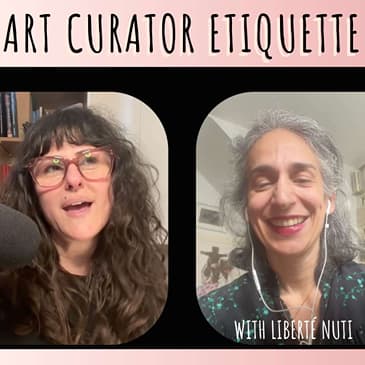
Art Advisor Liberté Nuti subverts the Art Etiquette segment and asks Joana P. R. Neves, our host, if she can interview her. How does Joana organise an exhibition? What is the prep work to conceive, plan and set up an art show? How does she work with visual artists? And more...
We're collecting your art experiences! Tell us what art does to you–specifically.
Read more about it here.
- by leaving us a voice message: https://exhibitionistaspodcast.com
We're launching our 1rst Crowdfunding Campaign: https://www.gofundme.com/f/exhibition...
Exhibitionistas is:
- An award winning podcast (Women Who Podcast Awards 2026)
- A companion Substack page with essays, articles and episode announcements.
- A YouTube Channel with art shorts.
- An instagram with questions & "visit with me series"
DONATE: https://buymeacoffee.com/exhibitionista
Become a monthly member:
https://www.buzzsprout.com/2624749/monetization/supporter_settings
Jingle: "Wunder", experimental poem by Joana P. R. Neves.
Did the episode stir Art Wonderment memories? Share them via text or voice message.
Created & Hosted by Dr. Joana P. R. Neves, art curator and writer with over 20 years of experience in the contemporary art field. Artistic director of Drawing Now Paris since 2018, she has worked across the industry, from the art market to education. She co-launched the art residency and project space Worlding in 2020. Exhibitionistas’ first year offered exhibition discussions with guest co-host Emily Harding; organically, it grew into a more experimental show exploring art topics, stories and interviews complemented by Joana’s publication Art Thinkosaurus on Substack. She champions ‘Art Wonderment’s’ embrace of complexity against the lure of ready-made opinions. A polyglot, she grew up in Lisbon, studied and lived in Paris, to finally settle in London with her artist husband, four children and two cats.
READ JOANA'S TEXTS:
Joana on Substack: https://joanaprneves.substack.com
Where you find the Exhibitionistas Files, our Newsletter: ...
Sometime I'm like great, but shall we ask a question to Joanna? And that's why I wanted to talk to you today. Because you're a curator, what do you do to put an exhibition together from A to Z? Then at day X, you open the door, it's already, and then the party can begin.
SPEAKER_01She is not new to the podcast. We've had her here before, so I know you love her. Her name is Liberté Nuti. So, Liberté, do you want to introduce what you do a little bit? Just to remind the listeners.
SPEAKER_00Yes, absolutely. Hello, Joanna. It's so nice to meet you again. It's great to have another conversation with you. I'm based in London, like you are, and that's where we met. And I'm an advisor and broker in modern and contemporary, which means um I advise people on what to buy or how to sell in the modern field and then the contemporary world. And I've been doing that for 30 years now. Then I'm quite a veteran, as one says. Valuing something, it's also understanding something. Then I spend a lot of time going to exhibitions and read about art. We share this love of visiting exhibitions together.
SPEAKER_01Absolutely. But tell me a little bit about this idea of drawing, of focusing on drawing. What does that mean?
SPEAKER_00Drawing is my specialty. It just happened to me because when I was at Christie's, first I started in the print department, then I was dealing with paper, and then I went to the impressionist department where I was the head of the works on paper for many years. I just love drawing, I understand drawing, I understand the condition of drawing, I understand the market of drawing, then drawing is my love. I'm also married to someone who is um dealer in all-mastered drawings, then we have a drawing life. And I have friends who are artists and who are doing drawings and curators like you who are focusing on drawings. And I'm a big advocate of drawing.
SPEAKER_01There's so many advantages to collecting drawing and also looking at drawing and the proximity that the medium allows for, where you're kind of like almost touching the brain of the artist. That's really fantastic as well. But I know that you brought me a question. So shoot. Tell me where you what where you want to talk about.
SPEAKER_00I admire you a lot as an interviewer and you know leader of the podcast. But sometimes I'm like, great, but shall we ask a question to Joanna? And that's why I wanted to talk to you today. And my question when I go to exhibitions, which is not my it's my field, but it's not what I do, is how do you do an exhibition? What do you do practically when as a curator, because you are a curator, what do you do to put an exhibition together from A to Z? Then at day X, you open the door, it's already, and then the party can begin. What is in your day-to-day and what is the time frame?
SPEAKER_01Oh, I love the question about the time frame because that's a big, big issue. So I'm a curator who works only with contemporary art. When we say contemporary, it usually is the time frame of like after after the Second World War to today, which I mean artists born after the Second World War to today, usually. Um and the time frame is a really interesting question because I, as someone who is independent, so there's two types of curators. There's curators who are institutional, so they are attached to a specific space. So imagine the Tate or the Centre Pompidou or the MAT in Lisbon, where I curated the show recently. So this question of the time frame is very important, first of all, for the amount of work and how you decide how to curate a show. Because, of course, the space is crucial. That's the most important thing that you need to think about. But you also need to think about the time that you have to curate an exhibition. And then for an independent curator, it's quite peculiar because if you're talking about a curator in a big institution, they will be working on one show. If all goes well, they work on one exhibition and then they have a colleague working on another exhibition. So they can be very obsessive and very research-driven if that's their thing, or really have a lot of time to dedicate solely to that project. And so when you're an independent curator, a lot of the times you are kind of overlapping projects. So you are working on several projects at the same time. That's the first thing. And the second thing is that you are not well paid most of the time. And you end up working for about two years, sometimes three, sometimes a year and a half on one exhibition for which you're paid very little. I mean, if you were to stretch the fee that you get across the time that you spend working on an exhibition, you would immediately think, I'm gonna quit and I'm gonna become a chef or something, because it is really a complex thing. But hopefully, as a curator, and I think that's the first answer to the question, is when you're not setting up the exhibition, you have a sort of ecosystem that is established between either your writing or art advising. Some curators do some art advising or managing a collection and your exhibitions, the whole activity of being an independent curator is usually tied up with other activities that are going to feed the project, and that project might also create or generate other uh work.
SPEAKER_00The serpentine gallery, which has a medium-sized space, calls you for contemporary and say, okay, we want to do an exhibition. First, who brings the idea? How does that come? How do you get the idea? And do you bring the idea to institution? Does the institution come to you? And what is the timeline? Is it one year, six months, two years, three years, ten years? Just to give us an idea.
SPEAKER_01Yeah, usually it goes both ways. I am a sort of a slow curator and I don't only curate, so I have lots of activity. So I'm not always building exhibitions. Usually they're tied with um a theme that I might be working on, and also um maybe artists that I want to really develop a work with. And so that goes across time. That can be very lengthy. It can go up to six, seven, eight years in terms of the personal work of the curator when you are in a situation of proposing exhibitions. Then it can also happen that um institutions, when you develop a profile, people know you. And so they might be preparing, say, an exhibition about drawing, and they'll think, oh, Joanna, she works with drawing, let's talk to her. Maybe she's interested in curating an exhibition. And the ideal time would be about three years, you know, to start gathering, you know, your staff, trying to understand what the institution wants, what kind of artists you might be working with, because then there's lots of parameters. Are you working internationally? Are you working nationally, regionally? Uh, do you have to work with a collection, for example, and propose um a thematic exploration of an exhibition of a collection? So there's so many ways to work that I think three years is usually kind of the you start talking with the institution, you start elaborating the parameters of an exhibition, and then you start really working on the show a year and a half before, two years before, and then kind of things accelerate six months up to the exhibition. It's usually not like that. Sometimes you're, you know, people reach out to you and you think, in six months, how am I going to do this? You know, so the ideal and the reality are very far apart. And the the fees change and the conditions change. Sometimes, you know, there's no fee for an aspect of an exhibition, and there's a lot of money for another aspect. So all exhibitions when you're an independent curator are really thrilling because you also get to understand how institutions work, what their priorities are. They're so different from one another. And that's a fascinating aspect of curating. But I have a question for you because I remember that you I think you told me about this a few months ago because you had had an experience, that there was an impactful experience and another less impactful experience, and you thought of the role of the curator suddenly. Why, what happened, and why suddenly did you think I need to formulate this and I need to kind of try and find out a little bit what goes on, you know, what happens?
SPEAKER_00Okay, I can't remember which exhibitions. Um, but generally I always think, well, I just wanted to ask you the question because sometimes I don't think people see the amount of work which goes into an exhibition. Then I think it's just because you're always the interviewer, and I was like, okay, let's what do you do, Joanna? First, and then the second thing is sometime I can get completely excited and elevated by an exhibition, and I always, in a way, think it's the artist. I'm like, oh, I love that artist, oh my god, and I I can really have some big haha moment due to the artist. Sometimes I know the artist and I go and see an exhibition, and I really have a big haha moment, and I know this is not the artist, it's um
SPEAKER_01the
SPEAKER_00curation, exactly. It can be also the for that. I have an example when I went to the Richter um show in um the Louis Vuitton.
SPEAKER_01In Paris.
SPEAKER_00Yeah, Richter is a big part of the of the market, but he's German, he's post-war. I don't really, really get it. Uh I've seen him and his work, and I have an idea, but I didn't really get it. And then I went to see the the Vuitton, and because of the sheer size and the way they've kind of paved it and explain exactly all the phase, and there are lots of phases. A one pawn, the penny dropped, and I was like, I get it, I get Michael. And then everything you know, and you've heard for 20 years, suddenly comes all together. It doesn't mean you know everything about him, but you understand and you're ready to open the books and study more, and then when something will come, an image will come to me, I'm like, okay, that's that period, we can go that way, or I understand. It's suddenly the storytelling comes together. That's what I call a ha ha moment in an exhibition. And some other exhibition, I I I I really get so upset, but really upset. And the last one I think I saw where I was really upset.
SPEAKER_01I think you said it was la end of last year, and I remember I'm pretty sure
SPEAKER_00I went to the Tate, which has always very different exhibitions, and they had an exhibition on Picasso and the theater.
SPEAKER_01You said there were so many masterpieces there, there were so many incredibly important works. And I remember that you were traumatized by and you're not the only one by the exhibition. And I remember you say, and then you went to the serpentine. I remember it was those two parallel experiences. You went to the serpentine, you loved the the Peter Dog exhibition, and you compared it.
SPEAKER_00What I loved about it, and it was Peter Dog, again, an artist we see a lot, is a darling of the market. Um, and what I love about the Peter Dog, which was created by Peter Dog himself and the director of the Serpentine, is you walk there and you think, Yeah, I've seen it. It will be his new body of work, exactly like Cecily Brown now. You know, she has a new body of work.
SPEAKER_01So you're kind of like, okay, I'm gonna see a few paintings, and that's it.
SPEAKER_00Yeah, but also Peter Dog and music, but you kind of
SPEAKER_01No, no, no. You say that like it could have been that, but it wasn't that. It was something
SPEAKER_00what I loved, it was about music, but it was not the music part, which I loved. What I loved is what he did with the music and the installation. Peter Doig managed to make you stop. And you know, we all rush, you go take the exhibition, and then actually I just stopped and I spent a lot of time there. It's not about
SPEAKER_01okay.
SPEAKER_00So you talk about
SPEAKER_01curation. So what did he do? What did he do? I have
SPEAKER_00no idea because I don't know. Oh
SPEAKER_01come on, we know what he did.
SPEAKER_00Yeah, he put music great, but that was that was
SPEAKER_01that's not the only thing that he put there.
SPEAKER_00He put music, he put objects with these big um um with the the big uh what the how to call the speakers, which for me didn't do anything to me. He put tables, I love that he put tables
SPEAKER_01and chairs
SPEAKER_00and chairs, which was very important because some people were just sitting there
SPEAKER_01doing
SPEAKER_00nothing. When when do you see people do nothing in London? I I don't. And I don't know, it was quite spare, and maybe because of the music, it was quite dark. It just you just kind of the my shoulder drops, and I just started to kind of swim into this the paintings, and and that was a gift. But I know it's not a gift like that. I think of course it's a paintings, but I think it's a creation in that case.
SPEAKER_01I it was definitely I think that's a great example, and I remember going to see the show, and it was a little bit like you. It's not that I don't enjoy Peter Doig's painting, it's just you know, painting is so tiresome at the moment because painting everywhere, I know his work, and I thought, okay, I'm gonna see the show. I didn't read anything, and I thought I I left the show thinking I would have loved to have curated that because a lot of my ideas are there that I cannot do, and I very seldom am able to uh act upon them because people are not open to that kind of exhibition. That exhibition hit me like a ton of bricks because, first of all, I was jealous, I was like, you have to be Peter Doig, and then they're not gonna say no to you, because it was so iconoclastic, it was so irreverent, and I think it was important that it was Peter Doig because so Peter Doig, established painter, loved by everyone, uh chérie, uh like the French say, like a darling of the art world. There's no one who's gonna say, I don't like Peter Doig's work, right? So you can be a bit indifferent to it, but you don't detest it. So you kind of go in and you think, okay, I'm gonna see a nice exhibition of painting. So you have painting in your head. So you enter the space and you have this painting that is so enormous, but also not your perfect Peter Doyck paintings. I I find I think it was a very um purposeful installation with flags, like a weird kind of like with blue. I remember the blue, like an interesting painting that was kind of like, huh, okay, well, interesting. And then you go into the space and you have the most beautiful Brancusian object that I had ever seen in my life. Huge, like huge, bigger than you, like these squares with a hole inside that kind of like uh were made of wood, what sanded wood, like very smooth and velvety. They look like sculptures. So Brancusi, you know, this um uh Hungarian or Romanian, I know Romanian. Romanian sculptor, modern sculptor who kind of made these like very ergonomic um and beautifully curved, um very simple sculptures, but quite you know, sophisticated. I thought, what is this object? It was huge, and that wood, you know, you know, used to sing wood like that. And actually, he kind of he um repurposed old auditorium speakers, and so already you're kind of like, oh, this is music. You're no longer thinking of painting, you're thinking of sculpture, you're thinking of spaces where you had a certain behavior that you don't have anymore, like that those things are kind of lost. I mean, there were cinema, old cinemas, but who's going to the cinema now? You know, things are changing. But it was not nostalgic because it wasn't something that you would immediately connect to something in the past. It was beautiful, it was just a beautiful aesthetic experience that you didn't particularly enjoy. I think the person I was with was not super entranced by it. I was like mesmerized.
SPEAKER_00I was not, for example, that uh interesting, but that didn't really do anything to me.
SPEAKER_01Yeah, um the person I was with was not that touched by it, but but the thing is not you it was not there to crush you with beauty, it was just there, like really unspectacularly. Then you have these chairs, and then suddenly you're like, Where am I? And we started laughing with my friend thinking, what is happening? Like, where are we? So some people were sitting, some people were studying with a book, and as you say, suddenly that mystical, solemn, um, authoritarian space of the museum, because the serpent time is small, but it's very historic, it has a lot of prestige. So you go in there with some reverence. Suddenly that was kind of over. Like at that moment, like everything was you were just relaxed, like you said, your shoulders dropped, you were not tense anymore, you spent time in that space. And thank you for saying that the chairs and the tables and being able to read the book in the presence of beautiful paintings is something that you don't have anymore. Like exhibitions of contemporary art now, and that's I know it sounds ridiculous, but if you are asking what I want to do as a curator, what I can do sometimes, and I manage to, is always have a bench, always have a place in the exhibition where even if people don't notice, for me, silences between works are very important. Because I maybe because I'm I don't have a collection, I don't live with art, for me, the art experience is most often than not in art spaces, of course, galleries as well and art fairs, but mostly museums and art centers. And so this ability of just spending time with an artwork that is not a modern or old master's artwork is very rare. And weirdly, you are given that possibility in the National Gallery, but you're not given that opportunity to just spend time. Usually you have benches because people calculate people are going to be a bit tired at this point, and poof, there's a bench. But the benches that are really purposeful for you even to be in the presence of, not particularly, because some benches in museums are just turned towards the artwork. And there it was just a place of existing in that space in correlation to a few paintings, music, and then you had the music, obviously. And the sound for me is very important, and I find that there's not enough sound in exhibitions, and one of the shows that I curated for a very long time, co-curated with Joanna Carrier colleague, were touring exhibitions of an artist who recorded the sound of her drawing, Yama Blank. And we added sound to the space, and so as you entered in the exhibition, you could hear which were the sounds of the first drawings she made.
SPEAKER_00Beautiful.
SPEAKER_01No idea. Thank you. Well, thank you for Yama as well. She passed away meanwhile, but it was beautiful because for me, one of another thing that is very important when I curate the show is how you enter. Because you are you have to condition people, people are busy, you don't know where they come from, how much time they have, you don't know if they're available, what happened to them. And the entrance for me in an exhibition is one of the most important moments. And that moment of having like that kind of sound shower was really, really important. And that's what happened at the Peter Doig exhibition. As you entered, you started hearing the music. And I thought it was such a clever curation, that show. And I think for me, those are the important aspects of I know the space needs to be thought for the art, but the art is not the only thing. You're creating a relationship, and I think that is very much forgotten. And that's the second element that is very important in an exhibition that Deuig and Hans Ulrich Aubres managed incredibly well, which is you have to be a space specialist. So one of the things that I do when I'm curating is I go in and out, I go in and out, I go and I walk in the space, and I every time I place a work, I go out and I enter. I'm a spectator entering in the show. So I look at this and then oh, and I'm like, oh, and I look, oh, that's that. And I try to. Understand how people are gonna be led by the placement of the work when the silences are necessary for the work to be there, for them to stay with the work and then go to the next one, or for some dialogues to establish themselves between work. So you're looking at it something, you turn, and then there is another work that's in that diagonal. So for me, that's really important, which is really make sure that you're not placing works in at the wrong moment. Of course, that's not an objective science. Lots of people go the wrong way, they start from the end, but there is something there that, you know, and thinking also of wheelchairs, maybe people who are not that tall, so kind of try to understand who's gonna be there and how you can kind of find ways for people, you know, who have a different physical experience of the space to also be able to see things. So that's really important. If you have things in vitrines, the vitrines cannot be too tall, they have to be, but they can't be too low either. And I always think of one example, which is Dieter Hot curated the show, and I always tell this to the students whenever I'm invited to go to um uh to lecture or do tutorials, is Dieter Hot curated an exhibition for dogs. So he placed all the paintings at dog level, and I just I wish I had seen that exhibition, and one day I want to create a show just for kids, like just for very small kids. I would love to do that.
SPEAKER_00That's so interesting you say that because um going back to serpentine, I just went to see the Cecily Brown show, which is the a bit the same format of the Peter Dog without the music, but it's it's just paintings, different sizes. Um, and she has some vitrines which are quite high. And the friend I went with
SPEAKER_01the Peter Dog also had a DJ set in the center of. Of
SPEAKER_00course, yeah, yeah. That's the whole thing. I thought that would be gimmicky, but actually it was not. But it was not
SPEAKER_01gimmicky at all. No, no, no,
SPEAKER_00but they you know, when you read about it, you're like, oh yeah, sure, now it doesn't know what to do, and it does you know, DJ, you know, I'll take my son. Actually, the whole DJ scene was very well done. But to come back about the height, then in the CCD Brown, there are a few tables with some of her drawings, and the tables are quite high, they must be at 140 or something. And the friend I'm going with, I went with, she's giving a lecture to the whole class of a of a daughter who's three years old. Then they're going to be 45 in the serpentine. And it's such a shame that they can't see this drawing, especially as these drawings are quite Walt Disney-like, they're very old fairy tale. And yeah, then these poor little children, no way they can see that. Um, then you as a curator, you think a lot about the space and how it's going to work. And it must be very difficult because a space has one exhibition after the other, you have two or three weeks in between, maybe. Then if you work a year and a half in advance, and then let's say for a year you come in and out. I'm a spectator, I come in and out. Maybe the the the section you put in are different, then you must be like an architect using a lot your imagination, being like, Okay, in a year, the space will be empty. Let's forget about what there is now. How I'm going to see it. You might use a different paint, you might use different divisions. That must be quite hard not to do you work with like maquette or how do you do it to once you've in and out for like 50 times, how do you matter like make it? Do you make drawings? Do you do 3D on your computer? Do you do something on a napkin?
SPEAKER_01There's the phase of trying to understand what angle you want to explore in a work, in an exhibition. When you're working with one single artist, it depends if it's a retrospective, it's if it's a new project. So you have to define also considering the whole body of work, how you're going to go about doing this exhibition, what kind of works you're going to be looking at, and then how you you what what works you would group together. And then
SPEAKER_00does a space influence your thinking?
SPEAKER_01Of course, there's different aspects of the space. So you can think in terms geographically. Is it in the mountain? Is it an urban space? Is it near a border? Are there any um very close proximities with you know issues of immigration or displacement or a very specific relationship to a landscape, so water, bodies of water, for example, that happened in the show at Mat, where uh Isabel Ferreira ended up um producing this very, very large work that she calls uh Teajou, which is uh the Tagus River, which is the river that should that wall not be there, that you would see. Um, so oftentimes there is a connection that you are going to establish very naturally because again, this is all about
SPEAKER_00then it's not only the inside of the space, like an architect's buttons also the geographical place of the museum and the meaning of the museum in a way.
SPEAKER_01Yes,
SPEAKER_00it's inside and outside. Wow. Okay.
SPEAKER_01If the museum has a mission, for example, a particular mission, um, say a museum is particularly interested in um, I'm gonna say landscape because I hate the word, but you know what I mean, like landscape or territorial um connections between communities, you know, that kind of thing. Um, that's going to be very strong in terms of the background that people will have when they enter. There's the uh Musée de l'immigration in Paris, the Immigration Museum. It's already so it informs so much how people go into the space. But then there's also kind of these more um evident and um main axes of a space, which are, as you say, internal, the light is incredibly important. Some places have like a change across the day, sometimes across seasons. Then you have the question of the height of the ceilings. If you have very big, big works on a wall, and then the ceilings are very low, it can really squish the artwork, and the artwork just doesn't radiate. There's some, I mean, it depends on what the artwork is creating, but let's talk about you know the aura and the presence of the work. So all of that has huge importance. And then the question of the the kind of work that you choose is incredibly important because, as you said, and that's what I love about exhibitions, is that you have spiritual, magical, sacred, philosophical, aesthetic considerations, and then you have the most pragmatic decisions to make, as in is it very hot? And is, you know, if you use that kind of tape, it's gonna like, you know, usually museums have conditions that that have stable temperatures. But I've curated shows in very different kinds of spaces. You I even curated shows outside. So all of those parameters are really important because sometimes you're talking to an artist, and at a certain point you ask a technical question because they say, well, you know, this is gonna hang from the ceiling, it's gonna be, you know, um uh held on the ground, and you're gonna and you think, oh, okay, so do you what kind of things do you use usually to hang and to hold the piece? Oh, I don't know. I was thinking of taking talking about the technical team and the technical team in contemporary art is always you never know, you never know. Some teams are incredible and they fix everything, others just go, oh no, no, no, that's not possible. And then you have to figure out. And sometimes the curator finds themselves, especially in contemporary, finding technical solutions and using the their imagination. And that's the beauty of it when you've worked two decades in contemporary art, is that even though you're not a technician, you're not a specialist in any material, you've developed so much experience. That's what happens with contemporary as well, is that artists, because they are no longer only painting or drawing or using the traditional materials of art making, sometimes they don't know their materials and they arrive at the exhibition site with a lot of trust and a lot of hope that things will work out. Because that's part of the work, and I think that's the beauty of art, is that the material becomes sacred, and the sacred becomes um an immersive uh experience, and the tune And
SPEAKER_00it's also very practical. Um and I guess I'm thinking when you're talking about a sculpture, for example, if you bring, if you have a contemporary artist, uh let's say uh Phil Dabalo, she has these huge sculptures. First, how do you get them through the door? That's question one, but also you have to make sure the floor is going to hold the weight. If you have um things in in bronze, which if they are big, they can be very, very heavy. You want to make sure they don't go from first floor to second floor by collapsing. But that's that's that's the reality of um work of art. Um when when when you figured out more or less, maybe we we know you're going to get into technical things at the end, uh, and that's the fun of it, I guess. Uh and the
SPEAKER_01plan. You wanted me to talk about the plan. Well, how do
SPEAKER_00you kind of um verbalize it, put it in writing, explain it to the others because you don't work alone. You know, first you work alone in your head, but then you have the artist, you have the tech, you have the museum director. How do you formalize all that? Or maybe you don't, I don't know.
SPEAKER_01So you were talking about like mapping out the exhibition, and I was kind of laughing because I use something that is called freeform, which is uh sort of a uh it comes with uh an Apple computer and it's like the most basic, it's basically just a white sheet with little dots,
SPEAKER_00okay,
SPEAKER_01orthogonally placed. And I just make like a wall. If I'm if it's just a wall situation, I love doing it like that because I I don't understand SketchUp. There's a lot of institutions that will send you SketchUp um configurations of the of the space, but the problem is that SketchUp doesn't tell you what the experience of the space is, so you need to have photos. I had I'm at Fantastic, so I don't visualize for me as a curator, it's really, really complicated. But that's also the pleasure for me of curating exhibitions, and I'll explain very quickly. So I don't do SketchUp. If the if they send me a SketchUp, I'll do it. But I it's for me, it's absolutely not useful. For me, what's essential is going to see the space twice if possible before setting up the exhibition, then having the floor plan. The floor plan for me is essential to make sure that you're not like thinking of 20 meter uh photographs, like me in terms of width, and then arrive at the space and be like, okay, there's only space for 10. Like that's kind of like the the obvious thing that you need to just calculate and place things. And I see. Yeah, but they're
SPEAKER_00important because all these things they're also costly. Moving these things around,
SPEAKER_01the shipping is incredible.
SPEAKER_00Shipping, making an error. You have a scripture which you ship, then it just cannot the floor can't cannot hold the weight.
SPEAKER_01But then um, what I do is that, and that's something that's quite odd. I don't know if other people work like that, but I need um a holding artwork. So I usually have one or two works by the artist or the artist that are central and pivotal to the exhibition, and that's where I start. And they don't have to be in the beginning, they don't have to be at the end. I usually have an idea of what works I want to start with, what works I want to finish the show, if it's even if it's a circular, there is always a progression, and then a kind of holding work. And usually the holding works can be the first and the last, but it really is something that kind of like sits.
SPEAKER_00Then you need an anchors like like in a book, basically. You have you have the first story, the anchor, the plus three, exactly, and then the conclusion. Okay, then it's it's it's really building up the story.
SPEAKER_01Yeah. Um
SPEAKER_00fascinating.
SPEAKER_01I have a theory, and and that's the thing that is the most complex because you talk about planning, but for me, curating an exhibition is a really, and I'm gonna go for it, I'm gonna say it, it's a sacred experience. It really is not um um a sort of like a placement of things. Oh, let's put this here, it goes well here. It really is a sort of a sacred mission that you have, and it's an embodied mission, and it's a pleasure, it's fun, it's supposed to be fun, it's nerve-wracking, really, but it's also fun. And for me, the ideal setting is to have one or three or four series, a little bit more works than those I want to use. And usually artists always do that, by the way. You say like insurance, and oh, you have to not disappoint. That happens a lot, especially maybe it's my experience because I tend to work with people who work like that. But I love to go there, have the anchors, place everything on my map, but I know that it's going to change because
SPEAKER_00then you allow flexibility in your mind.
SPEAKER_01Allowing for flexibility for me is very important because you can preempt everything, but you will never, and I don't believe you can, unless you have like you're a hyper-visible, you have um hyper um, how do you call it? Anyway, you know, people who like visualize everything, which is the opposite of what I do, I guess. But apart from that, the it's not only a visual experience and exhibition, artworks sometimes you arrive at a place, you place them, and you think that's the perfect setting, and they're eating up everything because they have too much energy, and then there's like these delicate works that you see on an image and they speak to you, and then you arrive at the space, even if you saw them in the artist studio, it doesn't matter. You place them and they disappear, and you have to figure out a way for them to exist in the space and honor them and honor the artist. So for me, and that's the thing that I have had a few moments of puzzlement, because a lot of technicians expect you to arrive with this goes this, this goes that, this and that. And then I'm like, why are you even calling the curator then? If you have, if you want to have like a placement and you just want to know heights, you know, oh, it's 120 in the middle of the work, or it's you know, on it's on the wall.
SPEAKER_00Sometime when you have this big haha moment or these magical experiences in exhibition, I'm like, what did the curator do to make it work? And also as a curator, what makes you think, oh, that's successful? Then is success, from what I hear from you, it's this kind of like often in life, this weird mix of there is a technical aspect, which clearly with experience that's brilliant, and you you you you you know how to you you have the know-how, and then you do the you have your own practice with working with the space, designing, going in, out, and then you also need for the success this magical moment, this this kind of things which you don't know, all the stars are aligned, and then suddenly it's magical, then is that the recipe to a successful exhibition to you?
SPEAKER_01Yes, absolutely. I would only add two things. One of them is that because you if you allow yourself to experience the space, to live with the work, to rediscover the work, I think that's kind of the key because artworks don't exist in artists' studios, they really exist in proper spaces.
SPEAKER_00Oh beautiful.
SPEAKER_01There's a moment always when I'm setting up an exhibition of sheer, unadulterated, pure panic, where I think this is not gonna work. And that's the best moment. That's the moment where you know that magic's gonna happen because you are present, you're open to the experience, and you're allowing yourself to rediscover the work, the space, the relationship with the artist, the project. The other thing that I would add is that
SPEAKER_00and be creative in a way, you let your create you're open to your emotion and your creation. Then there is a creative side to the curator um job.
SPEAKER_01Absolutely. Absolutely. It is a different kind of creativity than the artists, but there is
SPEAKER_00clearly you have something where you need to get the magic.
SPEAKER_01You need to you're writing a story, a visual verbal story most of the time. One just give you an example. One day I curated the show, and still to this day I'm like, why? I can't understand. It was a co-curated show. It was not just me. We I didn't hallucinate, but the only place for a piece, a beautiful drawing by an artist called Marine Pajès, had to be on the floor against the wall. And I don't know why, I know why, because the it was a sort of like orthogonal landscape, like an American-drawn landscape, and you saw it from above because it was a picture from above, and weirdly the drawing came together from that perspective, but we were so I don't know, it it it it kind of rattled us. We were so because I told I was the one who kind of like unblocked the thing. I was like, I I think this only works there, and there was a moment of silence and of like, oh my god, but it looks so gimmicky. I was like, Yes, but it doesn't work in any other way. So we went about trying other things. So that's the thing, you need to be really open, and contemporary is good for that, because it also, as you say, stimulates other forms of creativity, and then the other thing that I find really important just to finish is knowing, but that's me, knowing the artist's work really well because you're the one who's delivering the story to people who don't, and you can't know the work.
SPEAKER_00That's so crucial, and it's it's apart from the pleasure of discovering an artist, enjoying the work of art. I'm also part of the school that when you go to an exhibition, it's to open your eyes, enjoy it, but also understand a part of the puzzle, of the story, and sometimes, and that's where that's where I was very pissed off at the at the Picasso um exhibition at the the Tate, is some artists, and you it's a bit less you, but you need to tell the story with key questions. You cannot go up to the moon and maybe to uranium. You know, you have to, as an institution or a curator, say, okay, that's historical. There's not every five minutes an exhibition on the artist. Let's go back to ABC, like a little questionnaire for children that people understand the basics. And I think that's a very important part also of your work, which we'll reflect in the catalogue, but you also very much reflect in the past of an exhibition.
SPEAKER_01Absolutely. And also good exhibition texts. I'm getting really, really tired of bad exhibition texts. I I'm I'm quite shocked actually because we've been talking so much about this, and I I think they're getting worse.
SPEAKER_00Yeah, I
SPEAKER_01um
SPEAKER_00narrated. I don't know why. I had a funny experience. I went to the um Freud show, which was beautiful, Alecian Freud and Drawings at the National Portrait Gallery. I think it's finished, and um it was quite a nerdy exhibition, and every drawing had
unknowna uh
SPEAKER_00how does it call that a label. Very detailed. Yeah, but very, very detailed. This is the friend that did that, and she slept there, and she did that. Each time there was a story, and at the end of the exhibition, it was kind of a a glimpse of that time, all these friends, and who slept with who and who saw who and when, and they had arguments, and it was really great. And I thought, wow, it's you know, it's like a biography in a way. And then I I I wanted to buy the the the book, and the book was so poor. None of the things on the label was in the book. The book was very simplified.
SPEAKER_01You know why?
SPEAKER_00And I was like, why don't you put you've you've done the work, why don't you put all that work in a cat? I can tell
SPEAKER_01you why.
SPEAKER_00Why?
SPEAKER_01I can tell you why. Because they those texts that you found so interesting were not for you. Those texts were for the people who didn't know Freud because the National Gallery is, you know, it has lots of visitors who know nothing about art.
SPEAKER_00Sure.
SPEAKER_01And they despise that kind of information. They give out that information to seduce audiences because they think they're stupid. And that's
SPEAKER_00the thing.
SPEAKER_01And they were
SPEAKER_00so good. That's where you want to.
SPEAKER_01Those texts were the they should have invited that my theory, and this is going to be recorded here, is that you have to invite people in your team who are not curators, maybe not even from the education team, certainly not the interpretation team, which is the people who write only texts in like big institutions, and ask them to write about the text. Invite writers, invite people who love art, who knew the artist, and help them write. But the problem is the same thing that I was mentioning in the beginning with the chairs and the tables and the weird um uh repurposed speakers, they only are there because it's the artist's um you know decision. But the problem is that in visual arts you have the we have this purity of the artwork, and we don't understand, and since Abi Warburg said the same thing, you know, famous uh German historian, art historian, is that this kind of correlation between two languages in an exhibition space is a sin. It's an art it's a curating sin. And I don't understand why. Life is made of hybrid experiences, and that's the thing, because that for them the text was for stupid people who know nothing, and and they don't understand that that's what the artist was thinking about, that's what was important for him, and that's what is in the paintings for all the people who were in his um, you know, the London School of Arts, that's what they saw, and so you're serving that, you're recreating that experience for the people who are not their friends or weren't you know living in that time where you know. Yeah, but if you
SPEAKER_00I don't understand if you do a full two or three paragraphs on a drawing, it's very technical. Why not reproducing that in the catalogue? Because that's where you want to keep. But I I understand where you're coming from, and uh but I thought that was a shame. And now catalogues in general, you have like three essays, and then pair work. If you take old catalogs, normally the the curator will write an essay pair work, explaining the work itself, placing it quite nerdy, and that has disappeared. Now they put like 50 images, and then that ends up with huge books, as actually you want to have an explanation pair work. Well, I do. Uh, but that's great that you keep that um view of educating and taking people by the hand and opening their eyes, but also putting that in context, and that's very important. Um, I'm going to tell you how I do exhibitions. Uh, it took me a lot of time, and maybe you as a curator that would interest you. I've kind of put a system in place. Uh uh that's quite recent. Um, well, it has built up over the years. And when I go to a very big retrospective, which makes me tired because you can have like 10 rooms, 15 rooms. Now, what I do, I enter first room, as you said, super important. I relax, I read the intro, and then what I do, I go through the whole exhibition at a normal pace, enjoying each room, but just passing through to have an impression, see what catch my eye, and understand what the curator wants to do and what the story and what's the length. Because sometimes you get stuck in the first three rooms for two hours, and then you realize, oh my god, I have another 20. Then I have an idea of the story and where I go and how I'm going to pace myself. And I go the whole thing, enjoy it, and then at the end, I go back to the start, and then I go nerdily to one room after the other, depending on the time I have. And that's really great because you you kind of know how many chapters they are.
SPEAKER_01Uh,
SPEAKER_00and then I I look at everything, and normally at the end, I do two things that I've I've done for many, many years. I go back also, or that's when I go a second time, and I choose one room work by room, my favorite work, and then I choose the top work on all these works. And now what I've been doing, and here the bench um idea, I find a work and I sit in front of it with a timer for 10 minutes. With
SPEAKER_01a timer?
SPEAKER_00I put a timer, yeah, yeah. Yeah, because you sometimes things can look like I put on my phone, like I did to timer, 10 or 20 or 15 minutes, if I don't have too much time, 10. And you sit and you get bored or you get excited, and then you see things, and you get and you it's like swimming in the work, and this is fabulous. That's why benches can change your view about something, because then you really get into it. That's my new um kind of way to see exhibition, and I love that. I have to be alone when I do that. Uh, but maybe that'll give you a little glimpse of how you know thinking of your audience uh and the spectator.
SPEAKER_01That's really interesting to know, you know, that you do that, but it's also like a professional, a professional's perspective. But I think it can be really nice actually for someone who feels a bit overwhelmed when it's big exhibitions, a really good technique, actually.
SPEAKER_00Maybe it's professional, but actually it comes from my my passion, which is to go and see exhibitions. Uh I had that since I'm 18, and it's something I've developed over the years, and it's not me as a professional. Me as a professional is to go in tick, tick, tick, I've seen it, understand it, I live. This is really me as a person.
SPEAKER_01I think it's a very empowering way, actually, visiting exhibitions, rather than being crushed under the weight of having to understand immediately, you know, just kind of develop a relationship with the space. Like we like we said, you know, I think people are not aware enough of how much the space has an influence, but also your tiredness and your openness are predicated upon, you know, the the the the the uh size of the exhibition, the time that you have to stay there. And we don't often think about those things, that those things are important to manage as well when you visit. Well,
SPEAKER_00the big I think because exhibitions are expensive now, often they are they they can be very, very long and overwhelming and tiring, and you think, okay, if I knew I had I would have taken my morning or I would do it in two sections. Uh some of the big blockbusters are difficult. Uh and maybe because you've paid for your ticket, you really want to see it until the end, or you don't know when you're going to come back. And sometimes you can't swallow everything. How much do you involve the artist? Um and is there some moment where you prefer not to have the artist, or you know, is that good for you to have the artist in general? Because you are in the contemporary field, which is a bit different than dealing with exhibitions which are retrospective or about dead artists. When you have the artist, there is your say, but there is what he thinks too, or what she thinks.
SPEAKER_01For me, it's really crucial to work very, very closely with the artists to see how the work was made, if I'm missing something about the work, and that is very much about intense meetings, but also across time, because you also need to establish your own relationship with the work, because one of the things that I'm often told by artists is how curators help them see the work as well.
SPEAKER_00Ah, yes, yes.
SPEAKER_01A mutual beneficial um relationship. And then there's they
SPEAKER_00feed you, but you feed them.
SPEAKER_01Oh, absolutely. Yeah, yeah, yeah. Absolutely. It really is when it goes well, you know, and um I have worked with artists who are so knowledgeable of their work and so in tune with what they want from the audience, that you're not doing much there. And it's a very frustrating exercise because some artists are very prescriptive, and at a certain point, for me, I don't think they really need a curator, they need uh a curator who is there in the space with them when they can't really have a distance or when they need to solve some sort of thing in relation to the space, but and that's kind of rare. I I've worked with artists who pretty much want to establish a relationship, but there's all kinds of artists. And also it takes time for an artist to trust you because they know the work, it's their baby, it's a very strange relationship or situation for an artist to suddenly share the responsibility of putting the work out there, and they really have to trust you. It takes Yeah, because
SPEAKER_00you have your views, you can have strong views, you can have wrong views. Um, I understand it.
SPEAKER_01And and uh another thing that I think a lot of curators and institutions forget is that one exhibition with the same amount of works can be done in many different ways. There isn't a truth in regards to an exhibition. When you visit an exhibition, it is a possible um some are like honestly kind of like very difficult to reshuffle, but it is always a perspective. So it it is always the the outcome of a relationship and of course
SPEAKER_00it's always a point of view,
SPEAKER_01and also at certain moments you can't have any distance as a curator, you need the artist, and sometimes the artist really needs you because you come at the space and you kind of have that ability of being from the outside and being more able to put yourself in the space of like a hyper-specialized spectator, but spectator nonetheless, and so that relationship is really beautiful, and it's very that's why I was talking about like sort of a sacred thing. I mean, without I mean, I'm not like lighting candles, I uh laugh a lot. No, no, but there is a magic, and and
SPEAKER_00you know that's what the question is what makes an exhibition a great exhibition, also, and what a curator does to achieve that, and then you've explained very well this moment, but in life it's I think the same for every job. At one point, you you know you are in uh possession of your knowledge and your technical skills, but then you are inspired, and when these two things meet, uh it's success. Uh but what I love about what you talk about, and I didn't really uh well, of course I could imagine that, but it's incredible how much you care about the audience and you have that in front of your mind. It's not about just the story you want to tell, or the the story that the artist wants to tell, or or the maybe not the story, but uh what the he wants to explain, or she. Um but you really care about how people will walk in in the exhibition and the audience and how to make it easier for them and make it resonate, which is great. Um, and it's a big clearly a big part of your vision and what you think about.
SPEAKER_01Yeah, I like to share my passions, you know, and I'm very often told that I'm hyper-intellectual and that my texts are dense and hard to understand, and that I say too many things at the same time. I think it's also for me the possibility of letting go of words and trusting um that something that is material, that is just there. I I usually say a thing in the space is is carrying more than what you could verbally say about it. And we tend to forget that experience, the fact that things are really meaningful to people and to us, and we language is not just reduced to words. I'm here communicating with you, and my eyes are doing things, my hands are doing things, and I with life I've come to and with experience because I'm such a lover of words and and conversation and text, I've come to realize that communication between people is I think like 80% based on everything but words, and that's why art is so important.
SPEAKER_00That's another part, also, I guess, in the preparation of the exhibition is okay, you have the launch, people see it, but then when people leave the museum generally, you go through the gift shop, and the idea, and it's important for a museum that people buy the book. Uh well the museum I know they when there is one, then I guess then when there is one, then I guess also part of your doing in doing an exhibition, it's also writing the catalogue which goes with if there is one, which goes with it. And how much work is that? And how much how does that look like to put your exhibition, the space, all the thinking in words, in a book, in in and in a design in a way? What is that last part of the jigsaw?
SPEAKER_01I think that's what m comes the most naturally to someone like me, because then you have so many profiles of curators. There's curators who really don't write um or or really try to delegate as much as they can. If you're an independent curator, usually come as a package, and usually you're asked to write a lot, you know, a text about the okay,
SPEAKER_00then that's a big part of the job. Okay.
SPEAKER_01Big big part of the job. So and the thing that's become even more complicated.
SPEAKER_00And the writing on the exhibition, not your writing differently. I'm meaning the writing for the exhibition, huh?
SPEAKER_01You mean the war texts and the the letters? Yeah, well,
SPEAKER_00everything which is part of the doing an exhibition takes the. The
SPEAKER_01smaller the text, the most difficult it is to write. Because a war text, you know, there's sometimes there's exhibitions with like endless war texts. I really try not to do that because I hate reading, just standing up and reading a text. So I try to condense. That's a very difficult task to write, to choose the essential things to say for to in order to inform the experience, but not determine it. So there's a fine line between those two.
SPEAKER_00And you don't want to take too much the attention of the painting, and you don't want to make like, for example, when I go back to the third exhibition, which was great and the labels were excellent. If you read all of them three hours later, you're still there and you're room five.
SPEAKER_01Yes.
SPEAKER_00Then it's also an important balance to make it digestible in a way.
SPEAKER_01Yeah, yeah, it is. And I don't think you need labels for everything. I think that in that exhibition, I would have kind of maybe chosen a few portraits and then have maybe a QR code with all the texts and like a file or something. I think texts can be very invasive in an exhibition, but necessary, they're necessary. So you have to really balance out. And sometimes it's not you, it's not your choice. The usually the institution has a very clear um policy on that, and you have to follow it. And then I think in
SPEAKER_00the fruit case, I think cure codes, you know, I always download them, but I never read them. Then I think that's completely useless. Uh
SPEAKER_01depends, if you have a nice object, that's a problem. Is that how do you manage
SPEAKER_00it?
SPEAKER_01Well, then I I
SPEAKER_00would I would have this technical text in a catalogue that you buy that you read at your leisure at home of a one month to month.
SPEAKER_01You can't buy all the catalogues. I think that's that's a really
SPEAKER_00that's another problem. Yeah,
SPEAKER_01that's a big problem. And I think in museums, I what's irritating me the most at the moment, and you think you say I I I think a lot about the audiences, is that you um I think people are thinking about audience that are living in you know somewhere else because you cannot always um buy catalogues. I really choose my catalogs. I choose which ones I buy, which is which ones I don't buy. But sometimes when I choose not to buy, I would still love to have some information. And bear in mind that I'm working on applications, I'm gonna start applying to the arts council for my non-prof my nonprofit. And one of the things they have is accessibility. And all these big museums have arts council money, and they write the crappiest texts you will ever read. You go to a small museum, texts are usually much better than those that you find in bigger, especially contemporary art museums.
SPEAKER_00Really?
SPEAKER_01And yeah, like I went to Focal Point the other day. I mean, for yeah, this oh gosh, it's been a while. But and I remember reading the text and thinking, well, this is really great. These are great texts, they're exciting, they're fresh, they're they give like one or two pointers, but they don't like tell you what to think. And uh so one of the big things of the arts council money is accessibility, and accessibility is also intellectual accessibility, so access to information about the work. And I don't understand the money they spend with those leaflets that are absolutely useless. I don't I don't understand where you could have a nice QR code, and you of course you have to announce it. You have to maybe to have an example of it, like a nice, beautifully designed um website or app or something where you could you know go there and think because sometimes you're talking to a friend, you're like, oh, there was this exhibition, what was it called? And you can go to the app and just get it. Instead of using stupid AI for everything where texts are horrendous, they don't mean anything. Like if you if I see intersection, fostering, um, anymore, like the words that AI uses for anything related to culture, because cultural projects usually have three elements, like you have post-colonial, and then you have uh misplaced displaced people, and then you have the immigrant experience, and then you have the heritage of the and because there's different parameters, because art is not like a one single topic thing, the AIs produce words that you know kind of like enhance, foster, intersect, interconnect, uncover. It's always the same words, and they become absolutely meaningless, and that drives me crazy. It just horrifies me. But anyway, one of the things that is really difficult at the moment is that when it when it comes to texts, the amount of text that you have to write now is much bigger than you used to when I started. That's just
SPEAKER_00that's a world. That's a world because um I think I was just reading about that. You write a lot, everything has you know, the speed of things um has increased a lot. You have to write more, there's more things, everyone writes more, and then also everyone is using AI, AI makes things longer, and then that's more writing, and then to that more writing, you have to reply with more writing, and it's it's a snowball effect. And uh in your field particularly, but in other fields, um, hopefully that would be corrected. Um
SPEAKER_01I think it's a good thing. It's um because back in the day you were asked to, yeah, because what the writing I'm talking about is sometimes technical writing. So when you curate an exhibition, when you're an independent curator, one of the things that you have to do is to work with the education department. And so you have to produce texts that are accessible, technical, um, you have to uh suggest entry points for you know visits, and you have to do visits with them. So you have they need information way ahead of time, and then they want information while you're setting up the exhibitions, which is always a nightmare, because when are you gonna do that? And then you have talks sometimes. So you have to prepare a talk, so you have to write the blurb for the talk, then you have social media, and then you have the translations, and being, you know, the crux of being a polyglot is that the quality of translation is diminishing because everyone's using AI. And I, in the last show I did, I spent most of the time rewriting the translations, which were horrifying. They were really, really bad.
SPEAKER_00You put a lot of juice, huh? It's it's a lot on you. No, but that's also that's why I wanted to know what you're doing because we don't see that as uh visitors. Um, we don't see you do the education and you do the blurbs, and you you know, it's uh I could imagine you were doing the catalogue, but this is a lot.
SPEAKER_01Yeah, it's a lot, and you also have social media, so you have To do videos and you have to make sure that the information is correct. I mean, if all goes well, usually they should submit the posts that they do. And um yeah, but there's a lot that you have to do that is not particularly writing, but involves writing. You have to script what you have to say in the video, you have to think, you have to choose your words, and then you have to choose the appropriate, the appropriate vocabulary for each kind of uh audience that you have. Because if you're doing a blurb for a talk, it has to be really accessible. There might be students involved and interested. But then if you're doing a visit for the friends of the museum, so collectors, scholars, you know, people who kind of are a bit more knowledgeable about art, then you have to produce a different kind of uh text and presentation. So, of course, it can be varied, and and museums have different again, you have to also adapt to how the museums present things. So there's yeah, there's a lot of work and a lot of um uh uh you have to have the ability to adapt, but I have to say, I'm saying this as if it was a negative
SPEAKER_00adapts.
SPEAKER_01I like being on the outside. I don't I I would not be able to work in one single space.
SPEAKER_00I think you're a free bird and you like to do many, many things uh on many channels, and I hope your audience is following you on many channels, the from Substract to Spotify and in a um all your Instagram. Then tell us uh that we can follow you. What is or are your next exhibition you are thinking about within the next three years?
SPEAKER_01What is
SPEAKER_00on your desk now?
SPEAKER_01I I have one that is not confirmed, so I I'm I'm not gonna say anything about it. So, what I'm working on now is with uh my nonprofit, so World Inc. in Elephant and Castle, uh London. And uh that space is thought to expand the experience of creating work and also of seeing work. And so I'm working a lot on workshops, on events, talks, uh, how to curate open studios when we have residents over there, new exhibitions and exhibitions that are actually crossing um charity work and uh civic work with pure contemporary art, so like not completely um under the weight of the theme of the exhibition, so real quality art with uh those priorities. So we partnered with a collective, with a charity called Collective Aid, and through them we partner with other people. Um and so I'm working also uh on partnerships with different foundations who send artists or who use the space to then uh try and reconfigure how we talk about art, how we show art, how we create art, and how we experience it. So I'm trying, as you know, museums and universities, art schools are in a big, big crisis at the moment. I think crises are good. You know, it doesn't mean that they're going to disappear. Okay, but yeah, you
SPEAKER_00keep us posted, and we cannot wait to go and see your exhibition, experience how we are welcome as an audience. Uh, if you answer our question and hopefully be enlightened.
SPEAKER_01So I'm gonna ask you to wrap up because you've been interviewing me, which is not the purpose of our etiquette, but I I I I accepted to play the game and it was very You had the guest today.
SPEAKER_00You had the guest, it's different.
SPEAKER_01It was very, it was very pleasant. I think very good interviewer, very good. You could take my place when when I go on uh I was gonna say maternity leave, no more. That's done. But when you have no
SPEAKER_00audience, Joanna has four kids.
SPEAKER_01Yeah, who are grown-ups, by the way, most of them.
SPEAKER_00Yes. Um busy person.
SPEAKER_01Busy person, but when I go on a holiday, you know, maybe you can replace me at exhibitionists. So thank you. Thank you so much for this. This was so pleasant. Thanks.
SPEAKER_00And we've learned a lot. It was great to get into your world because you are a fantastic woman. What you do is rare, you work a lot, you're passionate, and you know, we need more people like you, and it's really fantastic. Then thank you for giving us your side of the world.
SPEAKER_01Oh, thank you for asking. That was really, really nice of you. Bye bye.