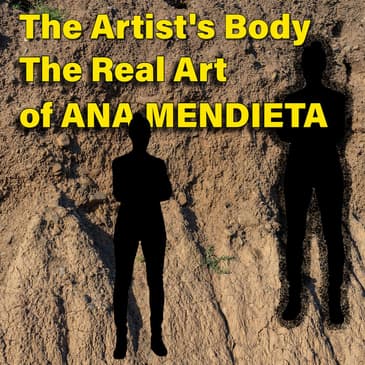
What does the artist’s body do? No one pushes us to ask this more than the Cuban-American artist Ana Mendieta. Her excavated silhouettes in the landscape, where her body would at times lie, covered with petals or feathers, are but one of the actions and rituals that she performed during her short career. What did occur in her own body? Community? Communion? What was the origin and the purpose of her embodied art? And what is the medium for this kind of art, happening in and with the body of the artist?
Did you enjoy the episode? Think about supporting Exhibitionistas by leaving a small donation: https://buymeacoffee.com/exhibitionista
Celebrated for being a visionary eco-feminist, an activist against violence women, Ana Mendieta’s work is often obliterated by the sensationalism around it. The exhibition at Tate Modern feels like meeting the artist for the first time. For more info: https://www.tate.org.uk/whats-on/tate-modern/ana-mendieta
Sign up for a tiered monthly support: https://www.buzzsprout.com/2624749/monetization/supporter_settings Your contribution keeps us going.
Art Etiquette Segment guest:
Esther Stanford, is the co-host of award winning podcast Limited Time Only (with Susie Riddell, WINNER: ‘BEST COMEDY MOMENT’ International Women In Podcast Awards 2025 sponsored by BBC SOUNDS), she is a sketch and TV writer. You can find her on Instagram, on YouTube, March House, a channel she has just launched where you can also find her podcast Conversations with Creatives. Or simply her website: ww.estherstanford.co.uk.
Soon: Bonus – full length Art Etiquette episodes.
Segment: Brainstorm in a Teacup:
Come for the art, stay for the creative writing segment, where Joana reads short texts from her notebooks exposing her inner thoughts and unexpected fictional / poetic / non-fiction / flash writing.
Jingle: "Wunder", experimental poem by Joana P. R. Neves.
Did the episode stir Art Wonderment memories? Share them via text or voice message.
Created & Hosted by Dr. Joana P. R. Neves, art curator and writer with over 20 years of experience in the contemporary art field. Artistic director of Drawing Now Paris since 2018, she has worked across the industry, from the art market to education. She co-launched the art residency and project space Worlding in 2020. Exhibitionistas’ first year offered exhibition discussions with guest co-host Emily Harding; organically, it grew into a more experimental show exploring art topics, stories and interviews complemented by Joana’s publication Art Thinkosaurus on Substack. She champions ‘Art Wonderment’s’ embrace of complexity against the lure of ready-made opinions. A polyglot, she grew up in Lisbon, studied and lived in Paris, to finally settle in London with her artist husband, four children and two cats.
READ JOANA'S TEXTS:
Joana on Substack: https://joanaprneves.substack.com
Where you find the Exhibitionistas Files, our Newsletter: ...
Well hello exhibitionistas. Hi, aspiring exhibitionistas, very welcome to the Exhibitionistas' notes on contemporary art and life. I'm Joanna, your host, contemporary art writer and curator, and you can find my writings on the page Art Thinkosaurus, which is a homage to the Beastie Boys' song, What Comes Around. At the very end, Adam Yauk says out of the blue, Doris the Thinkosaurus, and that always stayed with me. And so when I had to name a page with my writings, what could it be? What name could I give it? Of course, Art Thinkosaurus. Thinking of Adam Yauk shouting that. Only to discover recently that it is, in fact, Doris the Thincosaurus with an F, and it comes from the Flintstones. It's my personal joke to myself, which I now share with you, and that you will either think quite bizarre or appreciate. Who knows? Let me know. I would love to know your thoughts on this. Anyway, if you enjoy this kind of uh meandering musings, this is a space for you. You arrived at your art wonderment podcast. Welcome to this space. Don't forget, you have two segments, as per usual. There's art etiquette coming up in the middle of the episode where I invite someone to bring in a question about contemporary art. And then at the end, you have Brainstorm in a teacup, where I share writings that I find in my notebooks as a moment of vulnerability, but also a moment of creativity. One of those moments that stay in those journals and sometimes are lost forever. So why not put them out there? You know? Why not make a fool of myself while I can, while I have the opportunity for it? I mean I did create the space for that, right? Right, that's it. So without further ado, on with the episode. I hope you enjoy it. Joanna from the future. You know, these are the wonders of editing. I realized that I didn't really introduce the artist with the exhibition that I'm talking about all throughout the episode. So here you go. This episode will be mostly focused on the work of Cuban American artist Anna Mendieta, who has a show currently open at Tate Modern. Survey show quite a substantial experience of her work. Anna Mendieta was a Cuban American artist. She was born in 1948 and she passed away in 1985. She is very well known for her earthworks. She also produced a huge number of drawings, a few sculptures, video works, photographic works that are based mostly in the actions performed by herself for nature, for an audience sometimes, with a small community of people. You'll know everything about it. And I also invite you to look at her work through the perspective of a very unique experience, physical, embodied experience of art making, content warning. I will eventually talk about domestic violence, about violences against women. So if this is not the topic for you, maybe give this one a go. And there's a lot of other episodes for you to listen if you haven't listened to all of exhibition episodes. If you have, well, I don't know, you deserve a medal. Get in touch. I want to hear about you. Anyway, again, enjoy the episode. You have a body. I know this is no news, but me here talking to you, I have a body. But I have been thinking about the body of the artist, not in a creepy way, as the vehicle of the work. Without their unique vision, the artwork would not be there. But then their body is also the tool, it is the first tool, as it were, that engages with the technology. And by technology I mean the system in which the material that they use exists. Think of the pencil. The pencil is made of graphite within a sort of um cylinder of wood. To use that pencil, you need a surface, usually paper. So the cellulose extraction or transformation industry is necessary for that particular material to exist. And the same with graphite. So what I mean by technology is the whole apparatus with which the artist engages through their body. So the body holds a pencil that is part of a huge system that the artist is not always conscious of. We are not always conscious of that system, but it means that the signs that they produce and the material they use to produce those signs are in a very intricate relationship that I call technology. So the body, as it were, particularly the hand or the arm or the stance through which the artist produces a certain thing, is the place where a certain kind of gesture is initiated. And therefore, the body is the first tool of the artist. But the body is also the place of a transubstantiation, meaning that something happens in the body that produces an image. And I will try to draw a parallel between different types of physical engagement between the artist and us, the viewers. Recently I took a trip with my son Berthemu, and when he told me to look out the window, there was a strange sunset with a very dark brown, almost black earth, and the fluorescent orange dissipating into a faded blue. Of course, I immediately thought of two paintings by Mark Rothko because he has inevitably affected my perception, because his own perception was affected first in a singular way by a deep atmospheric sensibility in the complexity of phenomena that he abstracted from and synthesized with paint on the canvas. There's really something that accompanies us and that modulates the way we experience the world in the present moment, so in the moment where we are immersed in that experience, but also perhaps in the memory of that moment. Then you have another kind of artist, and I'm thinking specifically of a painting by Ithel Korhun, Scylla, produced in 1938. Scyla was a mythical creature that scared sailors away. The painting is about a meter high, and it has two rock formations that are quite phallic and pinkish in the very middle. The bottom is a sort of an aquatic element, very transparent, and at the very bottom you see a sort of a red pinkish coral. Ethel Calhoun actually was um basing this image on her experience of being in the bath, um legs bent, and imagining probably the body as a landscape. So playing with notions of scale and notions of also these mythic creatures, because she was so interested not only in surrealism but also folk tales and these energies, other dimensions of life that have an influence in our everyday existence and that are in other attainable or unattainable realms, and so as potentially figurative in regards to the body of the artists as this painting is, and as subjective as well as it is, it kind of detaches itself very quickly from that setting and plays with it. It is quite difficult to adjoin the experience of being in the bath with the experience of this painting that is so interested and so keen on taking you to another dimension. Two very specific examples of a moment where an embodied experience by the artist leads to the creation of an artwork from a very specific and different experience of the body, but it also induces very different experiences for the spectator. In the case of the perspective that I've been sort of obsessed with recently, and that is quite difficult to talk about, there is something different happening. And I, as I said in the beginning, want to talk about Ana Mendieta's exhibition. It gave me a sense of Mendieta's body as leaving a sort of a void in the exhibition space. That void is very difficult to explain because it can be confused with silhuetas, Spanish for silhouettes, these um excavated shapes. She ended up driving around her Volkswagen with a plywood cutout of her body on top of it, to then produce these happenings, these actions in the landscape outside, by the beach, by rivers, um, next to caves, on rocks. You could say, well, the void comes from obviously that big, big series of works produced by Mendieta. There are voids in some ways indexed to the size and the shape of the artist's body. All of Anna Mendieta's work was based on actions. She started at the University of Iowa, and one of her teachers was very keen on bringing to university this notion that art was too important to be constrained by the museum walls and art spaces. Art should go outside. And Anna Mendietta was very interested in that notion, and she was a very physical person. There's an anecdote about Mendieta still at university that I find quite telling. A group of artists, a group of students, including Anna Mendietta herself, went to see this professor, and the grass had just been cut on campus, and there was this very intense smell. And at a certain point, as they arrived, they hear Mendietta's voice saying, Cover me, cover me with the grass. She had taken off her clothes, she was lying down on the grass and asking one of her mates to cover her with the cut grass that was left over from um mowing it. She was someone who was experimenting with her body, certainly, but it was more than experimentation. It was being that moment, it was that grass, that cut grass, that smell, that release, and that moment was captured by her naked body, her skin. Even if someone had taken a picture of that work, that was the artwork in itself. One of the things that is really interesting in the silhouettes by Anna Mendieta is precisely the fact that those silhouettes are already an outline, particularly in the beginning, they started by being what is usually defined in semiotics, uh, so the language of signs, as an index, a sign, so something that means something, that is produced by a bit of the reality that they were taken from and that they represent. In this case, the shape of Mendieta's real body, that term index is also indexicality, is also used a lot in the theory of photography, um, especially analog photography, that is capturing the light and the play of shadow and light through a chemical reaction that that play of um different gradients of light and darkness, or in between light and darkness by the paper, that means that that moment's light and shadow was imprinted on the image. But once we look at the image, all the rest, the materiality of it, the depth, the object are lost, only their shadows remain in the image, and that's what we call an indexical sign. And in the case of the silhouettes, that's precisely what is happening. There's a trace of Mendieta's body, so there's something of hers that is given to the earth that is her body and her sweat and her DNA, um, her skin that is left there on in that space when she uh would lie inside the silhouettes and even cover herself with petals, with leaves, with rocks, with stones, with pebbles. There's a real physical exchange between the body and the place where the sculpture was carved, and the photo that we're looking at, in some ways, is a trace of a trace. So we're looking at a trace of something that happened, a communion between the artist's body and that whole, that figure that is left in the landscape, because then once she leaves, that image stays there, that sculpture stays there, and then nature takes its course. And when we look at the picture, then we're looking at a trace or an image, an indexical sign, which is the photography itself, and then you're looking at the trace of Mendieta's experience of communion with that particular place, because the places were chosen carefully. This particular angle that I want to develop in relation to the body of the artist is precisely this angle where there's a transubstantiation that happens. Then when you visit the exhibition space, you're not visiting documents really, you're looking at traces of something that happened, and it didn't happen for an audience, it happened for Mendietta herself in a research, a very specific research that she was doing. And that's what I'm interested in looking into, and that's why the question today is if the body of the artist is the vehicle of the artwork, is that important? Is the body of the artist important at all? And when it is, what happens in it? And how do we connect with it when we are looking at the work that is produced from that very specific form of transubstantiation or communion, connection that happened in the body of the artist very specifically. It's not a chronological exhibition. I loved starting it through the ripestrian works that she produced, so much later in the beginning of the 80s, she was looking at prehistoric sites, and she was really interested in rocks, in rock formations, and also in making sculptures that acquired a very fluid kind of gender. And she refers to uh Yoruba, she refers to many deities, uh, for example, at the center of many many rituals, namely in Cuba. Um, she mixes those references with Santeria, lots of uh practices that she would have known through the maids and the people working in her house for her parents, basically. When she left uh at 12, she had well-off family who was Catholic, so she went to a Catholic school, and she would have known about these rituals through other people who were not of her class, let's put it that way. There has been some criticism about the way that Mendieta connected to those practices without being of those practices that I will address later. What happens is that you meet her through those sculptures, those prehistoric sculptures, and immediately you understand that she was looking ever so widely at practices that were esoteric, that were ritualistic, and that were immersed in the landscape and in the elements that make up our world and the earth. There's a text written by her in 1982 that says, quote, for the last 12 years I have been carrying on a dialogue between the landscape and the female body. Having been torn from my homeland, Cuba, during my adolescence, I am overwhelmed by the feeling of having been cast out from the womb, nature. My art is the way I re-establish the bonds that unite me to the universe. It is a return to the maternal source. These obsessive acts of reasserting my ties with the earth are really a manifestation of my thirst for being. In essence, my works are the reactivation of primeval beliefs at work within the human psyche. So this is a very simple text that says on a very superficial layer, I was torn away by my country. So what happened was that some families in Cuba had a sense that there was going to be a law that would separate or take away parenting rights over children, and so trying to govern children in lieu of the parents. And so the parents got really, really frightened, and a lot of them sent their children temporarily to the US. So this was um an operation called Peter Pan Operation that was led by the CIA and the Catholic Church in Cuba, and 14,000 children more or less were sent to Miami, and from there they were distributed in the American um uh country, so in the United States of America, and Mendieta, Anna, and Raquel, her sister, ended up in um Iowa, if I'm not mistaken. So she was literally cut away not only from her homeland, so she was born in Havana, she was also torn away from her family, but of course, willingly, her family very consciously decided to send her to the her and her sister to the United States. And but then if you dig in a little bit deeper, the way she describes this experience of being torn away by her own, by the flow and the natural course of her own history is by being taken away from the womb, from a sort of um universal relationship to a place of growth. But that is kind of a tricky way of saying things because suddenly she associates nation with earth, she associates the womb and mother earth with universal life, with a universal force and energy that she was torn away from, to the human psyche. So this effort that she's making in finding the terms of her own relationship with the universe are going to be the guiding force of her work, and therefore they are going to take her into places where she doesn't belong. And there's a really interesting other text that she wrote two years before in 1980, which says something really, really fascinating because, of course, we're talking about a sort of a mystical and existential relationship between the body and the earth through the female energy. That's a very important thing to say. For her, it was always about finding the female energy, not the female body. Anna Mendieta also had a very intense and deep awareness of social issues. So there's another text that she wrote for an exhibition, a specific exhibition, that is also in the exhibition much later. And this form of curation is really interesting because it's not a hierarchical relationship with her work, as in this universal quest was more important than a social awareness. They are together. So she writes in this text there is a certain time in history when people take consciousness of themselves and ask questions about who they are. After World War II, the label Third World came into being in reference to the people of Africa, Asia, and Latin America. The movement of unaligned nations was founded in 1961 with a meeting which took place in Belgrade. Their aims are to end colonialism, racism, and exploitation. We of the Third World in the United States have the same concerns as the people of the unaligned nations. The white population of the United States, diverse but of basic European stock, exterminated the indigenous civilization and put aside the black as well as the other non white cultures to create a homogenous male dominated culture above the internal divergency. Do we exist? To question our cultures is to question our own existence, our human reality. To confront this fact means to acquire an awareness of ourselves. This in turn becomes a search, a questioning of who we are and how we will realize ourselves. During the mid to late 60s, as women in the United States politicized themselves and came together in the feminist movement with a purpose to end the domination exploitation by the white male culture, they failed to remember us. American feminism as it stands is basically a white middle class movement. As non-white women, our struggles are twofold. This exhibition points not necessarily to the injustice or incapacity of a society that has not been willing to include us, but more towards a personal will to continue being quote unquote other. And that's the end of the texts by Anna Mendieta, written or published in 1980. So this notion of this problematic relationship between Santeria and other forms of ritual that Anna Mendieta investigated and tried to incorporate, but not in the very literal sense in her work, has been criticized and fair criticism. However, Anna Mendieta's objective was clearly to reconnect to something that she had been cut away from existentially and not only socially, although socially she was associated as a Latina woman, so as a Hispanic woman, to non-white population, which for us in Europe at the time was absolutely egregious because these Latin American populations come either from Portuguese countries, so the from Portugal specifically, my country of birth, or Spain, and therefore they were white Europeans or Caucasian. So why does this passing over to that um area of the world suddenly turns this pop this Hispanic population into a non-white population? That conversion is really interesting, and in that sense, she is talking about these the construct of race that really exists and is effective in the United States to the point where it affects also her own relationship to her gender. So the feminist movement that was so important at that time in the United States was not an inclusive movement or was not a movement that was looking socially at the specificities at those women who continued to be on the margins of society and therefore that were amalgamated together. We have expressions that amalgamate them together still today, you know, BIPOC, for example, here um you know, that kind of take all the minorities and lump them together, and then you have wetness on the other side. What seemingly is a paradox, so this willingness to tie with an original experience or a principle of life or an energy of life that is maternal and feminine, and on the other side, the socialization of not only women but black and brown women and Latino women in the United States at that time as being cast away and being placed outside of society, and this area, this place that she found being outside, being on the margins, is a place that she wants to be in. So she doesn't want to be included, she doesn't want to be the same, she doesn't want to be in the spaces that were created with the authority of a certain number of parameters that are very much patriarchal and imperialistic. She wants to be outside of those parameters and therefore claiming to be other and claiming her otherness as a form of power. So that's the important information that you find in the exhibition as you visit, and as you discover Anna Mendieta's work, you start by feeling, or I did, this void, this notion of void. And this void is specifically brought up by this interest that Mendietta showed to have in traces. There is a video that is absolutely remarkable, with it's a very quick video, a few seconds, where we see an outdoor space with a big tree in the middle, and suddenly there's a flash, and you see a red shape, a female shape that suddenly appears like a sort of a burning coal, a flash of something that immediately disappears. And the red color is really important, it's a red shape, it's um luminous, and there's also the relationship to blood and viscera that she also used in her work. But that part of her work she used while she was still at university, and it was very socially oriented. At the same time, she was also using sound and the image of her own body sublimated by technology through X-ray filming. As you can see, beyond the silhouettes, there are so many things to discover about her work. First of all, the very savvy manipulation of technology and of film, particularly, and photography, and the awareness, I think, of this double void that is created by the photograph of a happening and the haunting quality of these films, but also this interest in the specific shape of the body as being both a symbol and also a sort of presence/slash absence that in the exhibition space acquires a really, really interesting paradoxical status. And I will give you an example. There is a series of works that she did with the shape of her hand. So she produced a branding tool made of um iron, I suppose, um, which is, you know, like the branding tools used for animals. So it was exactly the shape of Anna Mediet's hand. It is in the vitrine, and then around that vitrine, you see several works that she produced with that object. One of them is a bunch of twigs and um blades of grass and weeds that have been branded with that burning iron hand, and so that from a certain distance look like a hand, and as you go closer, they become something else. They are just this kind of collection of organic vegetable elements, and on the other side, you have a sand silhouette with the hand associated to it. So she used that hand to create this sort of mark, a little bit like prehistoric people would do when they would put their hands on the rock and then blow pigment onto them, and therefore create the um silhouette of a very specific person's hand. So that was Mike's hand, and then you had Joshua's hand, and then you had Anna's hand, and it was a person's print or imprint. So that's why I'm talking about this very specific kind of void created by Anna Mendieta's work. But before we go into the rest of the exhibition, I will leave you with the art etiquette segment. This time with someone who is such a delightful guest. She is a TV and film and theater writer, she is an acting specialist. Um, her name is Esther Stanford, and I think you are gonna have you're gonna have a blast. Art Etiquette. Hi, hello, welcome to another Art Etiquette, your favorite segment. Today I have Esther Stanford, who is the co-host of the award-winning podcast Limited Time Only, with Susie Riddell, who was a guest here in the podcast, and you should watch her episode. It's hilarious and very deep at the same time. A weird combination that only Esther and Susie can really, really manage. But Esther also has other projects, including March House, which is a production company and a channel, so a YouTube channel, you can find her on YouTube, where there is also a podcast to which I was invited. She's also a writer for TV, film, and sketches, her own sketches. Hilarious. On Instagram, you can catch up with her. Esther, welcome to Exhibitionistas and particularly to Art Etiquette. Thank you so much for being here.
SPEAKER_00Thank you so much for having me. And um, thank you for a lovely introduction. It's really weird hearing people talk about you, isn't it? When you just think, oh, I don't know. I spend most of my time just thinking, am I doing this right? Or and forgetting that people actually watch. So um, yeah, thank you.
SPEAKER_01Um back in the day, when we thought of YouTube, we thought, oh, that's the thing our kids watch. And now both you and I are YouTubers, which sometimes can feel very, very strange. Do you think that people in your field, in your professional field, are more attuned to what's going on with YouTube? Um, are you more attuned to it? And how does it feel to have your own channel over there as exhibitionist as does?
SPEAKER_00I'm sort of just branching into it. I um somebody who is a friend of mine in Susie's actually McCampion, he is a big producer. And he said to me two or three years ago, we're going to lose terrestrial television. The BBC will go, the ITV will go eventually. We it everything's primarily moving on to these streamers. And I couldn't quite get my head around that, but he puts a lot of stuff on there, and he does um like the Jamie Lang podcast, he makes loads of podcasts and stuff like that. It's been in the back of my mind for a while, but I've never taken it seriously. And then I wanted to do conversations with creatives and put that out as a show, but there are other things I want to make, and I think it's to do with the fact that there isn't a gatekeeper, really appeals to me, and that I can just create stuff and work that I'm proud of that hasn't had um much intervention from anybody else, you know, that I have complete autonomy over. And so it's just sort of in the beginning stages for me, really. But I'm I'm I'm looking at what I can do with it. Yeah.
SPEAKER_01So you have um conversations with creatives, which is the podcast that you invited me to. There's also sketches, there's other things that you're going to be feeding into it, but you were also saying that you're very keen to keep your own pace and not to yield to the pressures. I don't think people out there realize the pressures that we have in terms of content creators.
SPEAKER_00I don't have an off-switch. I'm really a bit of a nightmare. I I I can go 12 hours without stopping, and I don't have an off-switch. But but having an underactive thyroid and being in my late 40s is teaching me that I have to factor in those times where I can rest. And I think there's this sort of you see it all the time. I log on to YouTube and whatever, and it's like how to lose weight, how to have a side hustle. You should be doing this. We should everything is telling you you're doing something wrong. I just know that I'm somebody that can't doesn't function well on a constant treadmill. So I will oh yeah, I want to build this YouTube channel and I want it to be really good. Um, but I also know that I've just got to strike where my energy's good and then really protect my rest time.
SPEAKER_01Anyway, you ask me a question on something else. Great, great, great, great. Love it, love it. I think we need to talk about these these things, and while the world is you know in transition, I think we we definitely need to assess and know where we are and kind of course correct as well. But the rule is simple. You bring in a question, and now the platform is yours, shoot away and let's have a conversation about it.
SPEAKER_00Okay, so the first question that came to mind is is all art good? Is all what art worthy? And the very reason I asked this question is because I remember not long ago we go to a national trust by us quite regularly. National Trust is um a British thing where we have old properties that families can't afford to keep you pay for a national trust membership or you pay to go for the date, and you can go around as many of the old houses as you want, and there's a coffee shop, and there's a there's all it's lovely. But there's one by us, and I live in the middle of the country, and there's an art section. But in this one room, there are drawings and pieces of art that just feel like they've been done very last minute, um, they're being maybe a bit smudged, um, but they're supposedly great pieces of work. And I and my son will go, I I could have done something way better than that. Now I totally get that um we all connect with things differently, but they just don't seem like there was any thought that went into them in the first place, and so it sort of just made me think can everything just be classed as really good art because obviously it's subjective, or just are some pieces just not? Like there's one piece of art that's just uh black with loads of white squiggles on, like as though it's people, but it's not really, and then there's a ripped piece of like a cinema image, but it's ripped, and that's in a frame. Like would have taken five minutes, you know what I mean? It doesn't feel like there was anything poured into it, and for me, I want to feel what they were trying to communicate or what was behind it, whether I think it's objectively a I I obviously I can appreciate a very good painting that is very um looks like a photo. They're incredible, they don't tend to move me, but they're but I can appreciate what a fantastic artist. But but and I but I prefer something that moves me more, but this just feels like someone's just shoved something in a frame, but then it says made in 1962 by this person, and I think goodness. And it's historic. And it's historic.
SPEAKER_01How isn't this working? Let me ask you, now you're interested in just speaking to the camera in your sketches and putting them out there, creating these characters and just let them pour out of you. That is, from what I understood, a real choice in not choosing a sort of lavish, uh very structured editing and great cameras, like a cinematic setting, but really just grabbing something that poured out of you and putting it out there and sharing it with people. Did I understand that correctly?
SPEAKER_00Yes. Yeah, just just not not curated to fit the way society's everybody on Instagram is supposed to do things. Not trying to, not spending hours on reels trying to curate something because that's what's in fashion at the moment.
SPEAKER_01And my question to you is when you're doing that, so you're really being very close to the bone, like you're very close to the process, and you're revealing the process in some ways. What comes out is something a bit spontaneous, maybe, and how would you describe the scene that you put together, the the the text and the character?
SPEAKER_00I tend to um go for a walk and then things land in my head again, particularly when I listen to music. Um but also I will hear somebody say something, or I'll have a thought and I will make a note of it. And then I I will find a wig and a character, and then I will I don't write anything down, but I will improvise in front of the camera, and I and then I'll go, not quite actually it'd be funny if I said it like this. So I do it again and do it again. So it can take a while, but there's nothing, nothing's really written down. But as I do it, once I've got to a point where I feel like I've made myself laugh, or I'll show it to my husband and go, see, this is funny. And he'll and if he laughs, I go, Yeah.
SPEAKER_01The question behind my question, to be super clear, is that the only reason why you can improvise like that, it's because you have years and years and years and years of knowing yourself through a craft and a skill that you learned. And so when artists do the same thing, it's in a language that most people don't really know. Because visual arts languages are very much about the squiggles will come from years and years of drawing and looking at, I want to say that probably we're looking at abstract art, a little bit like the painting that you have behind you for those who are watching. I painted that.
SPEAKER_00That's lovely. It's the only thing I've ever painted. I did it. I've never painted anything in my life. And I bought I knew I wanted a framed picture to go there, and I knew I wanted it to be square and abstract, and I thought I can't get anything like that at the moment. But then somebody was selling that frame for £40 with a canvas in. I didn't like it, so I painted over it and I tried to stick with what was underneath, and it didn't do anything for me, and then I painted over it again, and it felt wrong, and then one day I thought, no one's ever gonna see it. Do what you want. It's up there to remind me to be close to the bone, to really put something out that because I think the work that connects with people is stuff that is expressing something that people can't always express.
SPEAKER_01themselves or makes people feel less alone or makes people think oh well I think that too oh okay it's not just me and so by and so by literally I don't know sweat and tears and laughter and hysteria into it it made me think yeah how long did it take oh not an hour that's my point you see maybe that person who made that work that sim you simply didn't connect to yeah I think that's the thing which is and I've you know many people come to art etiquette where I we talk a lot about this which is the fact that there is a pressure and I'm aware of that I think maybe tell me if you agree in visual arts to like everything and maybe we talked about this in your podcast yeah there's this idea of it's there it's from the 60s I should connect to this but if you're not into minimal arts if you're not into Zen Buddhism tantric drawing or whatever that person was emulating or their own taste in watching I don't know um water rivulets in in the in the river and then schematizing them and and losing them you know almost um and turning them into something else then you just are not connecting to that work because it doesn't speak to you from the description I think I would really like it.
SPEAKER_00I do connect with different things and I can see and I'm definitely driven like I went to see Grace and Perry's exhibition and I'd never seen Grace and Perry. Again it was on as a national trust and I walked in and I was blown away.
SPEAKER_01And are you interested in um providing closure or providing openness?
SPEAKER_00Uh I uh maybe openness. I think I'm interested in exploring uh the uncomfortable truth of being a human.
SPEAKER_01I'm looking at the painting behind you and I'm kind of in awe of you because you just painted it's so interesting. It's lovely to see and you're my second guest who has a story with the painting and I was not expecting so I'm really touched by your story with with your painting and I'm so I'm really happy to put it out there in um exhibition so thank you I know you have to go I know you have your time is limited not to do with your podcast but um thank you so much for your generosity thank you for bringing in a question that um again made me learn so much and I hope you come back oh thank you so much for having I've loved chatting with you arts etiquette hi there I hope you enjoyed um the segment with Esther and to change the subject change the angle completely I want to start by reading an excerpt of a text that I find particularly interesting when it comes to Anna Medieta's work. So Anna Medieta at a certain point wrote to the art critic Lucy Lepard saying and I quote I think I am the shaman of pre-Iberian Afro-Caribbean goddesses unquote. What defines shamanism is not a particular connection to a place the practices that we usually incorporate in this idea of shamanism are all over the world. The name comes from I think the steppe in the areas of Russia Eurasia pretty much but the name designates any ritual any practice that is very much connected and believes in energies from another realm that have an influence on our existence in this realm and then the ways that these energies are incorporated either via animals in North African cultures for example on or in any other way that is going to be modulated by the different practices of different communities but also different people. In this really interesting book called The Woman in the shaman's body reclaiming the feminine religion and medicine by Barbara Tedlock says something really interesting which is that yes it is true that shamanism uses herbs and plants but it would be a mistake to think that that's the way healing takes place in shamanism. The way it takes place is through a system of relationships. So I'm going to read from the book so quote Tedlock writes shamanic healing uses the power of a patient's faith in the healer and the healing process. Like all healers shamans employ hope suggestion expectation and rituals that elicit a powerful placebo effect. This effect which has been called quote the doctor who resides within unquote arises from a direct connection between positive emotions and the biochemistry of the body. By re-establishing emotional and spiritual equilibrium a shaman strengthens the self-healing abilities of a patient. Research has shown that the use of songs, chants, prayers, spells and music produce emotional states in the patient that affect the way the immune system responds to illness and later on she says it ha quote it has been scientifically demonstrated that shamans who encourage their clients to publicly perform their dreams in poetry, song and dance are 80% effective in healing. Psychiatrists who use psychoanalytic techniques that encourage their clients to talk about, draw, paint or describe their dreams in private are only 30% effective unquote. Fascinating because what happens in shamanic healing is that there is a relationship between the patient as it were and the healer and that relationship is a relationship of trust that exists within a certain system of beliefs or of representation a certain semiotic system pardon the jargon but semiotics being a group of signs that make sense to a group of people so that relationship to the body is described by Tedlock as placebo effect and here don't be alarmed because Tedlock herself is a shaman it is a really beautiful story and it's the basis of her research then the whole book is it's a you know it's a scientific book she's an anthropologist but she does come from an indigenous community and she did embrace her own powers through her grandmother. So she's not speaking from an external point of view and this is something that has always fascinated me because when in medicine Western medicine we talk about placebo effect it's something negative. But I've always thought well if it heals the person whether it's placebo or not something is happening because the person healed. Why are we not looking into that? And I was very happy to read this text because the participation of the person in their own healing is something that is also very important in shamanistic rituals. And another thing that is very important is a number of actions it's not a passive form of healing a lot of the time for the patient it is an active form of healing. And how is that active? Well depending on the state of the patient sounds are really important and that's what takes me to the piece by Anna Mendietta in the 70s that she produced while she was still at university to Anna Mendieta's experimental film of 1975 so really early on in her career is called X-ray and it uses cinetography equipment to capture moving radiographic images of her own skull while she's playing with sounds phonetically she's exploring the sounds of her language Spanish English so she's producing what we also know to be a sort of a basic um exploration of chanting praying in practices that are so well known such as Tibetan Buddhism for example or many um techniques of meditation the om for example is a sound that is supposedly helping you to go into a sort of tabla rasa kind of you know um putting all the counters to zero emptying out your consciousness so that you can fill with a newfound energy more serene and you can recalibrate so these are very much proven techniques that work physically that help you help yourself and there are ways that you can bring into your own life to heal or at least to recalibrate to regulate yourself because that's another thing that I have been thinking about which is this notion of healing is a very complicated notion. If you read Ted Locke's book there is in the beginning a situation where a person is paralyzed and clearly it's a psycho um it's a psychosomatic event that this person is having it's not a disease it's not a viral disease or a bacteria it is a psychosomatic event whereby a sort of a big emotional strain paralyzed this person. And so the healing comes into play by acknowledging the source of that paralysis but that paralysis what is what we would call in our own terms psychological. So this form of healing is also a sort of a mental hygiene of recalibration that is operated by these energies these forces that are brought into the body through communion through rituals but an yeta by using particularly this X-ray film she's also looking into new technologies and that I found really fascinating in the work because with the example of the film with the red silhouette and with the example of X-ray you can see that she was really looking into film in a very specific kind of way that would allow her to associate the novelty of technology and that's why I define technology the way I did with ancestral ways of finding a connection between the body the universe the human psyche and the female energy that is lost in a patriarchal society basically all her work is looking into that and her female body is very present in the exhibition not only as herself Anna Mendietta but also in its shape but in a shape that is going to become more and more abstract as time will go on until the sculptures that she produced in Rome with tree trunks also with fire a lot she used gunpowder as well in order to burn these shapes onto different materials. So the idea of fire is also a very important element in any ritual in alchemy as well so this metamorphosis she was looking into being as she says but she's also looking into becoming whereby the shape that she takes on is a different shape than the human shape and even than the female human shape. And so this energy that she's looking into is an energy that traverses her body but also traverses the male body and there's a particular work that is very interesting it's called Untitled Facial Hair Transplants and it is her with a friend so they're facing the camera in the photographs and they are sort of manipulating their faces and the man is um cutting his hair his beard and she's taking his hair and at the end she obtains a sort of a beard cutting someone else's hair and applying it to oneself that is if we think about ritualistic practices and dealing with the elements in the relationship whereby we are looking at the energies of the earth and how they connect us to a realm where these energies together have an effect on our existence and likewise through ritual and repetition and chanting and association of materials and shapes of some kind there is a circular relationship that happens with those energies then someone's hair is imbued with a very specific kind of energy with a specific kind of maybe male energy that then Mendieta applies to her own face and thereby becomes someone else. She is neither female nor male somewhere in between and therefore this notion of passing on this essentialist image to the spectator of this female goddess intrinsic female power of the woman seems to be a bit off topic here. If we go back to the more social or socially involved works by Mendieta one can talk about works that she developed where she was when she was at the Iowa university where there was an absolutely gruesome murder of a woman on campus that shook everybody you know you can imagine how these things can affect the a campus students their relationships and so Medietta invited everyone to her room and she stripped from the waist down covered herself with some red liquid or material that looked like blood on the table face down stripped and showing her buttocks to the people coming in and apparently all the people she had invited stayed there and started talking together about the circumstances about what they were feeling anyway they started the conversation while she was there performing as it were but in a way kind of reenacting the circumstances of that particular murder that was one of the actions she did another one was to put some um bowels and she placed them behind her door and the blood would drip from her studio door to the street and she photographed the reaction of the passers by to the blood and then at a certain point she placed the viscera on the floor and photographed people passing by again in reaction to domestic violence and violence against women in general not only domestic but all kinds of violence so these were works that she did not deny in any way shape or form but there were works that she wasn't interested in developing later. Very early on in her work there's this deep knowledge of a violent form of separation. So there's a notion of energy but also of place of body as place and then there's the actions and something that happens in the body that for us as spectators in the exhibition space is lost and not attainable. So all of these works lead to this impression of the a body that was present somewhere and that is present in a different way than most artists are. It is a wound it is a scarring thing to happen to someone in childhood but in some ways that did cut a very Eurocentrist upbringing and it did make her aware of a whole community of her own people in another territory as othered and what do you have what is the force that you hang on to when you don't have this very slim and also very recent layer of culture that is telling you who you are and not letting you discover who and what you are and what power you have. Recently I've been really interested in questioning the power that I have the power that we have we are going through quite peculiar times and I'm really interested in knowing what is this power that we have? Is the power of being able to write something that is used in the right way? Is the power of being an artist something that is used in the right way? Hi Joanna from the future again. I made a conscious decision in this episode to forego a certain episode in Anna Dieta's life which was also the decision that was made in this survey exhibition at Tate Modern. I want to talk about this decision but I didn't want to spoil the beauty and the intensity and the vigour of Anna Dieta's work in this episode. I will drop another episode next week about the decision that was made regarding this particular perspective. I think it's important to talk about it. It is a curatorial issue but it is an issue that affects the way stories are told, the way female artists are framed and narrated not everybody agrees with this choice so I invite you to stay tuned and to listen to the second part of the Anna Mendieta exhibitionist this feature. It will be a smaller episode but it will be equally as interesting fascinating as this one was I hope and as Anna Mendieta's life work certainly is it's time for brainstorm in the teacup So I, as many people out there with ADHD do, I start notebooks and then I don't finish them. Now I can, I think I measure my maturity, my wisdom phase, because I cannot finish notebooks. I've grown up finally. But there are some that I can't finish because they become objects in themselves. They kind of acquire this sort of indexicality, like they are marks of a moment in time and a vision that I don't have time to concretize, that I don't have time to bring into complete fruition. So there they stay, and they're kind of these petrified moments, these petrified um days or afternoons or weeks. And this notebook here that I found recently in the box is one of those moments. Um, in it I found a poem, and it is something that actually I am going to continue doing, and I am going to choose a moment specifically to do it because now I know where it's headed and where it belongs. Anyway, I won't say anything else and I'll just let you enjoy it. Ninth of May O violence, O sprinklers, O drips and drops and shoots and mess, oh shrubs, cubs, blades of grass, bay leaves, pigeons fucking in the tree, but where did they die? Spring, death, sex, critters talking to each other, to the rocks, to above, to below, firmly grounded on the horizontal line of their fate. O brands, O politicians, O morning interviews, drowning in the chirp chirp, rustling winds, breezes, sneezes from the mail trees, O abandoned child, now fifty, you will be looking forever at the price tag, at the contract, at the plane ticket, at the eczema, O compromised present, O past that wasn't meant to be, future strength, hold you now. Signing at the threshold of your home, whispering I love you, as your offspring goes. O quiet substrata, O male flow, O peaceful sleep. Your work table awaits you, your bed of dreams, your life displayed. That's it, that's it for today. I hope you enjoyed this. Um yeah, who was this person who wrote this? But I I still reconnect to a part of her. It's interesting. Anyway, have a good one. Hope you enjoyed this episode, and until next time. Next Monday, actually, there's a bit of a surprise. So you will have a sort of a special shorter episode coming up. I don't know if I can do that every week, but stay tuned. All right, take care of yourself, and I will be in your presence very, very soon. Until then, bye-bye.